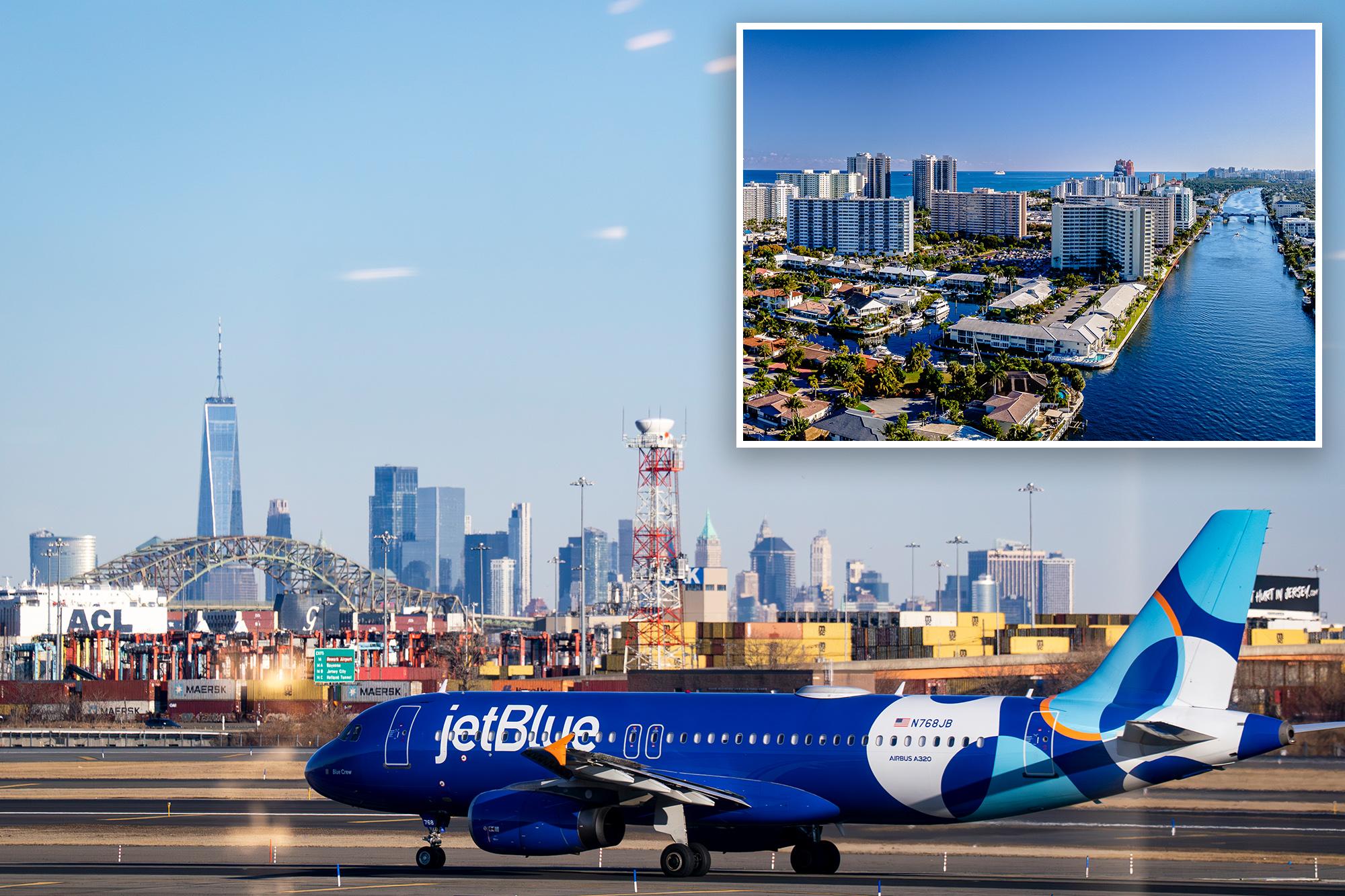
JetBlue is closing its flight attendant base at Newark and its technical operations bases at Newark and LaGuardia this fall, shifting resources to Florida as rising airport costs and the collapse of rival Spirit Airlines force a strategic retreat from New York. The airline, which remains New York’s largest carrier by passenger volume at JFK, will still serve both airports but eliminate seasonal routes to Los Angeles and Las Vegas to focus on expanding Fort Lauderdale as its third major hub. Executives cite per-passenger fees of $40 at LaGuardia—double what they pay at JFK—as a key financial drag, while Fort Lauderdale, now its busiest U.S. airport by departures, has become a “star” after Spirit’s shutdown. The moves come as JetBlue faces mounting debt and a United Airlines partnership that has failed to deliver the expected Newark growth.
Why JetBlue is abandoning Newark and LaGuardia
JetBlue’s decision to shrink its presence at Newark (EWR) and LaGuardia (LGA) stems from a brutal cost-revenue mismatch. The airline’s president, Marty St. George, told The New York Post in March that LaGuardia’s $40 per-passenger fees—up from lower rates before its $8 billion overhaul—make the airport “a money-loser.” His blunt critique of the airport’s aesthetics (“And the fountain is really pretty, but… I think people would rather have low fares than a really nice fountain”) underscores the airline’s frustration with New York’s high operational costs.
Newark, meanwhile, was supposed to be a linchpin of JetBlue’s partnership with United Airlines, which traded JFK slots for Newark access. But the strategy hasn’t paid off: JetBlue’s union blasted the airline for forcing crews to pay over $100 for late-night rideshares between JFK and Newark, a logistical headache that View from the Wing called “costly at a time they were growing service from the airport.” The airline’s Newark passenger numbers—just 1.9 million in 2025, or 4% of the airport’s traffic—now make the hub’s maintenance of a flight attendant base unsustainable.
The contrast with Fort Lauderdale (FLL) is stark. After Spirit Airlines collapsed in May—its “orderly wind-down” triggered by a failed $500 million bailout bid—JetBlue seized the opportunity. The carrier now operates 75% more daily flights from FLL than in 2025, adding 11 new destinations in May alone, including Barranquilla, Charlotte, and Indianapolis. “Lauderdale has been a star for us,” St. George told The Mirror, and the airline’s expansion there includes premium Mint service to San Diego, Los Angeles, and San Francisco starting November 19.
The Spirit Airlines collapse that reshaped JetBlue’s strategy
Spirit’s failure wasn’t just an opening for JetBlue—it was a catalyst. The ultra-low-cost carrier’s shutdown left a void in Florida that JetBlue was already poised to fill, having cut its own New York routes over the past four years. But the timing was perfect: Spirit’s collapse removed a direct competitor, and JetBlue’s existing Florida routes—including its first-ever destination, Fort Lauderdale—gave it a head start. “JetBlue is making targeted schedule adjustments, ending seasonal service between Newark and Los Angeles and Las Vegas, to support growth in Fort Lauderdale,” the airline confirmed in a statement to multiple outlets.

The shift reflects a broader industry trend: airlines are increasingly treating New York airports as cash drains rather than growth engines. JetBlue’s $9 billion debt load—highlighted by View from the Wing—means every dollar saved at LaGuardia or Newark is critical. Even JFK, where JetBlue carried 14.5 million passengers in 2025 (23% of the airport’s traffic), is now a secondary priority compared to Florida. The airline’s 118 nonstop routes in the New York region still make it the area’s largest carrier, but the writing is on the wall: its future lies south.
What this means for passengers—and United’s potential role
For travelers, the changes will be noticeable. Seasonal flights to Los Angeles and Las Vegas from Newark are gone, and LaGuardia’s already limited JetBlue service will shrink further. But the bigger story is what this means for JetBlue’s survival—and whether United will step in. Speculation about a United acquisition has swirled for years, but JetBlue’s $9 billion debt makes a clean takeover unlikely without a prepackaged bankruptcy. The airline’s retreat from New York could weaken its bargaining position: if it can’t turn Newark into a profitable hub, United may see less value in keeping JetBlue as a partner.
JetBlue insists no jobs will be lost, with affected workers able to bid for positions at other bases. But the message to New York is clear: the city’s airports are no longer a priority. “We are much, much smaller at LaGuardia than we were four years ago,” St. George said earlier this year—and that trend is accelerating. The question now is whether Fort Lauderdale’s growth can offset the losses in New York, or if JetBlue’s next move will be even more drastic.
How JetBlue’s Florida gamble stacks up against its New York roots
JetBlue’s pivot to Florida isn’t just about cost—it’s about aligning with where travelers are going. Fort Lauderdale’s 75% increase in daily flights since 2025 mirrors the broader shift of leisure and business traffic away from New York. The airline’s decision to add premium Mint service to West Coast cities from FLL—starting with San Diego in November—signals confidence in Florida’s long-term potential. But the risks are high: JetBlue’s debt load means it can’t afford another misstep.
Comparing the two markets reveals the stakes:
- Passenger volume: JetBlue carried 14.5M at JFK in 2025 (23% of airport traffic) vs. 1.1M at LaGuardia (3.4%).
- Cost per passenger: $40 at LaGuardia vs. lower fees at JFK and FLL.
- Growth potential: Fort Lauderdale’s departures surged 75% in 2026; Newark’s share of JetBlue’s network has stagnated.
- Competition: Spirit’s collapse left JetBlue as the dominant carrier at FLL, while New York’s airports remain crowded with Delta, American, and United.
The next 90 days: What’s on the horizon?
- Debt restructuring: With $9 billion in debt, the airline may need to file for bankruptcy protection to attract a buyer like United—or force creditors to accept a lower payout.
- Florida expansion: If Fort Lauderdale’s growth continues, JetBlue could accelerate cuts in New York, possibly shutting down LaGuardia operations entirely.
- United’s next move: The partnership’s Newark slots were supposed to boost JetBlue’s connectivity. If they don’t, United may lose interest in keeping the airline afloat.
The timeline is tight. JetBlue’s fall base closures at Newark and LaGuardia will begin this autumn, but the real test comes in 2027, when the airline’s financial health—and its future as New York’s hometown carrier—will be decided. For now, the writing is on the walls of LaGuardia’s Terminal B: the fountain may be pretty, but the math isn’t.
Find more reporting in our News section.
