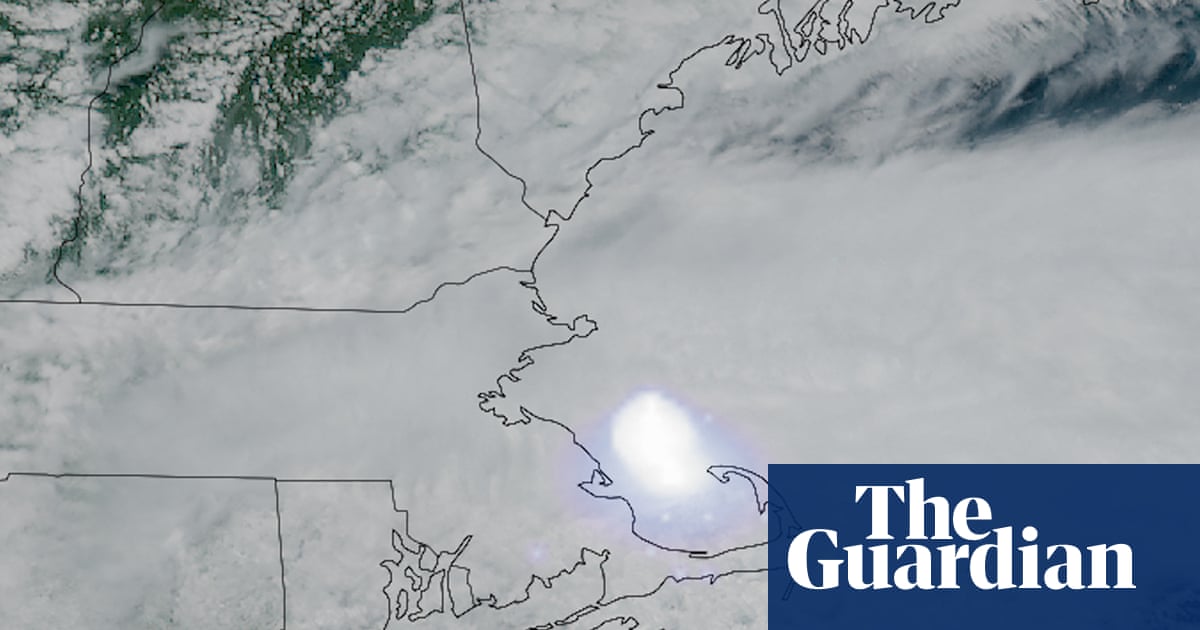
A meteor streaked across the skies of Massachusetts on May 30, 2026, triggering reports of sonic booms, shaking buildings, and sightings as far north as Canada and south to New Jersey. The event, captured on dash cameras and social media, sparked scientific analysis and public curiosity about its trajectory and potential impact.
Eyewitness Accounts and Community Reaction
Bob Todt, a driver in Fort Plain, New York, captured the meteor on his dash camera as it streaked across the sky. “We were leaving my daughter’s wedding, and as we were driving down the road, I saw the streak,” he recalled, adding he initially dismissed it as debris. His video, later posted on Facebook, became one of many shared online. In Massachusetts, Angela Cruz and Thomas Carroll described hearing a “loud noise” and feeling a “rock hit the windshield,” though they later realized it was a meteor. “I thought there’s no way some little tiny rock that made less than an inch of an impact made that loud of a noise,” Carroll said. Their dog, Penny, also reacted abruptly, “shocked” by the sound, according to Cruz.

Reports of shaking buildings and loud booms extended across New England, with the U.S. Geological Survey receiving “Did you feel it?” submissions. Steve Sobie, a USGS spokesperson, confirmed no seismic activity was recorded, ruling out an earthquake. The American Meteor Society (AMS) documented 81 reports of the fireball, with witnesses describing “a loud boom which shook my house” and “the floor under my feet vibrated.”
Scientific Analysis and Meteor Trajectory
NASA confirmed the meteor entered Earth’s atmosphere at 2:06 p.m. EDT, traveling at 75,000 mph (120,700 km/h) and fragmenting 40 miles above northeastern Massachusetts and southeastern New Hampshire. Robert Lunsford of the AMS noted the meteor was about 3 feet wide, with its energy release equivalent to 300 tons of TNT. “Most of them do burn up before they hit the ground,” Lunsford said, though NASA suggested the meteor may have landed in Cape Cod Bay. “This fall into water is technically called a ‘fishy squisher’ in uber-serious scientific terms,” NASA stated, adding that meteorites could be retrieved with a 100-foot rope from a boat.

However, the AMS emphasized that the meteor likely burned up or landed in the ocean, as no ground impact was confirmed. The event’s rarity stemmed from its low-altitude sonic boom, which is uncommon on land. “Sonic booms aren’t typically felt on land,” the USGS noted, making the meteor’s audible effects a standout feature.
Possible Origin and Meteor Shower Connection
Experts speculated the meteor could be linked to the annual Eta Aquarids meteor shower, debris from Halley’s Comet. A Boston Globe meteorologist highlighted the meteor’s near-90-degree entry angle, which allowed it to “drop from directly above” rather than skimming the atmosphere. This trajectory, he explained, increased the likelihood of a visible fireball and audible boom. “If the angle were larger, the meteor would have had to pass through more atmosphere, and we may not have even known it happened at all,” he said.
Despite this theory, NASA clarified the meteor was not part of an active shower. “This fireball was not associated with any currently active meteor shower,” a spokesperson noted. The lack of prior prediction underscored the challenge of tracking small, fast-moving objects. “Even though this meteor was around three feet wide, it was still too small or faint to be discovered and tracked before it entered our atmosphere,” a NASA official explained.
Meteorite Value and Public Interest
The potential discovery of meteorites in Cape Cod Bay drew attention from collectors and scientists. Meteorites can range from $1 to $10 per gram for common iron specimens to over $50 per gram for rare types. NASA encouraged public engagement, noting that “most meteorites are strongly attracted to a magnet,” making them accessible for retrieval. However, no confirmed finds were reported as of June 1, 2026.

The event also sparked online discussions, with videos from Rome, New York, and Massachusetts capturing the meteor’s descent. Daniel Wilcox, a driver in Rome, described seeing “a bright glow and fast-moving object shooting straight downward,” while Massachusetts homeowners shared audio of the boom. In Cumberland, Rhode Island, a faint popping noise was recorded, illustrating the event’s widespread reach.
What Comes Next?
While the meteor’s immediate effects were felt across the Northeast, its long-term implications remain unclear. Scientists will continue analyzing data to refine trajectory models, and the public may await further updates on potential meteorite recovery. For now, the event stands as a rare confluence of celestial spectacle and terrestrial impact, reminding observers of the dynamic forces at play in our atmosphere.
For more on the meteor’s trajectory, see The Guardian. Details on eyewitness accounts are available in WJAR. NASA’s statement on the event can be found here. The Boston Globe’s analysis is available, and additional videos are on USA Today.
