NVIDIA will launch DLSS 4.5 in August 2026, introducing a second-generation transformer-based Ray Reconstruction model across all GeForce RTX 20, 30, 40, and 50-series GPUs. The update, designed to replace traditional denoisers with a unified AI pipeline, aims to improve visual stability and lighting accuracy in ray-traced games without sacrificing high-end performance.
Evolution of the Ray Reconstruction Pipeline
cluster (priority): Sportskeeda Tech
The path to DLSS 4.5 has been defined by NVIDIA’s shift from traditional convolutional neural networks (CNN) toward transformer-based AI models. When Ray Reconstruction first debuted in 2023 via the DLSS 3.5 update, it was primarily engineered to solve the persistent image quality issues where ray-traced reflections and shadows appeared inaccurate when processed through older super-resolution techniques, according to TechPowerUp.
While the company introduced an initial transformer model in 2025, the upcoming August 2026 rollout represents a significant architectural leap. This new iteration utilizes a second-generation transformer model trained on a substantially larger volume of data. By moving away from multiple, disparate denoisers in favor of a single, highly efficient AI pipeline, the technology addresses the common visual artifacts that plague modern ray-traced titles, such as ghosting, shimmering, and blurry reflections, as reported by Sportskeeda Tech.
Broad Compatibility Across the RTX Ecosystem
cluster (priority): GameGPU
One of the most consequential aspects of the DLSS 4.5 release is its hardware accessibility. Unlike some advanced features that are restricted to the latest silicon, this update will be available across the entire GeForce RTX family. Users running hardware as old as the 2018-era RTX 20-series, as well as those with 30, 40, or 50-series cards, can expect to utilize the new AI-powered reconstruction, as NVIDIA notes in its official ecosystem updates.
This backward compatibility is a core strategy for the company, which continues to support its installed base nearly eight years after the initial launch of the RTX architecture. The ecosystem now encompasses over 1000 RTX-enabled games and applications. By maintaining performance parity across generations, the company ensures that the visual improvements provided by the new transformer models are not siloed behind the most recent hardware, but are instead accessible to the widest possible user base.
Unreal Engine Integration and Developer Tooling
CINDER CITY | Launching with NVIDIA DLSS 4.5
For developers, the transition to the latest RTX standards is being streamlined through new plugins and SDK updates. NVIDIA recently unveiled the DLSS 4.5 plugin for Unreal Engine, a tool built on Streamline technology that grants developers direct access to dynamic multi-frame generation and the new 6x frame generation mode. As noted by GameGPU, this integration is intended to drastically reduce the time required to bake high-fidelity scaling and ray-tracing features into both new projects and existing game ports.
The release also coincides with the rollout of the NvRTX 5.7.4 branch, which is fully compatible with Unreal Engine 5.7.4. This technical update addresses critical stability issues, including:
Fixes for RTX Mega Geometry shader compilation on non-DX12 platforms.
Improved stability for opacity micromaps to accelerate vegetation rendering.
Resolutions for compatibility conflicts with the Substrate material system.
Bug fixes within the low-level NvAPI interface.
Furthermore, the NVIDIA ACE platform is seeing simultaneous expansion, with multilingual AI models now optimized for local execution. Updates to the NVIGI SDK 1.6 include the Qwen 3.5 4B model, which supports 201 languages for context-sensitive non-player character (NPC) dialogue, and the Riva Parakeet TDT 600M, which provides speech recognition across 25 languages.
Games Confirmed for the DLSS 4.5 Launch
cluster (priority): TechPowerUp
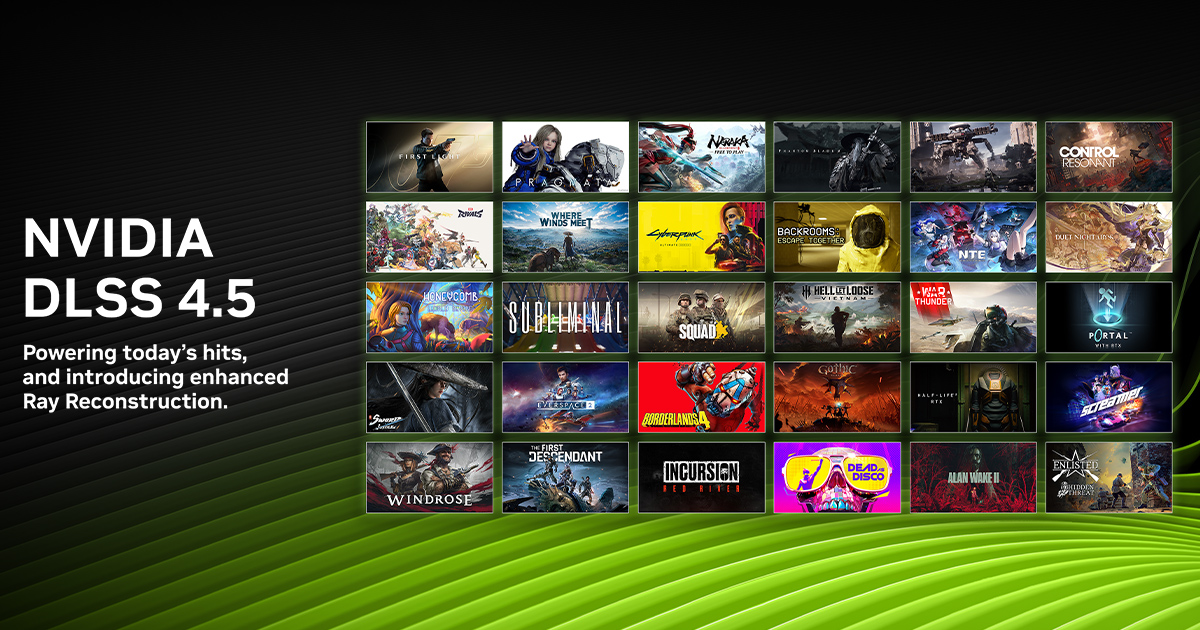
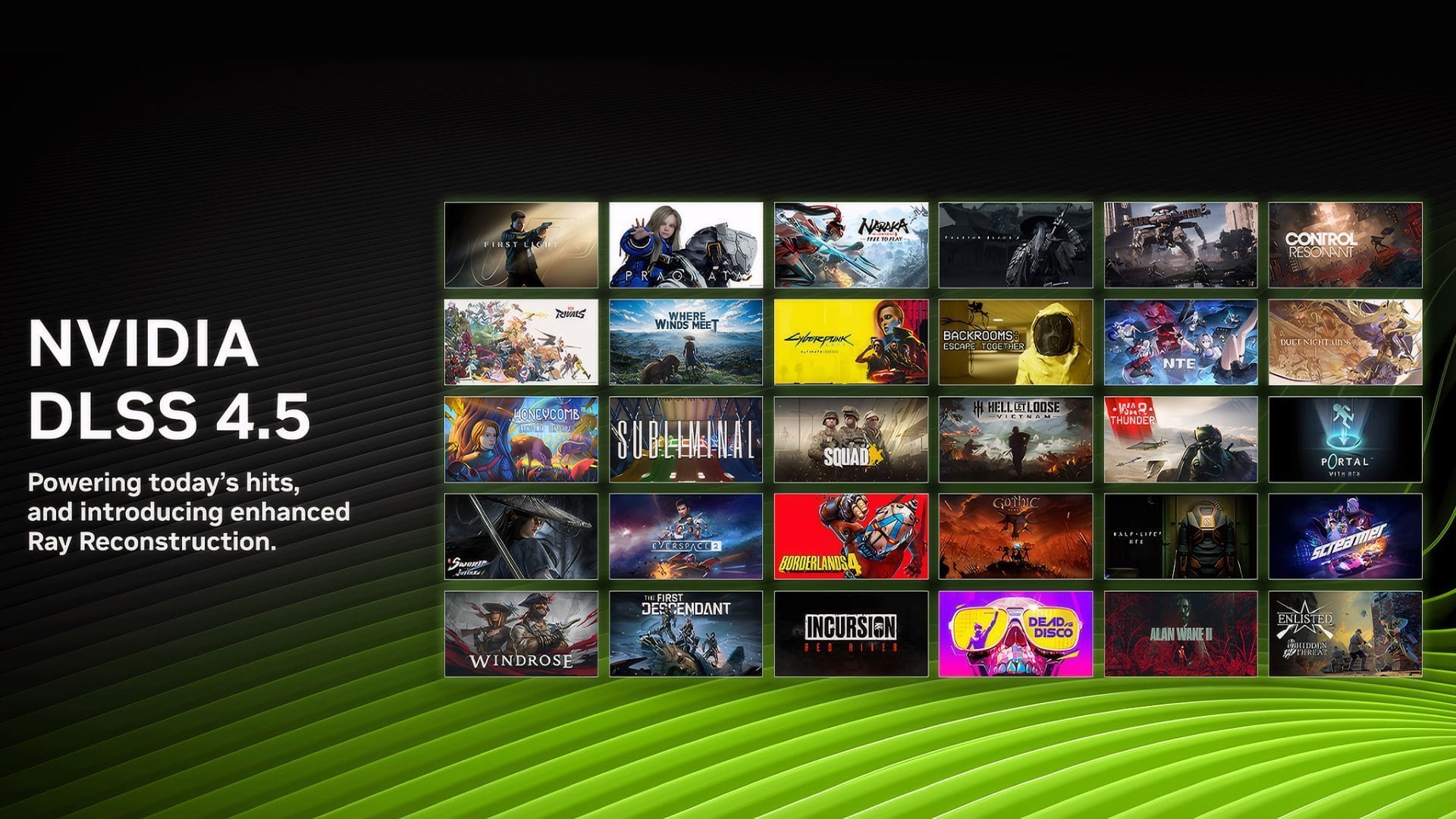
As of June 1, 2026, NVIDIA has confirmed that 27 titles are slated to support DLSS 4.5 Ray Reconstruction at launch. The list includes a mix of major AAA releases and highly anticipated upcoming titles, suggesting that the industry is moving quickly to adopt the new AI-denoising pipeline.
The confirmed titles include:
Alan Wake 2 and Avatar: Frontiers of Pandora
Call of Duty: Black Ops 7 and Cyberpunk 2077
DOOM: The Dark Ages and Star Wars Outlaws
Hogwarts Legacy and Indiana Jones and the Great Circle
Portal with RTX and The First Descendant
Crimson Desert, PRAGMATA, and Resident Evil Requiem
While this initial list provides a clear picture of the technology’s reach, more titles are expected to join the ecosystem in the months following the August release. The focus remains on delivering cleaner, more stable lighting environments that do not place an undue burden on the GPU, effectively balancing the demands of path-traced rendering with the realities of frame-rate targets.
Looking ahead, the success of DLSS 4.5 will be measured by how seamlessly these second-generation transformer models handle the most complex lighting scenarios in titles like Crimson Desert and Call of Duty: Black Ops 7. If the technology performs as intended, it could solidify the shift away from traditional, manual denoisers as the industry standard for real-time ray-traced lighting.
Leo Andersson covers innovation, AI, and cybersecurity. A former engineer turned journalist from Stockholm, Leo has contributed to major tech outlets across Europe. His analytical style and deep understanding of technology trends define Globally Pulse’s forward-looking reporting.