
The largest insects ever known to science—giant griffinflies with wingspans stretching over two feet—flourished in Earth’s skies 300 million years ago, when atmospheric oxygen levels were far higher than today’s 21%. New research now challenges the long-held assumption that these prehistoric giants could only have thrived in that oxygen-rich air, upending a textbook explanation for their extinction. Scientists studying the flight muscles of modern insects have found that the griffinflies’ respiratory systems might have been far more efficient than previously believed, raising questions about why they shrank so dramatically after birds evolved.
What the Fossil Record Reveals About Griffinflies’ Rise and Fall
The giants of the insect world belonged to the extinct order Meganisoptera, often called griffinflies—a group that included Meganeura monyi, a predator with a wingspan of up to 71 centimeters (about 28 inches), and Meganeuropsis permiana, which reached even larger proportions. These were not true dragonflies but distant relatives, their bodies built for hunting in skies devoid of birds, bats, or pterosaurs. The air they breathed was denser and contained roughly 30–35% oxygen, compared to today’s 21%, a difference that scientists long believed was the key to their size.
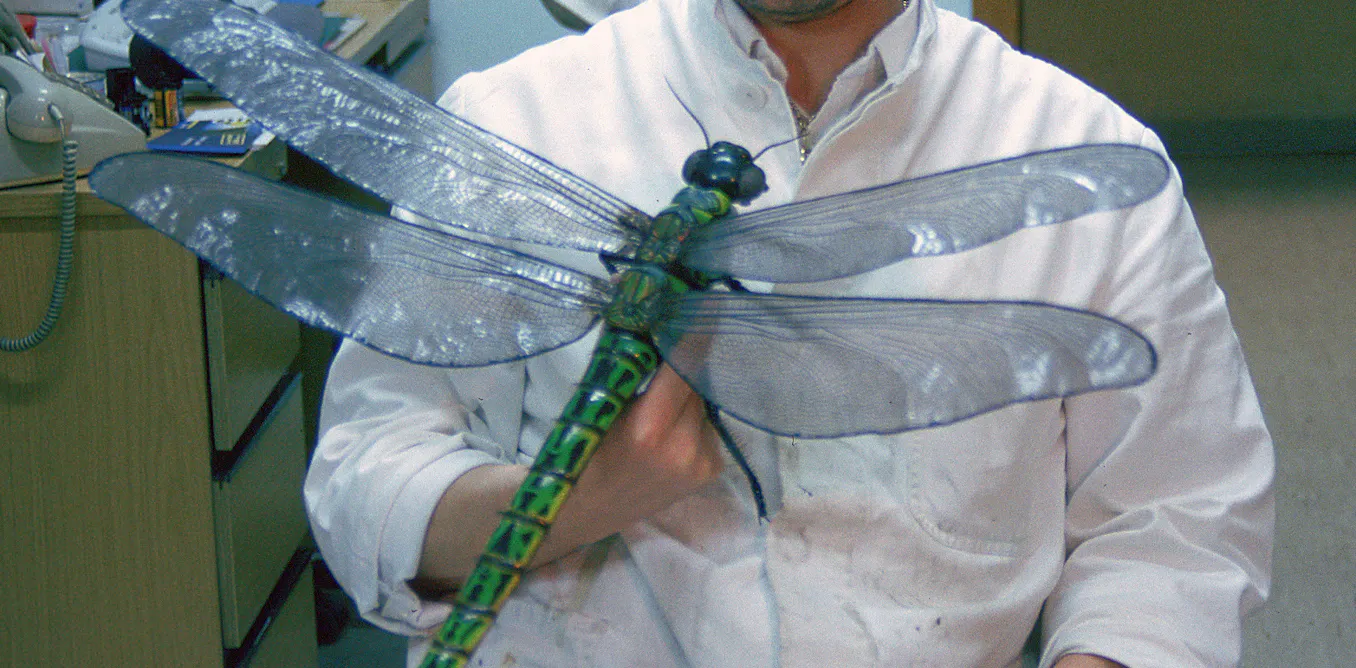
According to SpaceDaily, the oxygen hypothesis has been the dominant explanation for nearly a century: insects breathe through a network of tubes called tracheae, and larger bodies require more oxygen to diffuse through these tubes efficiently. In high-oxygen environments, the physics worked in their favor. But the fossil record complicates this story. A 2012 study published in Proceedings of the National Academy of Sciences (PNAS) found that insect size tracked oxygen levels for roughly 200 million years—until it didn’t. Around 150 million years ago, as birds began to evolve, insect sizes shrank even when oxygen levels rose again.
The Natural History Museum’s exhibit on griffinflies highlights another key factor: the absence of aerial predators. Before birds, these giants ruled the skies unchallenged. But once birds arrived, the pressure to shrink became overwhelming. The museum’s curator, Ben Price, notes that griffinflies likely lived in open wetlands, where their massive wingspans—up to 71 centimeters—would have been an advantage in the absence of competitors. Their larvae, meanwhile, were aquatic hunters with terrifying jaws, capable of preying on small fish.
The Oxygen Myth: Why New Research Challenges the Textbook Explanation
A groundbreaking study published in Nature this year directly challenges the oxygen-centric theory. Researchers analyzed the flight muscles of 44 modern insect species, including bees, flies, and dragonflies, and discovered that the tracheal systems of these insects are far more efficient than previously thought. The tracheoles—tiny tubes that deliver oxygen to muscle tissue—occupy only about 1% of the muscle’s cross-sectional area, yet they supply enough oxygen for flight even in today’s lower-oxygen air.

As The Conversation reports, the study’s lead authors found that griffinflies’ respiratory systems might not have been fundamentally different from those of modern insects. If that’s the case, the giants could theoretically have survived in today’s atmosphere—meaning the real reason for their extinction lies elsewhere. The study’s findings suggest that the arrival of birds, not oxygen levels, was the decisive factor in forcing insects to shrink.
The implications are significant. For decades, textbooks have taught that high oxygen levels were the sole reason giant insects could exist. But if griffinflies’ respiratory systems were no different from those of modern insects, then the oxygen explanation was incomplete—or even incorrect. The study’s authors argue that the tracheal system’s efficiency means that size was never the limiting factor; instead, it was the ecological pressure from predators that forced insects to evolve smaller bodies.
What Happened Next? The Role of Birds in Insect Evolution
The shift in insect size around 150 million years ago coincides with the rise of birds, which began diversifying during the Jurassic period. While griffinflies and other giant insects had dominated the skies for millions of years, birds introduced a new kind of predator: one that could chase, catch, and eat them. The fossil record supports this theory. As The Conversation explains, the uncoupling of insect size from oxygen levels began precisely when birds became a significant part of the ecosystem.
This isn’t just about griffinflies. Other giant arthropods of the Carboniferous—like massive millipedes and scorpions—also shrank as birds evolved. The pattern is clear: when predators capable of hunting large prey appeared, the ecological rules changed. Insects that had once thrived in open wetlands now had to adapt or risk extinction. The result was a dramatic reduction in size, as smaller, faster insects became the dominant aerial predators.
Why This Matters: A Lesson in Evolutionary Arms Races
The griffinflies’ story is more than a curiosity about prehistoric giants—it’s a case study in how ecosystems shape evolution. For millions of years, high oxygen levels allowed insects to grow massive, but biology is never just about physics. It’s about competition, predation, and the relentless pressure of survival. When birds entered the picture, they didn’t just compete with insects for food; they became the ultimate selective force, driving the insects that remained to evolve smaller, faster, and more agile.

This research also raises questions about other evolutionary puzzles. Could similar predator-driven size reductions have occurred in other groups? And what does it tell us about the limits of adaptation? The griffinflies’ extinction wasn’t about oxygen—it was about the arrival of a new kind of threat. In a world where atmospheric conditions are changing rapidly today, understanding how ecosystems respond to new pressures is more relevant than ever.
What Comes Next? The Search for More Answers
The debate over griffinflies isn’t over. While the new Nature study provides compelling evidence against the oxygen hypothesis, some researchers argue that the tracheal system’s efficiency might not fully explain the giants’ survival. Further studies could explore whether other physiological factors—such as muscle structure or metabolic rates—played a role. Additionally, paleontologists are still uncovering new fossil evidence that might shed light on the transition period when birds and insects coexisted.
One thing is certain: the griffinflies’ story is a reminder that evolution is never a straight line. It’s a dance of adaptation, where every new player changes the rules. For now, the textbooks may need rewriting—but the real story is just beginning.
