
SpaceX is set to launch its initial public offering on June 12, 2026, with an expected valuation of $1.77 trillion, according to Wikipedia. The private aerospace and artificial intelligence company, founded by Elon Musk in 2002, currently leads the industry in annual orbital launches as it prepares to enter public markets.
Financial Scale of the SpaceX IPO
The valuation of $1.77 trillion marks what Wikipedia reports as the largest initial public offering in history. This milestone arrives as Wall Street attempts to categorize the company’s diverse business interests. According to CNBC, investors are struggling to determine whether to value SpaceX as a traditional rocket manufacturer, a telecommunications provider, a defense contractor, or an infrastructure play for artificial intelligence.

Financial data for the fiscal year ending December 31, 2025, provides a snapshot of the company’s operations. Wikipedia states that SpaceX reported $18.7 billion in revenue for 2025, against total assets of $92.1 billion. The company reported a net loss of $2.6 billion and total equity of $2.6 billion for that same period. The scale of this valuation reflects the massive capital intensity required for space exploration, where companies must manage long-term R&D cycles alongside high-frequency operational demands.
Corporate Structure and Market Position
Elon Musk maintains significant control over the firm. As of 2026, Musk holds 42% equity and 79% of the voting control in the company, per Wikipedia. The company operates from its Starbase site in Texas and employs more than 13,000 people. This concentration of voting power is common among founder-led technology firms, often structured through dual-class share arrangements that allow founders to retain strategic direction despite public ownership.
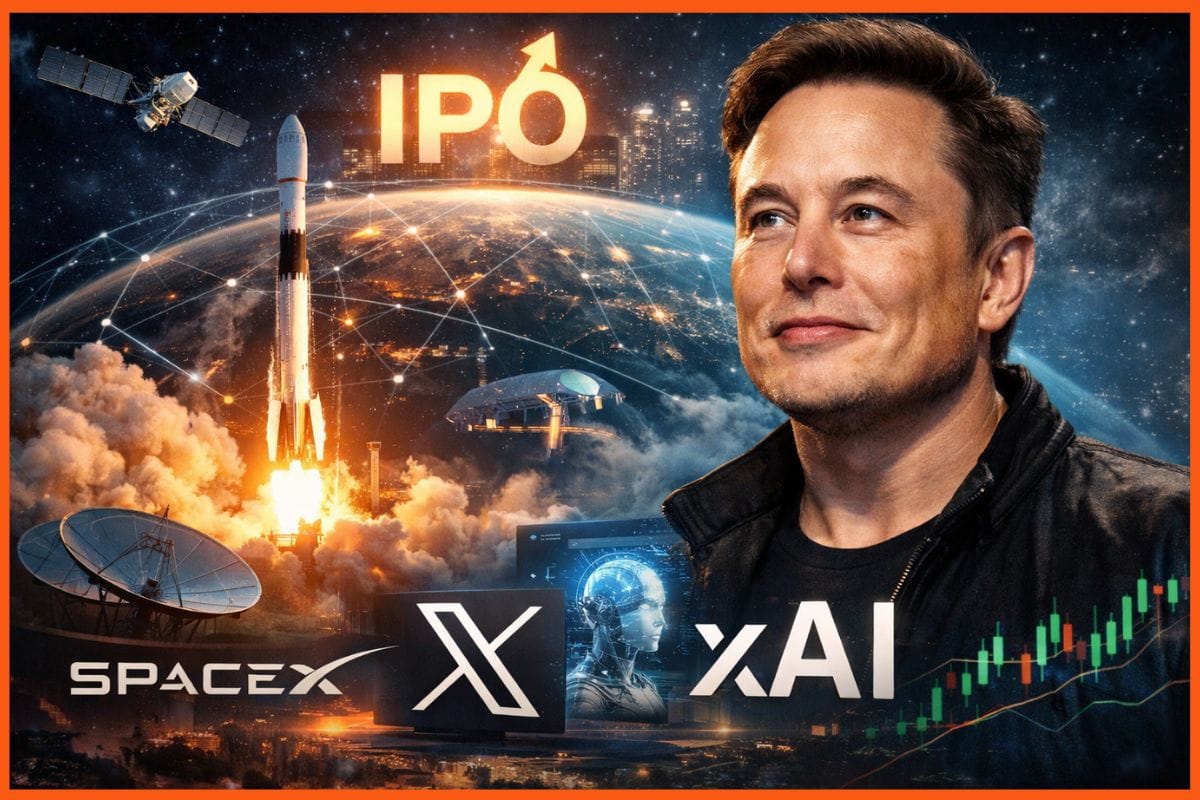
SpaceX has diversified its operations significantly since its founding. While the company initially focused on decreasing the costs of space launches, its income is now bolstered by the Starlink internet satellite constellation. According to Wikipedia, Starlink generates the bulk of the company’s income and has facilitated the development of Starshield, a military-focused counterpart. By vertically integrating satellite manufacturing, launch services, and ground-based user terminals, SpaceX has created a closed-loop ecosystem that differentiates it from traditional aerospace primes that rely on outsourced components.
Operational History and Government Partnerships
The company’s path to the public market is built on a history of government and commercial contracts. Since launching the Falcon 1 in 2008, SpaceX has secured partnerships with NASA and the United States Armed Forces. Wikipedia notes that the company began delivering Commercial Resupply Services missions to the International Space Station in 2012. These contracts established the company as a critical partner for the United States government, moving the industry away from cost-plus contracting toward fixed-price milestones.
The Falcon 9 rocket, which has been central to these operations, now launches an average of three times per week. As of May 2026, these rockets have landed and flown again nearly 650 times. These reusable launch vehicles are currently used for both NASA crewed missions and private sector operations. Reusability remains the cornerstone of the company’s economic model, significantly lowering the cost per kilogram to orbit compared to expendable launch vehicles used by competitors in the global space sector.
Tax and Regulatory Context
While the IPO approaches, the company’s financial history remains a subject of scrutiny. According to reporting from Facebook, Tesla—another company led by Musk—reported $12.58 billion in U.S. income over a three-year period while paying $48 million in federal taxes. This resulted in an effective federal income tax rate of 0.4 percent. The ITEP report cited in that source notes this figure is significantly lower than the 21 percent rate typically expected of profitable corporations. Publicly traded companies are subject to rigorous financial transparency requirements enforced by the U.S. Securities and Exchange Commission (SEC), which typically mandates detailed disclosures regarding tax strategies, executive compensation, and potential legal liabilities in S-1 registration statements.

As investors prepare for the June 12, 2026, offering, market analysts are watching to see if SpaceX will be priced similarly to other “strategic tech” firms, such as Palantir, which also serve as government contractors, according to CNBC. The IPO will test how the market assigns value to companies that operate across multiple high-stakes sectors simultaneously. Unlike traditional aerospace companies that are often valued on dividend yields and steady government cash flows, SpaceX’s valuation is heavily influenced by the projected growth of the Starlink network and the potential for long-term space logistics contracts. The transition to the public market will subject the company to quarterly earnings calls and the immediate scrutiny of institutional shareholders, a departure from the private-capital-focused funding rounds that characterized its growth over the last two decades.
Find more reporting in our Business section.
