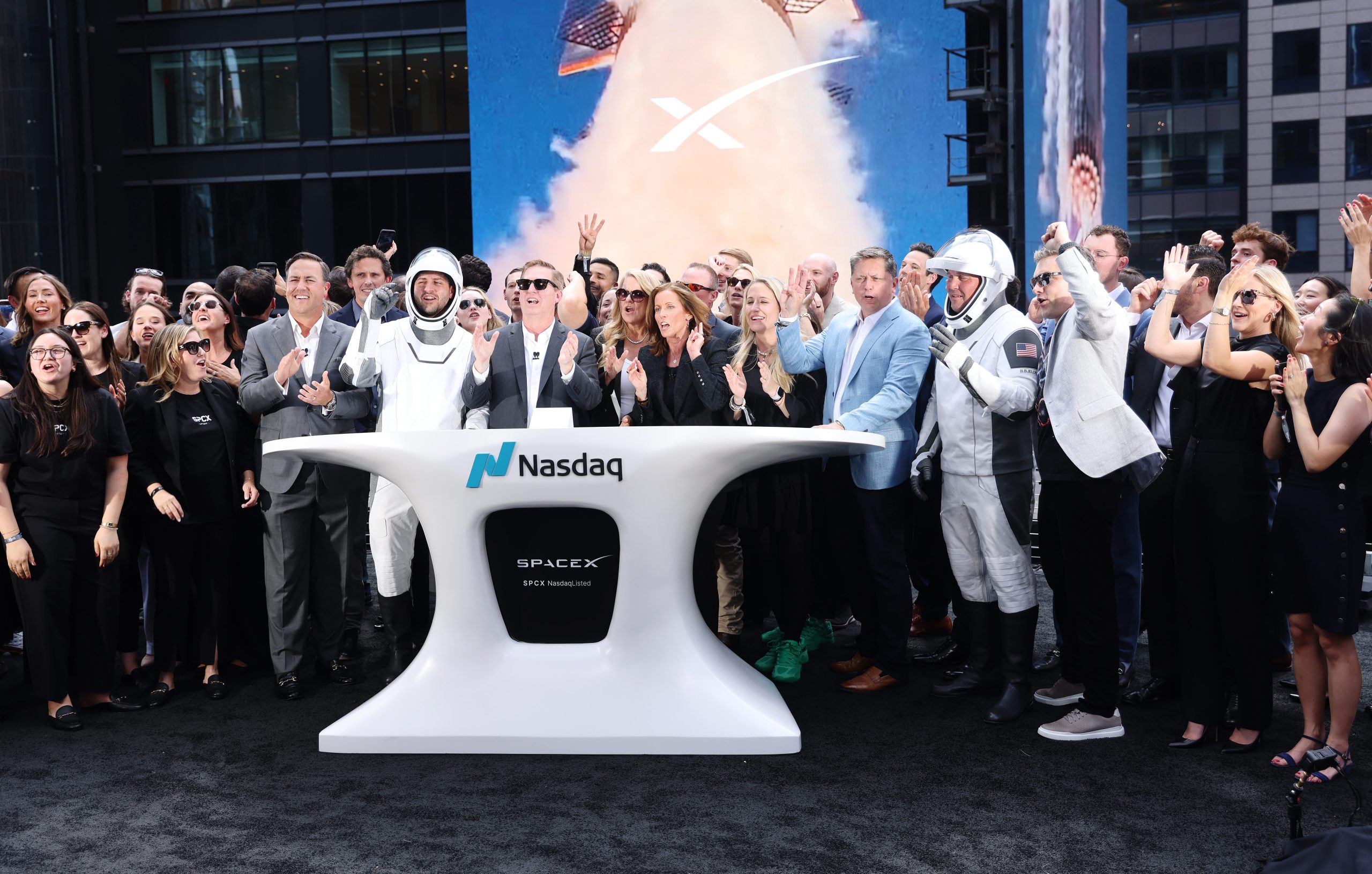
SpaceX completed the largest initial public offering in U.S. history on June 12, 2026, reaching a market capitalization of $2.2 trillion. The company’s shares closed at $160.95, a 19% increase from the $135 offer price, as investors reacted to Elon Musk’s strategy to pivot the firm’s primary focus from aerospace to artificial intelligence.
A Trillion-Dollar Pivot to Artificial Intelligence
The successful market debut marks a sharp departure from SpaceX’s traditional identity as a manufacturer of rockets and a provider of satellite broadband. According to Fortune, the shift began in February when Elon Musk integrated xAI into the company. The resulting prospectus indicates that Musk now forecasts a total addressable market of $28.5 trillion for the enterprise, with AI accounting for $26.5 trillion—or 93%—of that figure.
This valuation strategy prioritizes the “moonshot” potential of AI over the company’s established space divisions. While the Space segment generated $4.1 billion in revenue last year while suffering losses, the Starlink broadband business has emerged as a reliable financial engine. Starlink sales grew 50% year-over-year in 2025 to $11.4 billion, supported by a fleet of 9,600 satellites and over ten million subscribers. The integration of xAI, as outlined in the company’s S-1 filing, suggests that the firm intends to utilize the computational power generated by its low-Earth orbit satellite constellation to provide edge-computing services for AI training models, a move intended to diversify revenue streams beyond traditional launch contracts with NASA and the Department of Defense.
Market Reaction and the Quest for Growth
Investor enthusiasm pushed the stock to $160.95 on its first day, with trading volume exceeding 500 million shares. By the close of business, the company’s market cap had reached $2.2 trillion, a figure described by Fortune as ten times larger than the 2014 debut of Alibaba, the previous record holder. The momentum continued into Friday’s extended trading, where shares climbed an additional 3.5% to $166.76, according to CNBC. This market reception follows a broader trend in 2026 where IPO activity has accelerated, following a period of relative stagnation in the mid-2020s. However, the sheer size of the SpaceX offering has drawn comparisons to the 2012 Facebook IPO, which faced significant technical hurdles on its first day of trading, unlike the relatively seamless execution seen on the Nasdaq exchange this week.
Not all analysts are convinced by the valuation. Michael Tanney, CEO of investment firm Pereon Wealth, expressed caution regarding the company’s ability to maintain such high demand for capital raises. Tanney noted that historical data from Truist Wealth shows 30 major IPOs—including Meta and Shopify—struggled significantly within their first year of trading. The skepticism is rooted in the “valuation gap,” where market pricing reflects future expectations of AI dominance rather than current, audited quarterly earnings.
Industry Sentiment and Political Pushback
The IPO has drawn significant attention from both the technology sector and the political sphere. Andrej Karpathy, a former OpenAI co-founder and Tesla AI director who joined Anthropic in May, praised the company’s trajectory in a public post.
“In awe of SpaceX and its story – past, present and the future,” Karpathy wrote. “You can think about it in 10+ different ways and continue re-blowing your mind in circles. Huge congrats to the team!”
Andrej Karpathy, AI researcher, via CNBCFormer Nasdaq chief Robert Greifeld told CNBC that he would “definitely bet” on other AI-focused firms like OpenAI and Anthropic seeking public listings this year. Greifeld noted that SpaceX is currently trading “on the aspiration of what’s possible with human spirit going forward in time,” rather than traditional fundamental metrics. In the context of regulatory scrutiny, the Securities and Exchange Commission (SEC) typically requires extensive disclosures regarding the risks of such pivots; the SpaceX prospectus details specific warnings about the regulatory uncertainty surrounding AI governance and the potential for federal antitrust investigations into the company’s dual role as a satellite provider and a data-processing AI hub.
However, the company’s massive market cap has also reignited debates regarding wealth inequality. Following the IPO, which established Musk as the world’s first trillionaire, New York City mayoral nominee Zohran Mamdani called for a wealth tax. Sen. Elizabeth Warren (D-Mass.) echoed this sentiment on social media, stating, “We need a wealth tax.” These political reactions mirror the legislative discourse surrounding the “Billionaire Minimum Income Tax” proposals introduced in previous congressional sessions, signaling that the company’s public status may invite increased oversight from the House Financial Services Committee.
Long-Term Viability of the Musk Vision
The central question for investors remains whether SpaceX can capture the AI market share Musk has projected. The company currently faces competition from entrenched tech giants including Microsoft, Alphabet, and Meta. With the stock now publicly traded, SpaceX is under pressure to move beyond the “annuity-style” cash flow of its Starlink business and deliver on the AI-driven future outlined in its prospectus. The company remains subject to quarterly reporting requirements, which will force management to provide granular data on the profitability of its AI division, separate from the capital-intensive nature of its Starship development program.

As the company moves into its next phase, the disparity between its $2.2 trillion valuation and its actual revenue generation will likely remain a focal point for institutional scrutiny. With Starship’s reusable rocket technology aiming to reduce launch costs significantly, SpaceX is counting on both its physical infrastructure and its AI-integrated services to justify its position as the largest IPO in history. Success remains conditional on the company’s ability to scale xAI’s large language models across its existing satellite hardware without incurring massive new debt loads, a challenge that will be tested when the company releases its first post-IPO earnings report in the coming months.
Find more reporting in our Business section.
