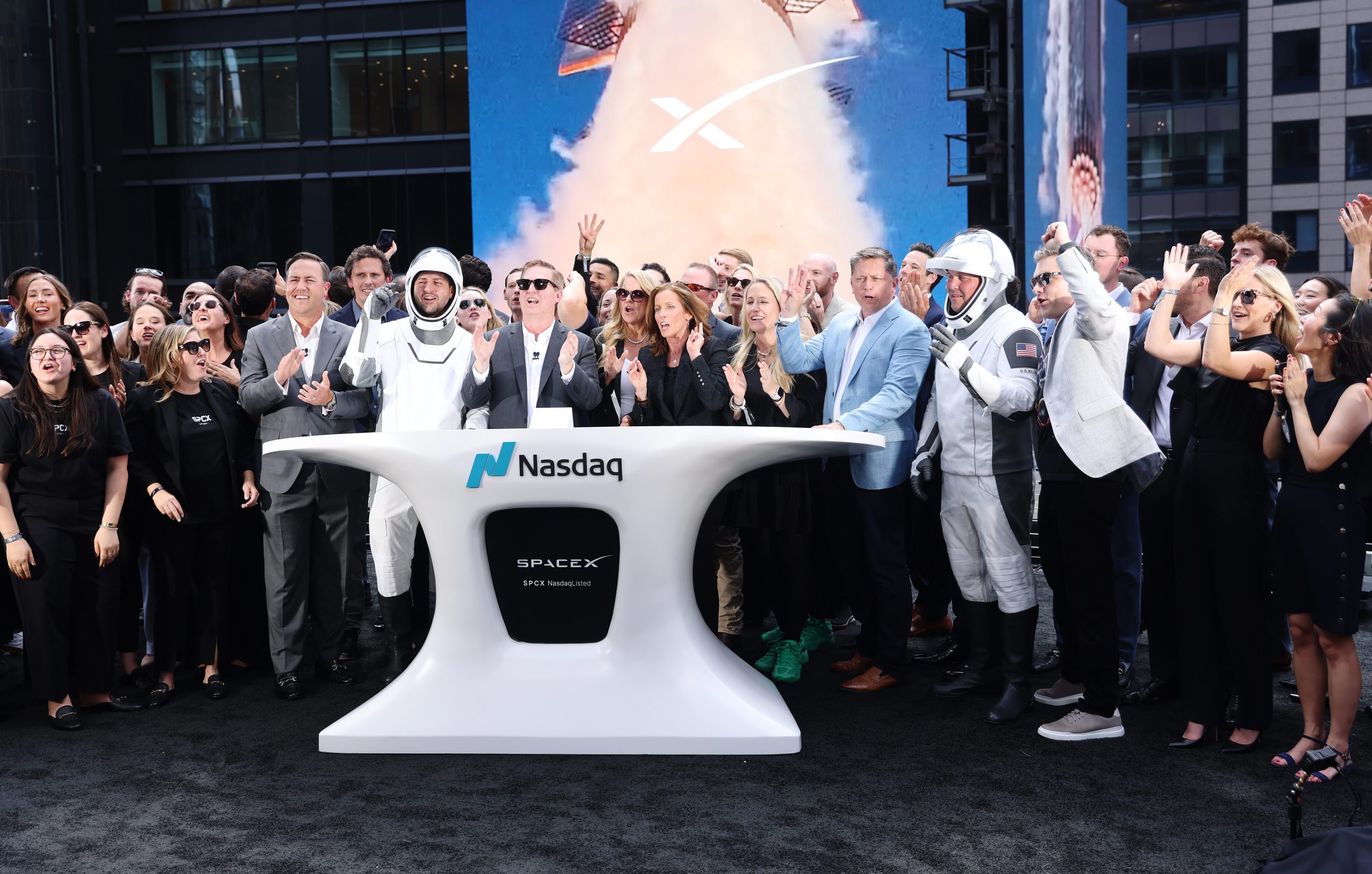
SpaceX completed its initial public offering on June 12, 2026, with shares closing at $160.95, a 19% increase from the $135 offer price. The debut vaulted the company to a $2.2 trillion market capitalization, marking the largest U.S. IPO in history and signaling significant investor confidence in Elon Musk’s pivot toward artificial intelligence.
Market Performance and Valuation Records
The market response to the SpaceX debut was immediate and aggressive. After opening at $160, the stock saw heavy volume, with more than 500 million shares traded during the day, according to CNBC. By the time markets closed on Friday, the company’s market cap had reached $2.2 trillion, a figure that easily eclipses previous records, including the 2014 debut of Alibaba, which Fortune notes was surpassed ten-fold.

The momentum continued into extended trading hours. Shares climbed an additional 3.5% to $166.76 by 6:30 p.m. ET, adding approximately $80 billion to the firm’s valuation. While the enthusiasm is high, some analysts remain cautious regarding the long-term sustainability of such valuations. Michael Tanney, CEO of Pereon Wealth, pointed to historical data from Truist Wealth indicating that high-profile IPOs like Meta, Alibaba, and Shopify faced significant challenges within their first year of trading, raising questions about whether the market can absorb multiple large-scale capital raises.
The Strategic Pivot to Artificial Intelligence
SpaceX’s valuation is heavily predicated on its February integration of xAI, a move that fundamentally altered the company’s investor narrative. While the firm maintains legacy operations in rocket manufacturing and satellite deployment, current projections emphasize an AI-driven future. According to the company’s prospectus, the total addressable market for the enterprise is estimated at $28.5 trillion, with AI applications accounting for $26.5 trillion—or 93%—of that total.
This focus represents a distinct shift in scale. In comparison, the rocket and satellite segments are projected to contribute a combined $2.0 trillion to the total addressable market. Despite this, the satellite business remains the company’s primary revenue engine. In 2025, Starlink sales grew 50% year-over-year to $11.4 billion, providing more than half of the company’s total revenue. The current fleet of 9,600 satellites services over ten million users, serving as a stable source of cash flow while the company pursues what Musk describes as an AI “moonshot.”
For more on this story, see SpaceX Hits $2.2 Trillion Valuation in Historic IPO Driven by AI Pivot.
Industry and Political Reactions
The IPO has drawn reactions from across the technology and political sectors, reflecting the polarized view of Musk’s influence.
“In awe of SpaceX and its story – past, present and the future. You can think about it in 10+ different ways and continue re-blowing your mind in circles. Huge congrats to the team!”
Andrej Karpathy, former director of AI at Tesla, via CNBC
Conversely, political figures have used the event to highlight wealth inequality. New York City Mayor Zohran Mamdani characterized the IPO as a “Reason #1,000,000,000,000 why we should tax the rich” in a post on X. This sentiment was echoed by Sen. Elizabeth Warren, D-Mass., who reiterated her stance on the necessity of a wealth tax. Robert Greifeld, the former chief of the Nasdaq, observed that the stock is currently trading on the “aspiration of what’s possible with human spirit going forward in time” rather than traditional fundamentals, noting that he “would definitely bet” that other AI-focused firms like OpenAI and Anthropic will seek public listings later this year.
Financial Outlook and Future Capitalization
Investors are now looking toward how SpaceX will manage its immense valuation. David Trainer, CEO of the research firm New Constructs, has expressed skepticism regarding the company’s current market price, suggesting that to justify a $2.2 trillion valuation, the firm would require sales of at least $1.1 trillion. The company’s ability to maintain its competitive moat in satellite communications—bolstered by the Starship launch system—will be tested as it attempts to expand its orbital network to 100,000 satellites.

As the market moves into the next month, the focus will remain on whether SpaceX can bridge the gap between its current $4.1 billion in space segment revenue and the massive AI-driven forecasts presented to shareholders. With the window for tech IPOs appearing to widen, industry observers expect other major AI players to monitor SpaceX’s post-IPO volatility as a bellwether for their own potential market entries.
Find more reporting in our Business section.
