Flipper Zero Creators Release Hackable ‘Busy Bar’ Desk Display
The creators of Flipper Zero have introduced the Busy Bar, a Matter-certified desk display designed to signal focus status and integrate with productivity workflows.
- Headline Dispatch: Flipper Zero Creators Release Hackable ‘Busy Bar’ Desk Display
- Core Takeaway: The creators of Flipper Zero have introduced the Busy Bar, a Matter-certified desk display designed to signal focus status and integrate with productivity workflows.
- Source Synthesis: Continuous live monitoring aggregated across major news wires and independent bureaus.
Flipper Zero Creators Release Hackable ‘Busy Bar’ Desk Display
London-based Flipper Devices, the team behind the Flipper Zero hacking multi-tool, has expanded into the home office market with the launch of the Busy Bar. Announced on 29 June 2026, the device is an open-source productivity tool designed to signal focus status and block digital distractions. It will officially go on sale and begin shipping on 14 July 2026 to customers in the U.S., EU, U.K., and Canada.
The Busy Bar is designed as a physical intervention for the hybrid work era, acting as a "Do-Not-Disturb" sign for roommates, family, or colleagues. While it functions as a modern Pomodoro timer, the device also integrates with a companion software ecosystem to mute phone notifications and block distracting apps across iOS, Android, macOS, and watchOS. Support for Windows is planned for later in 2026.
Hardware and Aesthetics
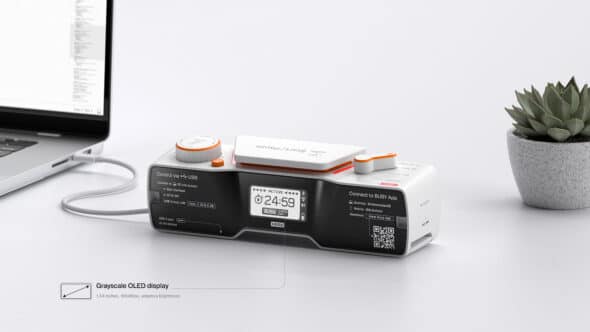
The device is a plastic box measuring 17×6×4 centimeters with a retro, toy-like aesthetic. Its primary interface is a front-facing 6.35-inch RGB LED matrix with a resolution of 72×16 pixels, capable of displaying 16 million colors and reaching up to 400 nits of brightness. An automatic sensor adjusts the screen brightness. To keep the user informed without alerting others, a smaller monochrome OLED screen on the rear mirrors battery tracking, connectivity indicators, and active Pomodoro countdowns.
Physical control is managed via three inputs on top: a mechanical Start/Pause button, a mode selector switch to toggle layouts, and a dial knob for navigating menus and adjusting focus timers. A small speaker on the side handles custom sounds and notifications.
The unit is powered by a 3,250 mAh battery, providing eight hours of active use and up to two weeks of standby time. It supports 15W fast charging via USB-C, allowing for a full charge in approximately one hour.
Developer-First Architecture
Following the ethos of the Flipper Zero, the Busy Bar is built for customization. It features fully open-source firmware published on GitHub, allowing developers to write custom widgets or replace the software stack entirely without firmware signing keys blocking builds.
The device offers three connection modes:
- Local API: An open HTTP API running over local Wi-Fi or a USB Virtual LAN interface, enabling full offline operation without a cloud account.
- MQTT: Support for an external broker, allowing users to subscribe to device events like button presses and publish commands to the display.
- Cloud API: An optional connection via busy.app.
To support these integrations, Flipper Devices provides official SDKs for Python, TypeScript, and Go. The hardware is powered by an STMicroelectronics STM32U5M microcontroller and a Silicon Labs SiWG917 chip for Wi-Fi 6 and Bluetooth 5.4 LE.
Smart Home and Automation
The Busy Bar is Matter-certified through the Connectivity Standards Alliance, allowing it to drop natively into Apple HomeKit, Google Home, and Amazon Alexa ecosystems. This certification allows users to trigger home automations based on the device's status, such as turning office lights red or locking a front door when focus mode is active.
Automation can also be triggered by software events. On macOS, mic integration can automatically set the display to on call
and mute notifications when a user joins a meeting or starts recording. Other triggers include opening specific workspace applications like Photoshop or Word.
"How do you let people know politely, yet firmly, that you don't want to be disturbed?"
Callum Tennent, creative writer at Flipper, via Wired
Pricing and Availability
The Busy Bar retails at a standard price of $249. However, Flipper is offering an early-bird price of $199 for the first 3,000 waitlist orders. Some early waitlist signups were offered a special price of $179.
Beyond the main unit, Flipper Devices plans to release a series of accessories, including custom switches, screen protectors, and wall mounts to allow the device to function as a door-mounted indicator.
How significant is this development?
Participate in our community survey on the trajectory and real-world impact of this news.