
NASA’s Parker Solar Probe just became the first human-made object to repeatedly survive the Sun’s corona—not once, but dozens of times, at speeds that defy comprehension.
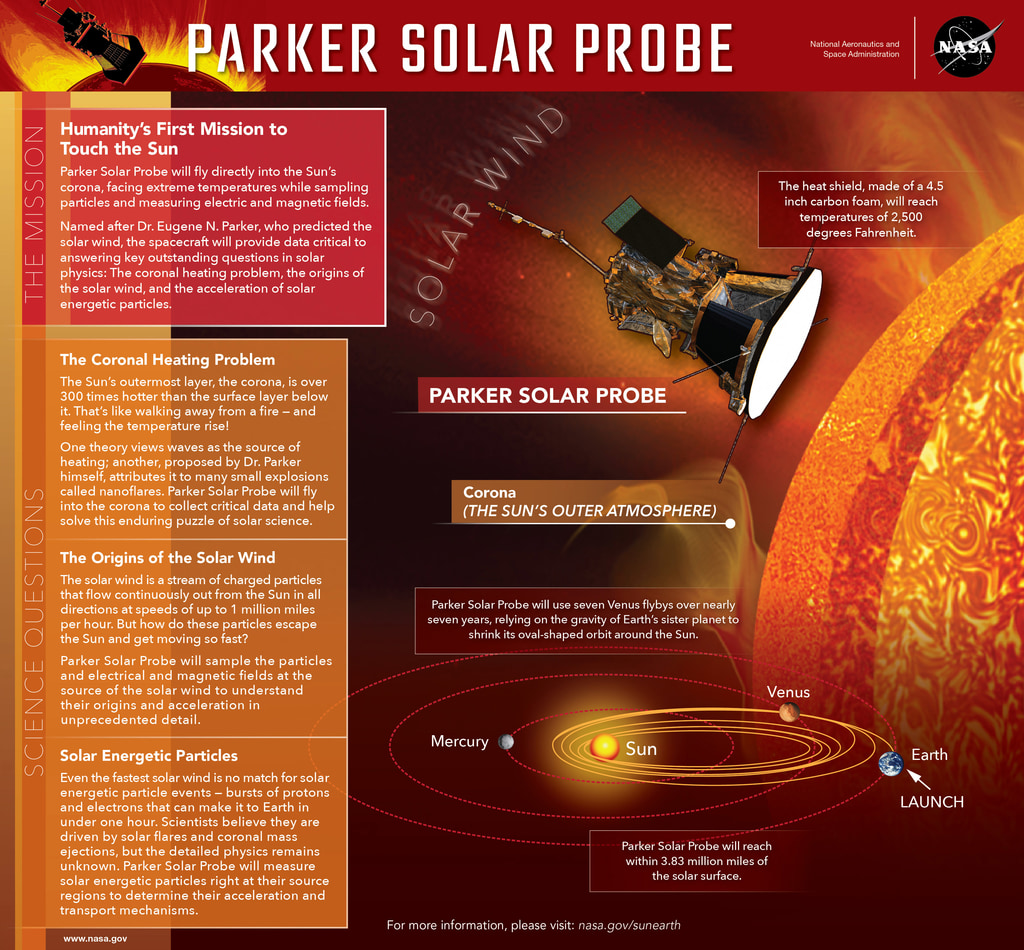
On March 11, 2026, the probe completed its 27th close solar flyby, matching its own record of skimming just 3.8 million miles above the Sun’s surface at 430,000 miles per hour—fast enough to cross the continental U.S. in 20 seconds. That speed, roughly 200 times faster than a bullet, isn’t just a milestone; it’s a fundamental shift in how we explore stars. The probe’s 4.5-inch carbon-foam shield, painted white to reflect searing light, keeps its instruments at room temperature while the Sun-facing side reaches 2,500°F. The corona, despite its million-degree plasma, is nearly a vacuum, meaning “temperature” measures particle speed, not heat transfer. Parker’s survival here isn’t just engineering—it’s rewriting the rules of thermal protection.
The Speed That Redefines Human Ingenuity
Parker isn’t just fast—it’s repeatedly achieving the fastest speed ever recorded by humanity. On December 24, 2024, it first hit 430,000 mph during its 23rd perihelion (closest solar approach), a mark it has since matched or exceeded on at least three occasions. For context: the International Space Station orbits Earth at 17,500 mph. Parker is moving 25 times faster. A bullet from a high-powered rifle? 200 times slower. The probe doesn’t use rockets to reach this velocity—it falls toward the Sun, using Venus’s gravity to tighten its orbit like a slingshot. Each pass, the Sun’s gravity accelerates it further, a process that will continue until its final orbits in 2025, when it will skim within 3.8 million miles of the solar surface—closer than Mercury.
What makes this speed possible isn’t brute force—it’s physics. The Sun’s gravity well is so deep that even a small drop in orbital altitude (thanks to Venus flybys) yields exponential velocity gains. By the time Parker reaches perihelion, it’s moving at a velocity no chemical rocket could match. The probe’s orbit isn’t circular—it’s an extreme ellipse, where 90% of its energy is spent in the outer solar system, and the remaining 10% is converted into a blistering sprint near the Sun.
The 4.5-Inch Shield That Outsmarts a Star
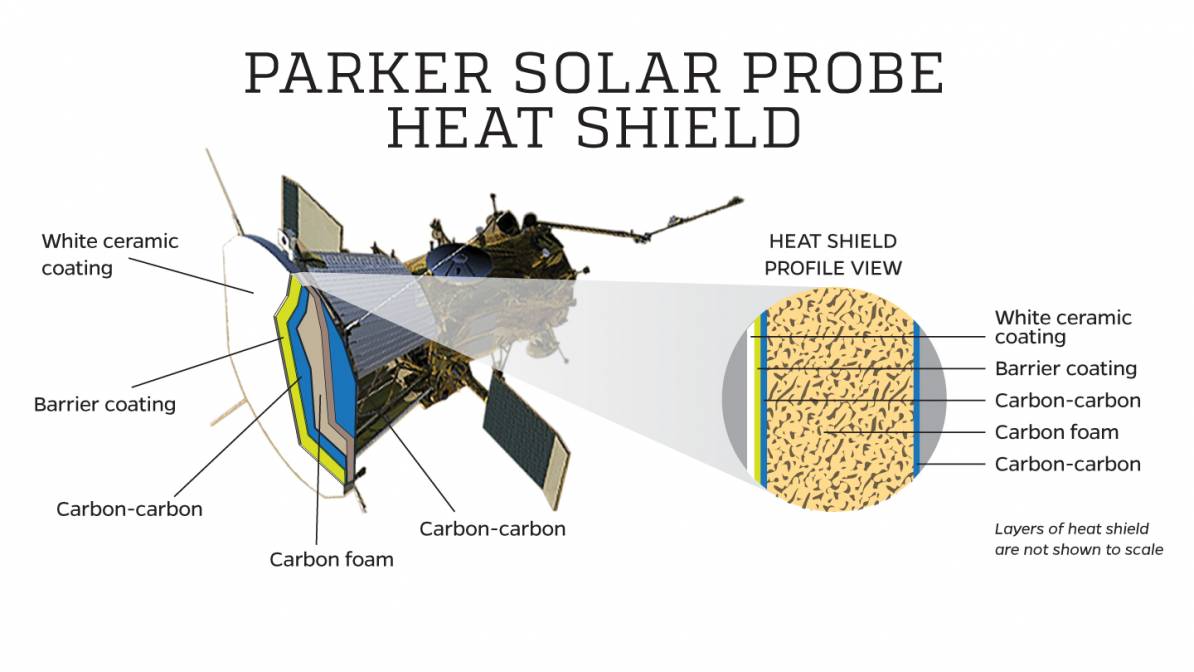
The real hero of this mission isn’t the speed—it’s the thermal protection system (TPS), a 4.5-inch-thick slab of carbon-carbon composite sandwiching a core of carbon foam that’s 97% air. This isn’t just a heat shield; it’s a thermal insulator operating at scales never before attempted. The Sun-facing side reaches 2,500°F, while the instruments behind it stay at a balmy 85°F. The secret? The corona, despite its million-degree temperatures, is a near-vacuum. Heat transfer relies on particle collisions—fewer particles mean less energy transferred to the shield. The TPS reflects most solar radiation with a white ceramic coating and dissipates the rest through its porous structure, which radiates heat away from the probe’s delicate electronics.
This isn’t just about surviving—it’s about sampling. Parker is the first spacecraft to repeatedly fly through the corona, where the solar wind is born. Every pass delivers data on magnetic fields, plasma waves, and energetic particles that could revolutionize space weather forecasting. The probe’s instruments, including a Faraday cup and magnetometer, are designed to operate in this extreme environment, sending back measurements that could explain why the corona is hotter than the Sun’s surface—a 3-million-degree mystery that has baffled scientists for decades.
The Sun does not have a hard edge. The visible surface is just the layer where plasma becomes opaque enough for photons to escape. Above it sits the corona—the ghostly halo we see during eclipses, where temperatures soar to millions of degrees.
Why This Matters: The Data That Could Save Earth
Parker’s mission isn’t just about speed records—it’s about understanding the Sun’s behavior, which directly impacts life on Earth. Solar flares and coronal mass ejections (CMEs) can disrupt satellites, power grids, and communications. By flying through the corona, Parker is measuring the solar wind’s origins, which could improve forecasts of space weather events by days or even weeks. The probe’s data has already revealed unexpected magnetic structures near the Sun’s surface, challenging decades-old models of solar physics.
But the implications go beyond science. The TPS technology could inspire future missions to Venus, Mercury, or even exoplanets orbiting other stars. If we can protect a probe in the corona, we can protect instruments in environments where traditional cooling fails. And with Parker’s data, engineers might one day design spacecraft that survive close encounters with stars—opening the door to interstellar probes that study alien suns up close.
The Next Orbits: What Comes After the Speed Records?
Parker’s current orbit isn’t its final one. By late 2026, the probe will complete its 28th and 29th perihelia, each time skimming even closer to the Sun—though not breaking new speed records, as its velocity is now at its theoretical maximum for this mission. The real focus shifts to data collection. Each pass refines our understanding of the solar corona, but the probe’s autonomy is critical: during close approaches, it operates independently, sending back only a beacon tone to confirm survival. The risk is high—if the TPS fails, the probe vaporizes. If the instruments fail, years of data are lost. But the payoff is just as high: answers to questions that have persisted since the dawn of solar physics.
What happens next? If funding holds, Parker could continue until 2025, when its orbit will decay naturally. But its legacy is already secure. No other spacecraft has come this close to a star—or survived to tell the tale. The probe’s success proves that humanity can touch the Sun, not just observe it from afar. And in doing so, it’s not just rewriting speed records—it’s rewriting the boundaries of exploration itself.
For the first time in history, we’re not just watching the Sun. We’re flying through it.
