Astronomers have finally detected the long-missing wind from Sagittarius A*, the Milky Way’s supermassive black hole, after five years of radio observations revealed a three-light-year cavity carved by unseen outflows.
The discovery, published by researchers at Northwestern University and Yale, resolves a decades-old mystery: why our galaxy’s black hole appeared “windless” while others produced powerful jets and winds. The findings also suggest black holes can still launch winds even in quiet phases.
How a three-light-year cavity revealed the wind
For over half a century, astronomers have observed supermassive black holes in distant galaxies producing powerful outflows—jets and winds that shape galactic evolution. Yet Sagittarius A*, the 4-million-solar-mass black hole at our galaxy’s center, remained conspicuously quiet. Using five years of data from radio telescopes in Chile, researchers led by Mark Gorski and Lena Murchikova mapped cold gas near the black hole and discovered a conical cavity spanning three light-years. The cavity’s shape and size, they argue, could only have been carved by a hot wind emanating from Sagittarius A* itself.
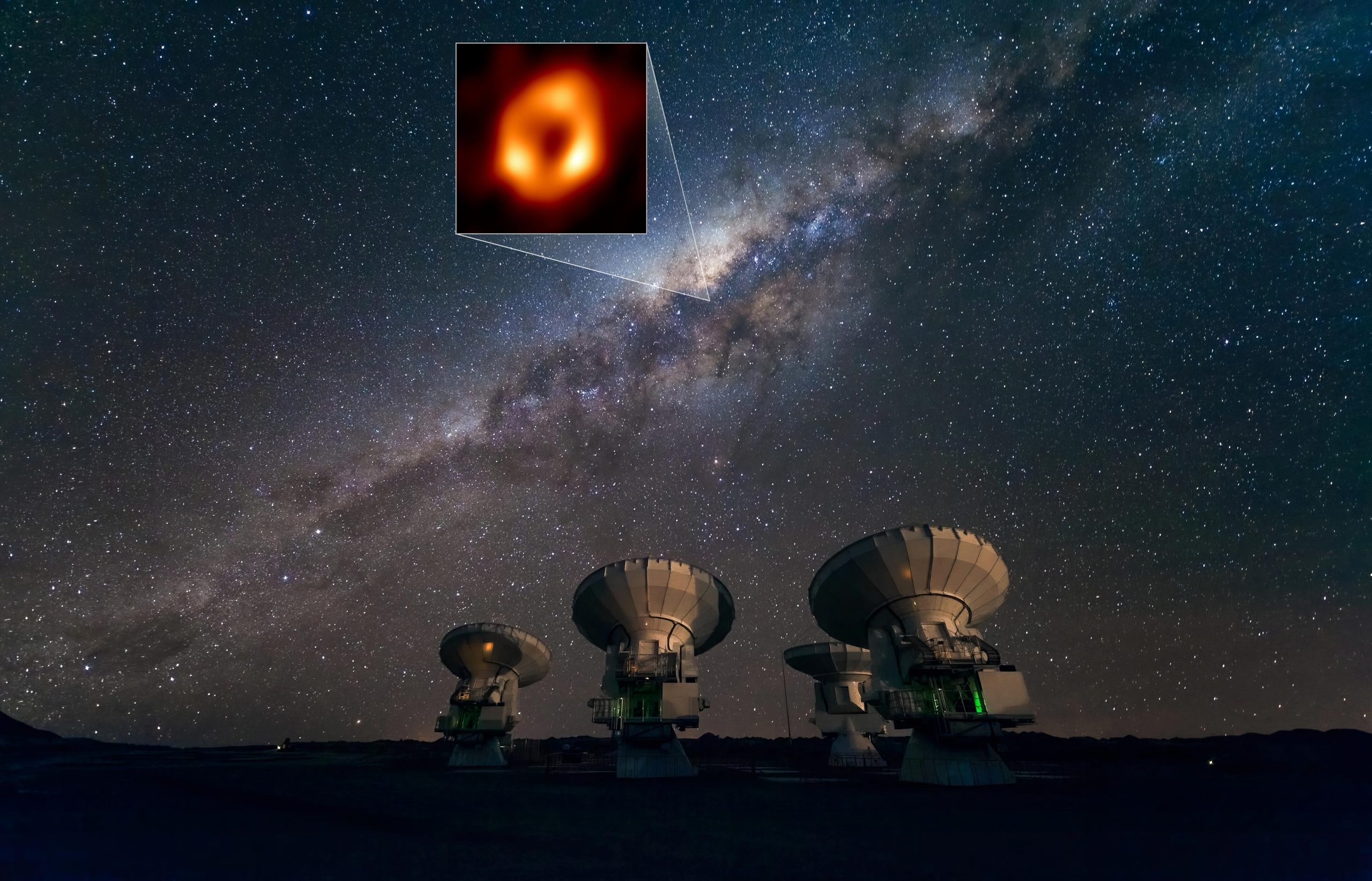
According to mezha.net, the team’s analysis of almost five years of high-resolution radio data from the world’s most sensitive telescopes revealed the wind’s indirect signature: the absence of cold gas in a precise conical region. “This work provides a fairly compelling argument that the wind from our galaxy’s supermassive black hole really has moved outward through the surrounding dust and gas,” said Dan Wilkins, an astrophysicist at Stanford University. “Although they did not see the wind itself, its presence is quite evident.”
“This work dispels that picture. This is what persistent, deep observational astronomy looks like, delivering feedback.”
Why this discovery matters for galaxy evolution
Black hole winds are critical to galaxy formation. By ejecting gas and dust, they regulate star formation and influence a galaxy’s long-term structure. The discovery that even a “quiet” black hole like Sagittarius A* can produce winds challenges previous assumptions. “Sagittarius A* has long been a major disappointment for galactic-center astrophysics: so close to being studied in detail, yet at the same time it remained quiet, as if windless,” Natarajan noted. The new findings suggest such winds may be more common than previously thought, even in black holes not currently in active growth phases.
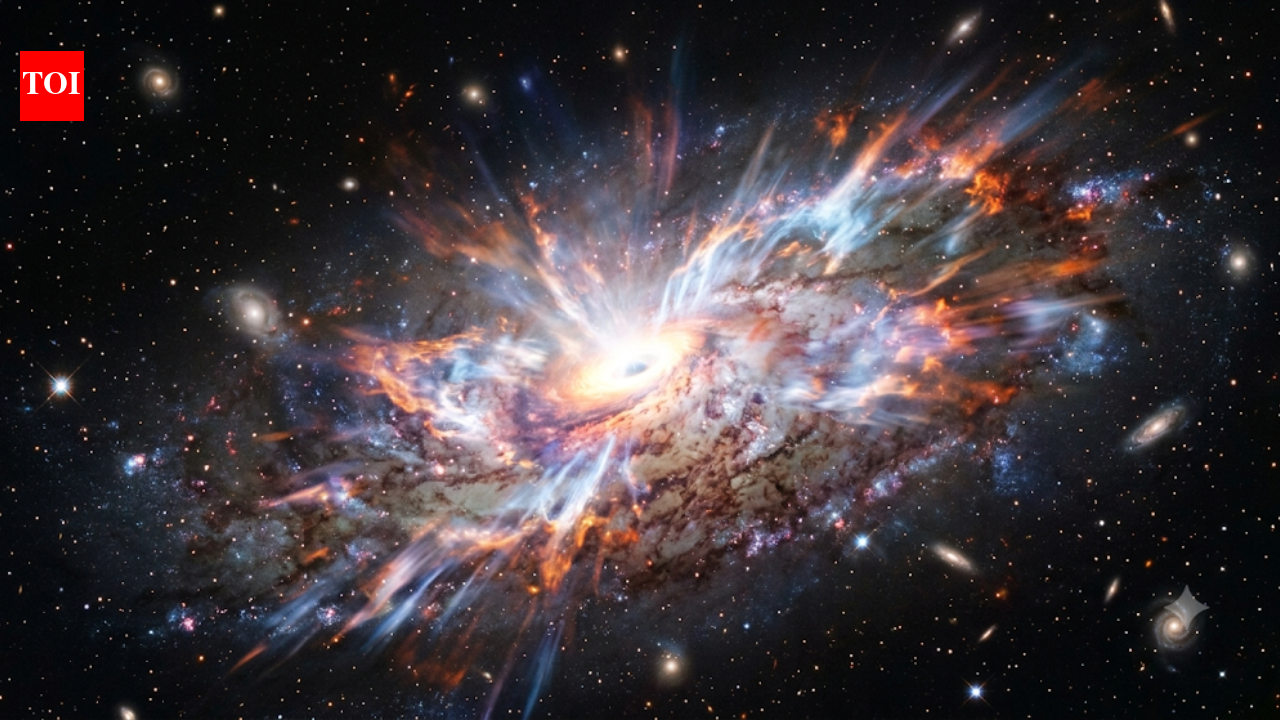
Christopher Reynolds, an astronomy professor at the University of Maryland, emphasized the broader implications: “These outflows were truly elusive when we looked at our own supermassive black hole—until now.” The team’s work aligns with growing evidence that black hole winds can extend far beyond their immediate vicinity, influencing entire galaxies. A recent study highlighted by The Times of India found a quasar’s outflows moving at 30% the speed of light—far faster than anything observed in our galaxy, but reinforcing the idea that these winds are a universal feature of supermassive black holes.
For more on this story, see Gaia satellite reveals Milky Way’s ancient galaxy merger, 10 billion years ago.
A comparison: Our black hole vs. distant quasars
| Feature | Sagittarius A* | Quasar J2318 (3 billion light-years away) |
|---|---|---|
| Wind speed | Not directly measured (indirect evidence of outflow) | 30% the speed of light (~323 million km/h) |
| Detection method | Radio observations of cold gas cavity | Ultraviolet spectroscopy |
| Black hole mass | 4 million solar masses | 1.7 billion solar masses |
| Galactic influence | Regulates local star formation | Shapes entire galaxy structure |
The contrast between Sagittarius A* and quasars like J2318 underscores a key difference: while distant quasars produce visibly violent outflows, our black hole operates on a subtler scale. Yet both demonstrate the same fundamental process—black holes channeling energy outward to govern their cosmic environments. The discovery also raises questions about why Sagittarius A*’s wind appears weaker. “This work shows that even in quiet phases, black holes can still launch winds,” Wilkins said. “It’s a reminder that we’re still learning the full story of how these cosmic engines work.”
What happens next: Mapping the wind’s motion
The team plans to expand their observations, creating a “mini-film” of gas motion near Sagittarius A* to predict how much material the black hole will eventually consume. By tracking the wind’s movement, they hope to quantify its impact on star formation in the galactic center. “The next step is to map the wind’s motion in more detail,” Gorski told mezha.net. “This could help us understand how much gas the black hole is actually swallowing—and how much is being pushed away by the wind.”
Beyond Sagittarius A*, the discovery may prompt a reexamination of other “quiet” black holes. If our galaxy’s black hole can produce winds despite its low activity, similar mechanisms might explain observations in other galaxies where outflows appear weaker than expected. The findings also highlight the importance of long-term observational campaigns—what initially appeared as a “disappointment” (a quiet black hole) turned out to be a missing piece of the puzzle.
“This is our closest and best-studied black hole, yet it remained quiet, as if windless.”
What this means for black hole physics
The detection of Sagittarius A*’s wind challenges long-held assumptions about black hole activity. Previously, astronomers assumed that only rapidly accreting black holes—those consuming vast amounts of material—could produce powerful outflows. The new evidence suggests that even “sleeping” black holes can generate winds, albeit on a smaller scale. This could reshape models of galaxy evolution, particularly for galaxies like our own, where the black hole operates in a relatively quiescent state.

This follows our earlier report, Mars’s Hidden Water and Atmosphere Located..
Dan Wilkins noted that the discovery required “a very careful analysis of almost five years of data”—a testament to the power of persistent observation. “For this, a true feat of strength was needed,” he said. The work also underscores the importance of multi-wavelength astronomy, combining radio, X-ray, and infrared data to piece together a complete picture of black hole behavior.
Looking ahead, the findings may influence how astronomers interpret observations of other galaxies. If Sagittarius A*’s wind is detectable only through indirect methods, similar outflows in distant galaxies might have been overlooked. The discovery serves as a reminder that even the most familiar cosmic objects can hold surprises—and that some of the most important insights come from patient, long-term study.
Key takeaways: What we know now
- Sagittarius A*’s wind was detected indirectly through a three-light-year cavity in cold gas near the black hole.
- The wind’s presence suggests even “quiet” black holes can influence their galaxies.
- Comparisons with distant quasars show our black hole’s wind operates on a subtler scale.
- Future observations aim to map the wind’s motion and predict its impact on star formation.
- The discovery challenges assumptions about black hole activity and galaxy evolution.
The story of Sagittarius A*’s wind is a testament to the power of persistence in astronomy. What once seemed like a cosmic dead end has revealed a critical piece of the puzzle—one that could rewrite our understanding of how black holes shape the universe.
Find more reporting in our Technology section.
