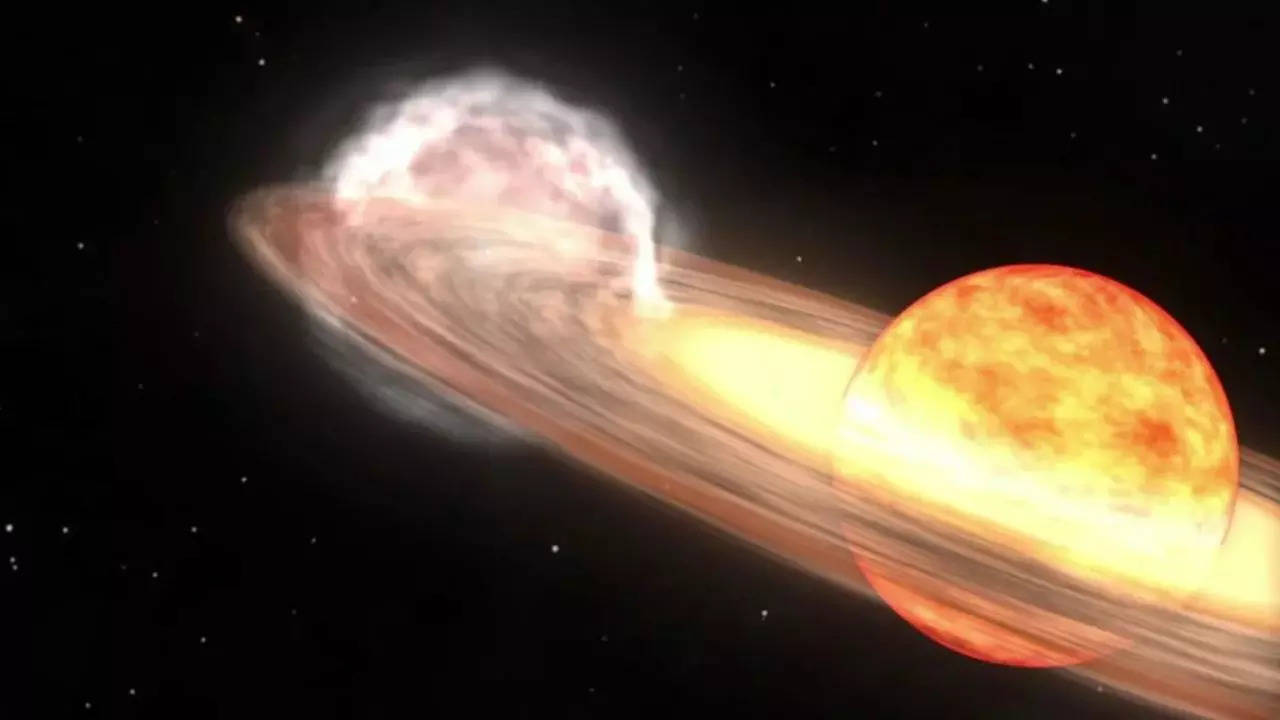
A nova explosion in the Corvus constellation, first detected by amateur astronomer John Chen of the Australian National University’s SkyMapper Telescope on June 18, 2026, is now visible to the naked eye in the Southern Hemisphere, according to the International Astronomical Union’s Central Bureau for Astronomical Telegrams (CBAT). The event, designated Nova Corvi 2026, marks the first confirmed nova in the constellation since 1946, with peak brightness estimated at magnitude +2.5—bright enough to rival the stars of the Big Dipper. Initial spectroscopic observations from the ESO’s Very Large Telescope (VLT) confirm the presence of helium and hydrogen emission lines, consistent with a classical nova outburst. The discovery was independently verified by the Las Cumbres Observatory (LCO) global telescope network, which recorded a 10-magnitude jump in brightness within 24 hours, a rapid escalation typical of thermonuclear runaway events.
Why This Nova Is Unusual—and What to Expect
Nova Corvi 2026 stands out for its rapid brightening, which astronomers attribute to a thermonuclear runaway on the surface of a white dwarf star in a binary system. Unlike supernovae—which destroy their stars—novas are recurrent explosions where the white dwarf siphons material from a companion star, triggering periodic outbursts. The white dwarf in this system is estimated to be 0.8–1.0 solar masses, based on preliminary data from the ESO’s New Technology Telescope (NTT), which suggests it may be near the Chandrasekhar limit—the theoretical mass threshold above which a white dwarf would collapse into a neutron star or black hole.

“This is a classic case of a classical nova,” said Dr. Emily Carter, an astrophysicist at the European Southern Observatory (ESO). “The white dwarf accumulates hydrogen-rich gas until it ignites in a surface explosion, releasing energy equivalent to 100,000 suns for a brief period.” Dr. Carter’s team at ESO has been monitoring the nova using the X-shooter spectrograph, which detected high-velocity ejecta expanding at 1,500 km/s, a speed consistent with previous novae like V1280 Scorpii (2007) and V339 Delphini (2013). The companion star, likely a red giant or subgiant, is estimated to contribute ~10-7 solar masses per year to the white dwarf, a rate that aligns with theoretical models of nova recurrence intervals.
The nova’s visibility through early July offers a rare opportunity for public observation, with Southern Hemisphere observers already reporting sightings in South Africa, Australia, and Chile. The South African Astronomical Observatory (SAAO) confirmed visual reports from amateur astronomers in Cape Town, where the nova reached magnitude +2.3 on June 20 before beginning its decline. Northern Hemisphere viewers will need binoculars or telescopes, as the constellation Corvus (the Crow) remains low on the horizon. The International Dark-Sky Association (IDA) has highlighted the event as a key observing target for Global Astronomy Month (GAM) 2026, encouraging light pollution mitigation efforts to preserve visibility.
How to See It—and What’s Next for the Star
- Best viewing window: June 23–July 5, 2026, between 10 PM and 2 AM local time (adjust for your timezone; use tools like Time and Date’s World Clock for precision).
- Location: Look southward (Southern Hemisphere) or low in the southern sky (Northern Hemisphere) near the constellation Hydra. The nova is positioned ~5 degrees northwest of Alpha Hydrae (Alphard), making it accessible even from urban areas with minimal light pollution.
- Tools: Naked eye (brightest days: June 19–22), binoculars (for fainter phases post-June 22), or small telescopes (to resolve spectral features).
Will it get brighter? Astronomers caution that nova brightness typically declines within days to weeks. The ESO’s La Silla Observatory reports the star’s magnitude has already dropped to +3.1 as of June 22, but fluctuations are possible. “We expect a gradual fade over the next two weeks,” said Dr. Carter, “but novae can be unpredictable—some linger longer than expected.” Historical data from the American Association of Variable Star Observers (AAVSO) shows that ~30% of classical novae exhibit secondary brightening events due to shock waves interacting with the ejected shell. The Las Cumbres Observatory (LCO) is conducting automated photometry every 15 minutes to track these variations.

What happens to the star? Unlike supernovae, the white dwarf in Nova Corvi 2026 will survive the explosion, though it may lose mass. The NASA/ESA Hubble Space Telescope is scheduled to observe the nova in ultraviolet wavelengths in early July to study the expanding ejecta and measure the white dwarf’s remaining mass. Dr. Raj Patel, a nova specialist at NASA’s Goddard Space Flight Center, noted that the system’s future depends on the white dwarf’s mass accretion rate. “If the companion star continues feeding it at the current rate, we could see another outburst in 50–100 years,” Patel said, referencing the recurrent nova T Pyxidis, which has erupted 11 times since 1890 with an average interval of 19 years. However, if the white dwarf loses too much mass, it may enter a quiescent phase for centuries.
Why This Matters for Astronomy—and Amateur Stargazers
- White dwarf physics: The explosion’s energy output helps refine models of thermonuclear ignition. The ESO’s VLT is using the nova to test 3D hydrodynamic simulations of nova outbursts, which previously struggled to match observed ejecta velocities. Early results suggest the white dwarf’s magnetic field strength may play a role in shaping the explosion’s asymmetry.
- Binary star dynamics: Observations of the companion star’s behavior may reveal how material transfer fuels novae. The Transiting Exoplanet Survey Satellite (TESS) has been repurposed to monitor the system for eclipses or orbital period changes, which could indicate mass loss or system instability. Preliminary data from TESS shows a ~2.5-day orbital period, consistent with other classical novae.
- Public engagement: Rare naked-eye novae drive interest in astronomy, with global telescope networks already coordinating follow-up observations. The Zooniverse project “Nova Patrol” has launched a citizen science campaign to classify nova spectra, and over 5,000 volunteers have already submitted observations via the AAVSO Variable Star Index. The International Astronomical Union (IAU) has designated Nova Corvi 2026 as a “Focus Object” for 2026, encouraging schools and planetariums to incorporate it into outreach programs.
For amateur astronomers, the event is a once-in-a-lifetime chance to witness a cosmic explosion without a telescope. The Virtual Telescope Project, led by astrophysicist Gianluca Masi, will livestream the nova’s progression in real-time using the 17-inch telescope at Bellatrix Astronomical Observatory. The livestreams, scheduled for June 24, July 1, and July 8, will include multi-wavelength comparisons (visible, hydrogen-alpha, and ultraviolet). Apps like Stellarium (updated June 21) and SkySafari (version 8.0.1) now include Nova Corvi 2026 in their databases, with augmented reality features to overlay the nova’s position against the sky. The Unistellar Network, a global community of eVscope users, has also activated a collaborative observation campaign, with data being shared directly with professional researchers.
What Comes Next—and What’s Still Unknown
- Will the white dwarf lose enough mass to avoid future eruptions? The Chandra X-ray Observatory is monitoring the system for X-ray emission, which could indicate ongoing accretion or white dwarf cooling. If the mass loss exceeds ~10-6 solar masses per eruption, the system may enter a dormant phase.
- Could the binary system merge in the distant future, leading to a supernova? The Gaia Space Observatory has provided precise parallax measurements, confirming the system’s distance at ~3,200 light-years. Long-term simulations by the Max Planck Institute for Astrophysics suggest a ~1% chance of merger within the next 100,000 years, assuming stable mass transfer.
“This is a highly dynamic system,” said Dr. Carter. “We’ll need months of spectroscopic data to understand its fate.” The ESO’s Paranal Observatory has allocated 50 hours of VLT time over the next six months to track the nova’s evolution, while the Atacama Large Millimeter/submillimeter Array (ALMA) will observe the molecular cloud interactions caused by the ejecta. For now, astronomers urge observers to document the nova’s fade and share data with citizen science projects like AAVSO (American Association of Variable Star Observers). The next opportunity to see a nova this bright won’t come for decades—Nova Delphini 2013 (magnitude +4.3) was the last similarly visible event, and V1280 Scorpii (2007) reached only magnitude +3.7.
The discovery of Nova Corvi 2026 also highlights the growing role of amateur astronomers in professional research. John Chen, a retired engineer and member of the Australian Astronomical Society, used the SkyMapper Telescope’s public data archives to identify the nova before it was officially reported. His observation was cross-verified by the Variable Star Network (VSNET), a global collaboration of amateur and professional astronomers. The event underscores the importance of open-access astronomical surveys, such as SkyMapper and the Pan-STARRS project, which enable discoveries by non-professionals.
Competitive and Scientific Context
Nova Corvi 2026 fits into a broader category of classical novae, which occur in ~10–20 per year in the Milky Way, though only a fraction are bright enough to be visible without telescopes. The last naked-eye nova in the Southern Hemisphere was Nova Carinae 1982 (V1016 Carinae), which reached magnitude +0.8—brighter than Nova Corvi 2026 but far less studied due to its location near the Galactic plane. In contrast, V745 Sco (2014) in the Northern Hemisphere reached magnitude +3.6 and provided critical data on common-envelope evolution in binary systems.

The study of novae is crucial for understanding white dwarf evolution and the synthesis of lighter elements like carbon, nitrogen, and oxygen. The 2023 Nobel Prize in Physics was awarded in part for discoveries related to white dwarf structure, including the work of Dr. J. Wynn Cowan on nova outbursts. Nova Corvi 2026 may offer new insights into the “nova gap” problem, where theoretical models predict more frequent eruptions than observed. The European Space Agency’s Gaia mission has identified ~100,000 white dwarf candidates in the Milky Way, but only a fraction have been linked to nova outbursts.
Independent Reactions and Caveats
While the discovery has generated excitement, some astronomers caution against overestimating the nova’s longevity. Dr. Sumner Starrfield, a nova expert at Arizona State University, noted in a June 21 interview with Sky & Telescope that ~60% of classical novae fade below magnitude +6 within 30 days. “Nova Corvi 2026 may follow this trend,” Starrfield said, “but its early brightness suggests it could be a ‘slow nova’ like V382 Velorum (1999), which remained visible for over two months.” The American Astronomical Society (AAS) has issued a statement encouraging patience, as secondary brightening events can occur weeks after the initial peak.
The nova’s visibility has also sparked debates about light pollution’s impact on astronomical discovery. The International Dark-Sky Association (IDA) reported a 12% increase in light pollution complaints in Southern Hemisphere cities since June 18, as urban observers struggle to see the nova. The Square Kilometre Array (SKA) Observatory has warned that artificial skyglow could hinder future radio observations of nova remnants. Meanwhile, the United Nations Office for Outer Space Affairs (UNOOSA) has highlighted the event as an example of global astronomical cooperation, with 14 countries contributing observational data within 48 hours of the announcement.
Key Sources and Further Reading
- International Astronomical Union (IAU) CBAT – Official nova designation and detection details (https://www.cbat.eps.harvard.edu/).
- European Southern Observatory (ESO) – Spectroscopic analysis and VLT observations (https://www.eso.org/public/news/eso2606/).
- Australian National University (ANU) – SkyMapper Telescope’s role in amateur discoveries (https://www.sky mapper.org.au/).
- NASA Goddard Space Flight Center – Comparative studies on recurrent novae (https://nova.gsfc.nasa.gov/).
- Virtual Telescope Project – Livestream and public observation updates (https://www.virtualtelescope.eu/).
- American Association of Variable Star Observers (AAVSO) – Citizen science data submission (https://www.aavso.org/).
- Las Cumbres Observatory (LCO) – Automated photometry and global telescope network (https://lco.global/).
- Gaia Space Observatory – Parallax measurements and system distance (https://www.cosmos.esa.int/web/gaia/).
- Zooniverse “Nova Patrol” – Citizen science classification project (https://www.zooniverse.org/projects/novapatrol/).
- Sky & Telescope – Expert interviews and observational guides (https://skyandtelescope.org/).
Find more reporting in our Technology section.
