“SpaceX is set to test its Starfall prototype on June 23, 2026, a disk-shaped reentry capsule designed to revolutionize cargo return from orbit, as noted by Tech Times and WFTV. This development follows a $1 billion investment by Ron Baron, founder of Baron Capital, boosting his total SpaceX holdings to $25 billion, according to news.google.com. The test aims to demonstrate a 30-fold increase in return capacity compared to existing systems, with implications for space manufacturing and logistics.”
The Starfall Prototype: A New Era in Space Logistics
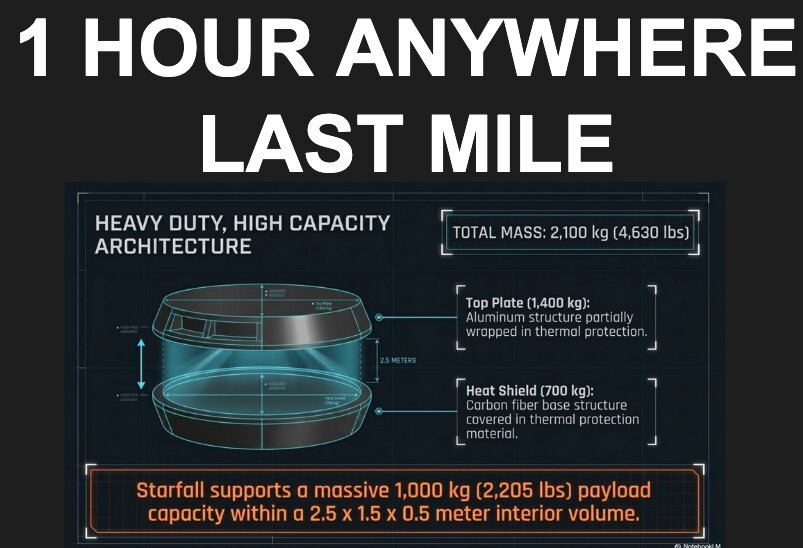
SpaceX’s Starfall prototype, a flat, circular capsule measuring 3.1 meters in diameter, is scheduled to launch from Cape Canaveral on June 23, 2026, according to Tech Times. The vehicle’s design—replacing the traditional conical shape with a disk—aims to maximize cargo capacity, potentially returning up to 1,000 kilograms of payload from orbit. This represents a significant leap from current systems, which typically return dozens of kilograms per mission.
The capsule relies on a Falcon 9 launch vehicle for deorbit maneuvers, using cold-gas thrusters for attitude control during descent. Upon reentry, a parachute sequence will deploy to ensure a controlled splashdown in the Pacific Ocean. SpaceX’s approach eliminates the need for onboard propulsion, reducing weight and complexity while leveraging existing launch infrastructure. “This is not an engineering shortcoming; it is a deliberate tradeoff,” a source familiar with the project told Tech Times.
WFTV reported that the test is the first of two FAA-approved prototype flights, focusing on reentry, splashdown, and recovery. If successful, Starfall could disrupt the orbital manufacturing industry, which currently depends on SpaceX’s Falcon 9 rideshares for cargo delivery. The disk shape’s aerodynamic efficiency and mass-production potential position it as a game-changer for space logistics, according to Nextbigfuture.com, which highlights its role in enabling “one-hour anywhere delivery” via Starship.
Ron Baron’s Vision: Betting on the Future of Space Travel
Renowned investor Ron Baron, founder of Baron Capital, has further cemented his confidence in SpaceX by purchasing an additional $1 billion in shares, pushing his firm’s total holdings to $25 billion, as reported by news.google.com. Baron, who began investing in SpaceX in 2017, described the company’s achievements as “not possible for anyone else to accomplish,” citing its advancements in reusable rocketry, Starlink, and Mars exploration.
“I think we’re going to make hundreds of billions of dollars,” Baron stated, emphasizing SpaceX’s potential to reach valuations of $10–30 trillion within 15 years. His investment aligns with a broader vision of space as a “lifetime investment,” alongside his stakes in Tesla. “SpaceX isn’t just building rockets—it’s trying to save humanity by expanding our horizons beyond Earth,” he said, per the same source.
Baron’s move underscores his belief in SpaceX’s trajectory post-IPO, where the company’s valuation exceeded $2 trillion. His early investments, initiated through secondary markets and employee tender offers, have generated over $13 billion in unrealized gains, according to the first source. Analysts note that his strategic patience—holding shares through multiple phases of SpaceX’s growth—reflects a long-term bet on the company’s dominance in the space economy.
Implications for the Space Economy: A New Frontier
The Starfall test and Baron’s investment signal a pivotal moment for the space sector, blending technological innovation with financial speculation. SpaceX’s ability to scale cargo returns could lower costs for orbital manufacturing, enabling new industries such as space-based AI data centers and direct-to-cell satellite connectivity. Nextbigfuture.com theorizes that the system could revolutionize logistics, allowing “millions of passenger and package deliveries” within a decade.
However, challenges remain. Critics question the feasibility of achieving $10–30 trillion valuations amid high costs and execution risks. Yet, SpaceX’s track record—marked by milestones like Starship development and Starlink deployment—lends credibility to its ambitious goals. “The company has redefined access to space,” said a spokesperson for a rival orbital manufacturing firm, who declined to comment further.
The broader implications extend beyond economics. Starfall’s infrastructure-free design could democratize space access, reducing reliance on ground-based launch towers. This aligns with SpaceX’s vision of a “multi-planetary future,” as articulated by Baron, who sees the company as a cornerstone of humanity’s expansion beyond Earth.
What Comes Next: The Road to Scalability
The success of Tuesday’s test will determine whether Starfall progresses to full-scale operations. If validated, the capsule could become a linchpin for SpaceX’s post-IPO strategy, competing with existing cargo return systems. Meanwhile, Baron’s $1 billion purchase highlights the growing intersection of venture capital and space exploration, with institutions betting on a sector poised for exponential growth.
Analysts caution that the space economy’s trajectory remains uncertain, with regulatory hurdles and technical challenges ahead. Yet, the combination of Starfall’s innovation and Baron’s financial backing suggests a bold new chapter for SpaceX—and for the industries it aims to transform. As one industry observer noted, “This is not just about rockets; it’s about reimagining what’s possible in the final frontier.”
“SpaceX’s Starfall mission represents a critical step in redefining space logistics,” said a source familiar with the project. “If successful, it could unlock a new era of commercial activity in orbit and beyond.”
“SpaceX’s Starfall mission represents a critical step in redefining space logistics,” said a source familiar with the project.
Find more reporting in our Technology section.