An international team of geoscientists has identified a massive, fan-shaped geological structure beneath the East Antarctic Ice Sheet, spanning a substantial portion of the continent. Published June 3, 2026, in Nature Geoscience, the discovery suggests the region formed through rotational extension before the breakup of the Gondwana supercontinent, significantly influencing modern ice-flow patterns.
Mapping the East Antarctic Fan-Shaped Basin Province
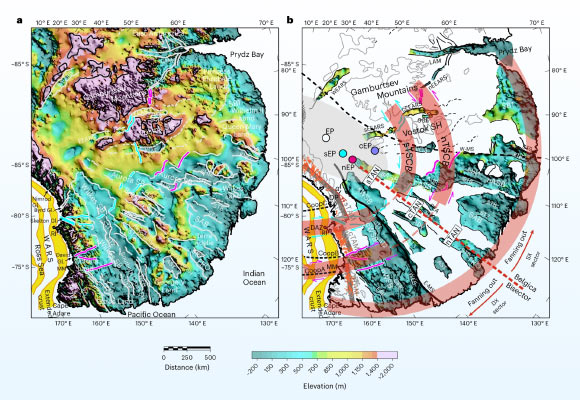
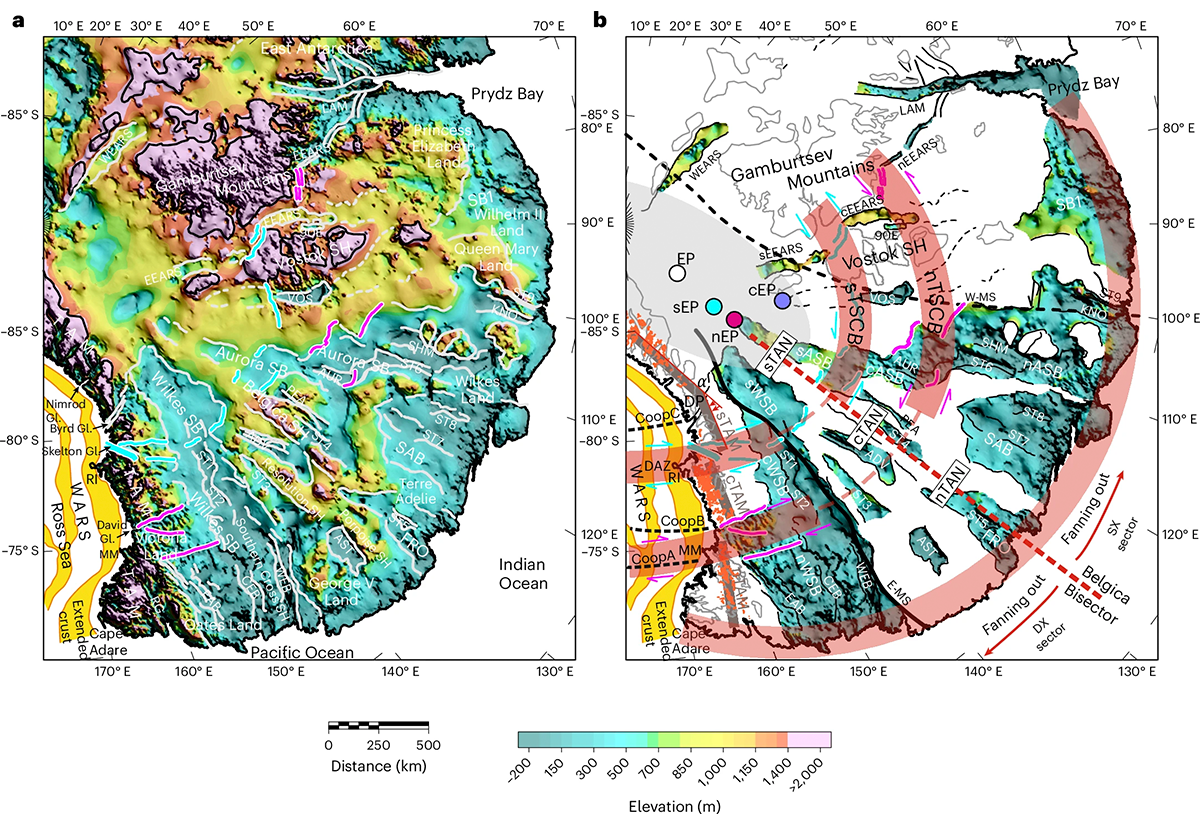
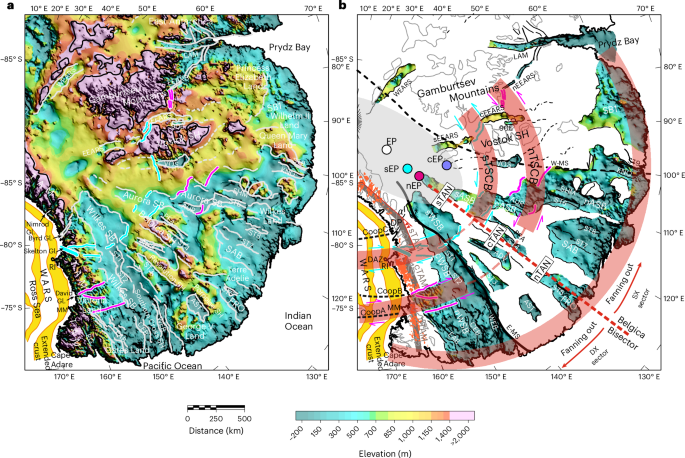
Researchers led by geophysicist Egidio Armadillo of the University of Genoa have formally defined the East Antarctic Fan-Shaped Basin Province (EAFBP). This newly identified feature encompasses a network of approximately 30 connected subglacial basins, including the Wilkes and Aurora basins, as well as the basin housing Lake Vostok. The structure, which researchers describe as having a “coherent continent-scale radial pattern,” covers a significant percentage of East Antarctica’s landmass, according to reporting by ScienceAlert.
Photo: Sci.News
The identification of the EAFBP resulted from a multi-year effort to reconcile conflicting geophysical data. By combining reconstructed rebound topography—which accounts for the crustal uplift that would occur if the ice were removed—with radio-echo sounding, gravity, seismic, and magnetic measurements, the team determined that these basins were not isolated features. Instead, they form a single physiographic unit that fans out from a central pivot point located near the South Pole.
Photo: Nautilus | Science
In the field of geophysics, “rebound topography” is a critical tool for understanding polar regions. When massive ice sheets retreat or thin, the underlying Earth’s crust slowly rises, a process known as glacial isostatic adjustment. By calculating these uplift patterns, scientists can infer the density and shape of the bedrock that remains hidden beneath miles of ice. The integration of this data with magnetic and gravity surveys allows researchers to see “through” the ice to the basement rock, which often reveals tectonic signatures that have been erased from the surface by erosion in less frozen environments.
Origins and Tectonic Evolution
The formation of the EAFBP is attributed to a process known as distributed rotational extension. As the continental crust stretched, it created a series of V-shaped basins aligned in a north-south orientation, with the overall geometry resembling a handheld fan. The researchers propose that this structural development likely occurred during the lead-up to the fragmentation of Gondwana, the ancient supercontinent.
“The triangular gap of oceanic crust separating two cratonic blocks with fault margins converging to a point, and interpreted as having originated by the rotation of one of the blocks with respect to the other.”
HUGE UPDATE: Scientists Finally Enter Grand Canyon's Hidden Structure
Egidio Armadillo et al., via Nature
This tectonic history likely created a zone of lithospheric weakness. According to Sci.News, this weakness may have acted as a guide for the subsequent separation of Antarctica from Australia. The geometry of the continent’s margin, which features a distinct semi-circular arc, further supports the theory that the entire region functioned as a single tectonic unit during the late stages of Gondwana’s evolution.
Gondwana was a colossal landmass that included modern-day South America, Africa, Antarctica, Australia, and the Indian subcontinent. Its breakup, which began roughly 180 million years ago, fundamentally altered global ocean currents and climate patterns. The discovery of the EAFBP provides a clearer picture of the mechanical “tearing” that occurred during the early stages of this separation. By identifying the specific pivot points around which crustal blocks rotated, the team has provided a new mechanical model for how Gondwana’s interior was stretched before the final rifting occurred.
Implications for Modern Ice-Sheet Dynamics
While the EAFBP provides a window into ancient crustal evolution, its current influence on the Antarctic Ice Sheet is perhaps more urgent. Because these basins underlie approximately 50 percent of the East Antarctic Ice Sheet, they dictate the path of subglacial water and the speed at which ice flows toward the coast.
Photo: Nature
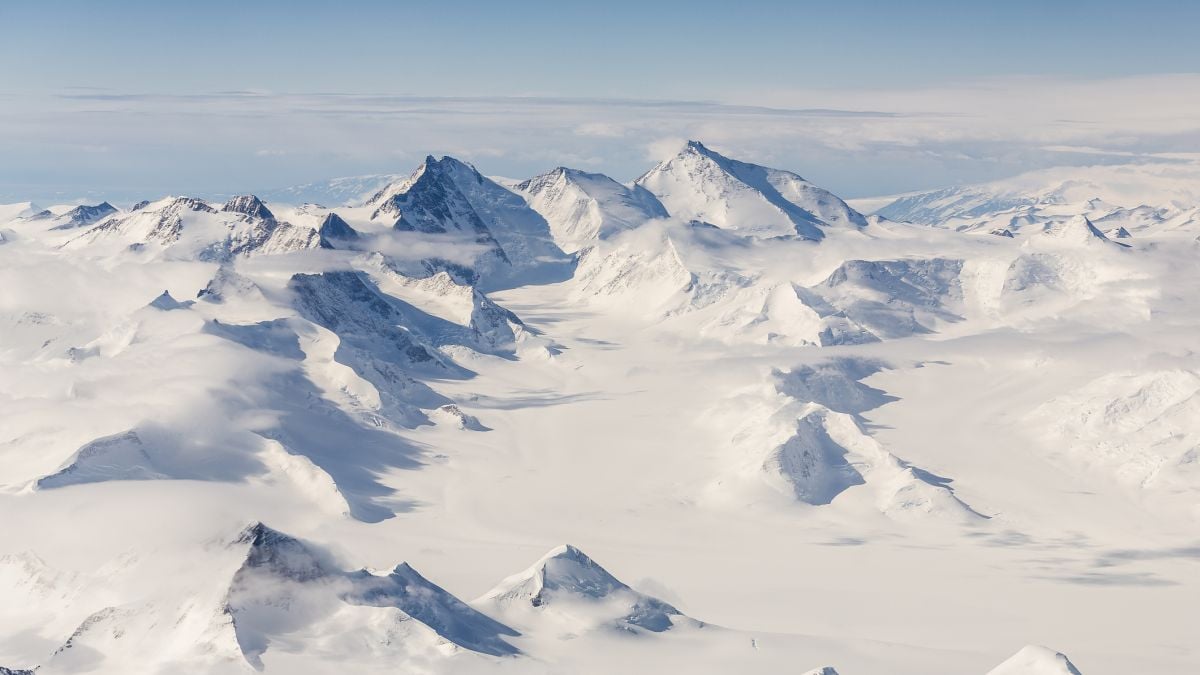
The research team emphasizes that the bedrock topography is not merely a passive floor but an active constraint on the ice. As Nautilus reports, understanding these contours is essential for climate modeling. If researchers cannot accurately map the “towering mountains and plunging chasms” hidden beneath the ice, current projections regarding sea-level rise and ice-sheet stability remain incomplete.
Ice-sheet stability is heavily dependent on the slope and composition of the subglacial floor. Basins that dip toward the continent’s interior, known as retrograde slopes, are particularly susceptible to instability. If warm ocean water reaches the base of an ice sheet resting on such a slope, it can trigger a runaway retreat. By mapping the EAFBP as a continuous, interconnected system rather than a series of isolated pockets, scientists can better predict how subglacial meltwater will drain and whether the ice above these basins is prone to rapid acceleration.
Feature
Geological Context
EAFBP Structure
Fan-shaped network of ~30 basins
Primary Mechanism
Distributed rotational extension
Ice Sheet Coverage
Approximately 10 percent of Earth’s landmass
Primary Influence
Ice-flow direction and subglacial hydrology
The discovery of the EAFBP highlights how much of Earth’s terrestrial history remains obscured. With more than 99 percent of the continent covered by ice, the EAFBP serves as a reminder that the bedrock architecture—shaped millions of years ago—continues to exert a profound influence on the planet’s climate-sensitive regions today. Future research is expected to focus on the precise geodynamic mechanisms that triggered the rotational extension and the exact timeline of the tectonic phases that formed the province. This work marks a significant shift in Antarctic research, moving from localized mapping to a continent-wide understanding of how ancient tectonic history dictates modern environmental stability.
Leo Andersson covers innovation, AI, and cybersecurity. A former engineer turned journalist from Stockholm, Leo has contributed to major tech outlets across Europe. His analytical style and deep understanding of technology trends define Globally Pulse’s forward-looking reporting.