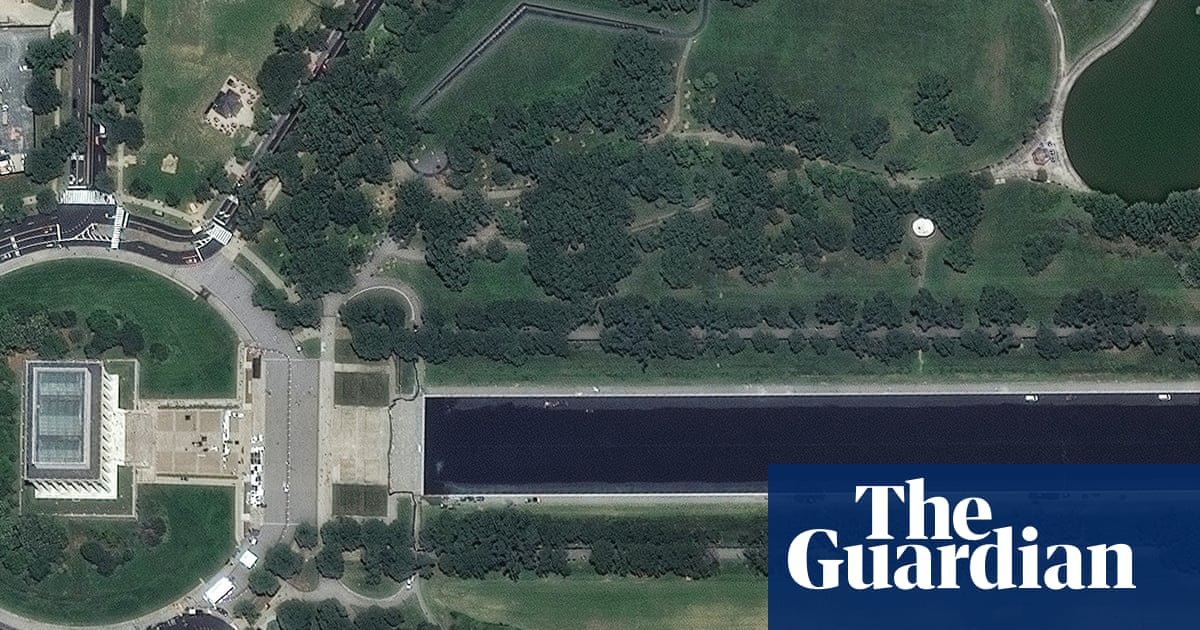
Workers began removing residual algae from the Lincoln Memorial Reflecting Pool on June 10, 2026, just days after a $14.2 million renovation was completed. The Department of the Interior attributed the buildup to dormant supply lines, while public reactions to the project’s high costs and aesthetic results remain divided among Washington visitors.
A $14.2 Million Makeover Under Scrutiny
The Lincoln Memorial Reflecting Pool, a focal point of the National Mall, officially reopened this week following an extensive renovation project. While the Trump administration touted the effort as a necessary upgrade, the final price tag has drawn significant attention. According to The Guardian, the project cost reached $14.2 million, a figure that far exceeds initial estimates. Reports suggest the project began with a calculation of roughly $1.8 million before costs soared past $14 million.
The procurement process for the work also faces questions. The Daily Beast notes that the administration steered a no-bid contract to Atlantic Industrial Coatings Ltd, a Virginia-based firm with experience on the president’s golf resorts but no documented history of government contract work. President Trump defended the selection in April, stating, “I have a guy who’s unbelievable at doing swimming pools,” and claiming the contractor reached out to offer services. Federal contracting rules typically require competitive bidding to ensure taxpayer value and transparency, yet the use of emergency or specialized procurement exemptions can bypass these standard oversight mechanisms.
Algae Removal and Startup Challenges
Within 24 hours of the pool being filled with approximately 6.75 million gallons of fresh water, observers noted workers manually scraping algae from the basin. The Department of the Interior moved to address the optics of the situation, characterizing the growth as a temporary byproduct of the renovation process.

“What you are seeing is residual algae from the supply lines, which have been sitting dormant for eight weeks while construction has been taking place,” Katie Martin, a spokesperson for the US Department of the Interior, told The Guardian.
Martin further described the cleanup as “part of the normal startup process.” To prevent future issues, the National Park Service installed a “state of the art” nanobubbler filtration system. Despite these assurances, the presence of maintenance crews so soon after the project’s completion has fueled public skepticism regarding the effectiveness of the multimillion-dollar investment. The pool, which requires constant water circulation to prevent stagnation and biological growth, relies on complex mechanical systems that must be balanced with the aesthetic requirements of a site visited by millions of people annually.
Public Reception and Mall Vandalism
Visitor reactions to the pool’s new “American flag blue” aesthetic have been mixed. Lara Harvey, a New Zealander residing in Bethesda, told CNN that she was impressed by the appearance. However, local resident Kyra Brown expressed disappointment, stating, “It doesn’t look that much different, honestly, to me.”

The tension surrounding the pool renovation coincided with broader unrest on the National Mall. On June 11, 2026, authorities reported the discovery of the numbers “8647” carved into the grass near the Washington Monument. The Interior Department labeled the incident “deranged vandalism” and confirmed that U.S. Park Police are investigating. While “86” is common slang for removal, the “47” reference underscores the political volatility currently surrounding the administration’s beautification projects.

As the Department of the Interior attempts to stabilize the site, the administration continues to position the pool as a lasting success. “President Donald J Trump is an expert builder who has fixed the Reflecting Pool for good,” Martin said, dismissing earlier attempts at refurbishment by previous administrations as “failed and extremely costly.” The National Mall, managed by the National Park Service, remains one of the most highly trafficked public spaces in the United States, and maintaining the infrastructure of the Reflecting Pool is a perennial challenge due to its size, environmental exposure, and the historical significance of the surrounding monuments.
Find more reporting in our News section.
