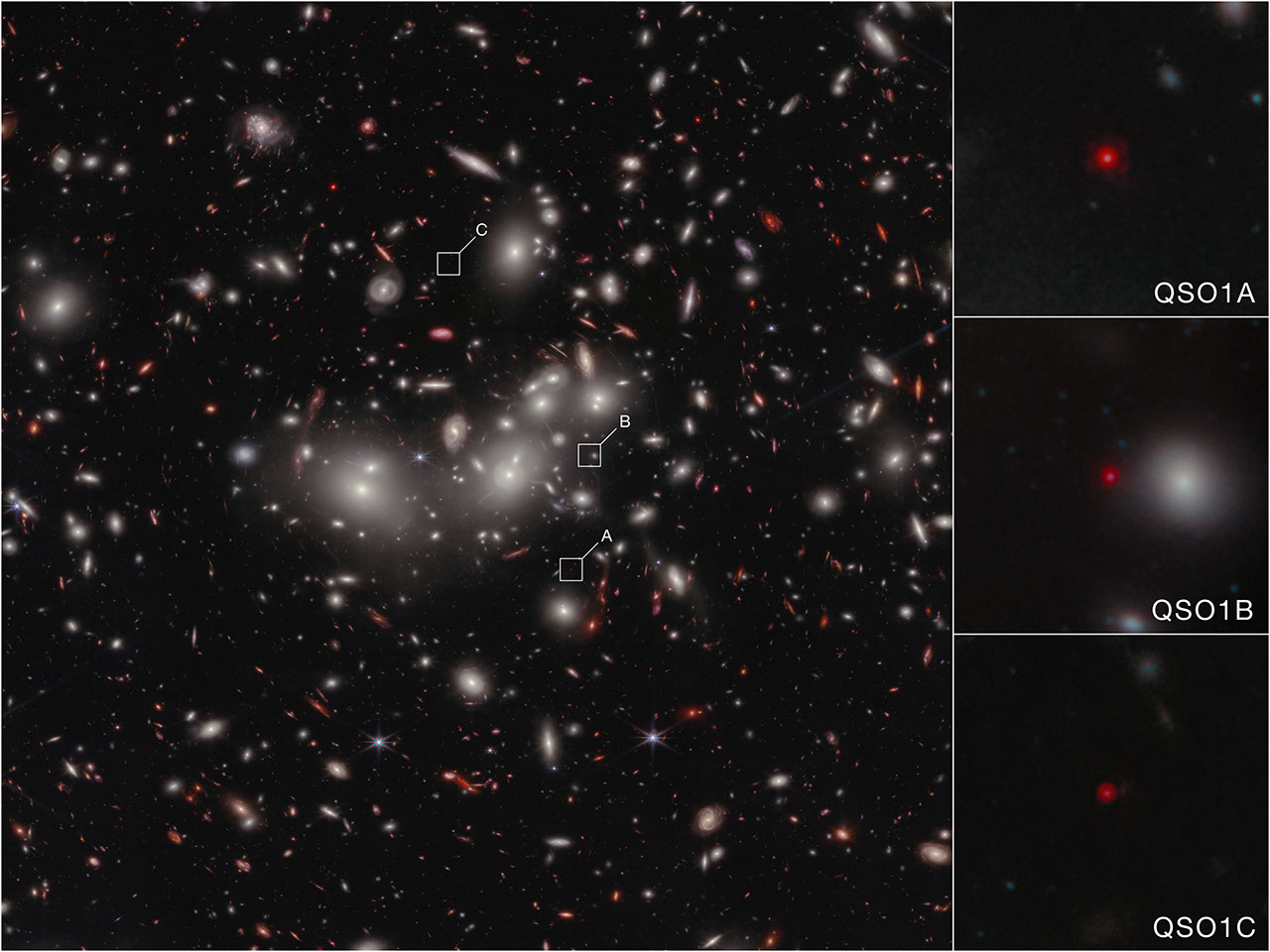
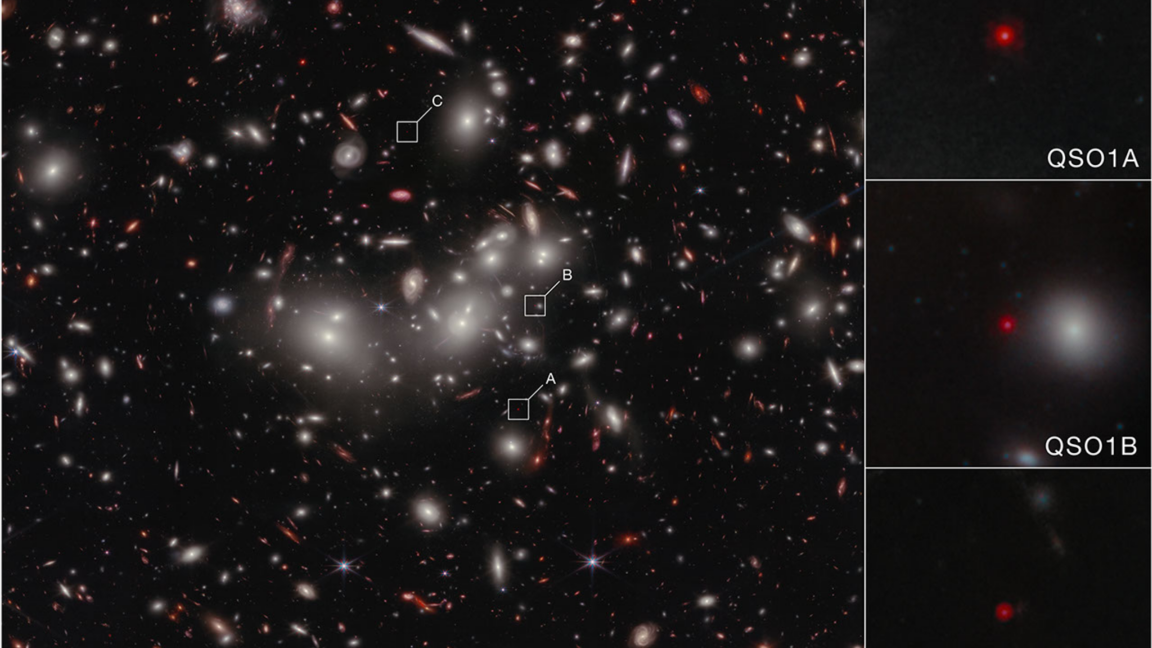
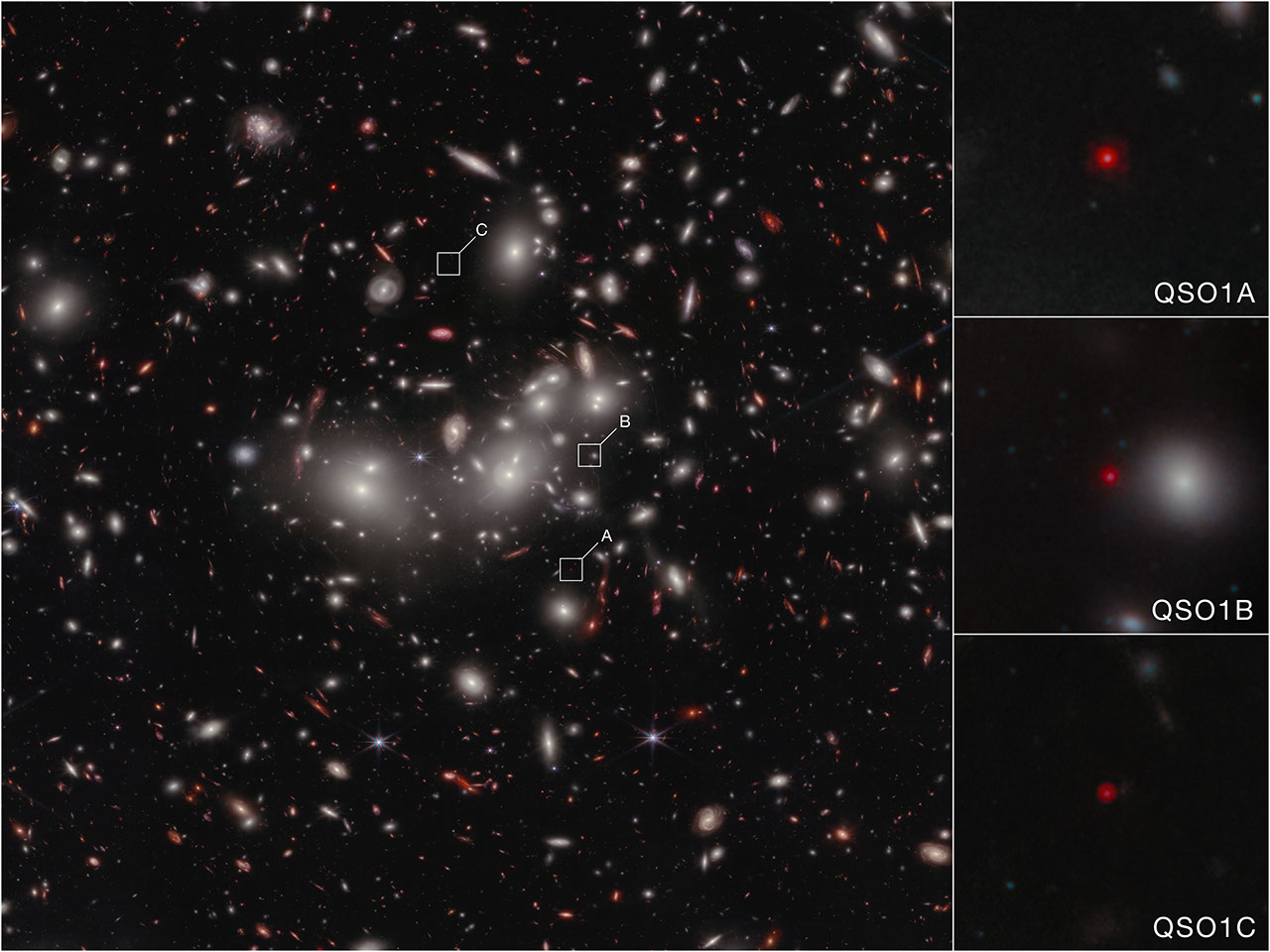
NASA’s James Webb Space Telescope has discovered a supermassive black hole—estimated at 50 million times the Sun’s mass—that appears to have formed before its host galaxy, upending long-held theories about cosmic evolution. The finding, published May 27 in Nature, centers on a compact object called Abell2744-QSO1 (QSO1), a “little red dot” observed just 700 million years after the Big Bang. Unlike typical black holes, which grow within galaxies, QSO1’s black hole dominates its surroundings, with stars contributing less than one-third of the system’s total mass—making it the most “naked” supermassive black hole ever detected.
What the Webb Telescope Revealed: A Black Hole Without a Galaxy
The discovery forces astronomers to confront a fundamental question: Did galaxies form around black holes, or did black holes form first? For decades, the prevailing model assumed that supermassive black holes grew gradually, fed by gas and stars within existing galaxies. But QSO1 defies this narrative. Its black hole—estimated at 50 million solar masses—dwarfs the combined mass of any stars in its vicinity, suggesting it may have formed independently, perhaps from the direct collapse of primordial gas clouds or even remnants of the Big Bang itself.
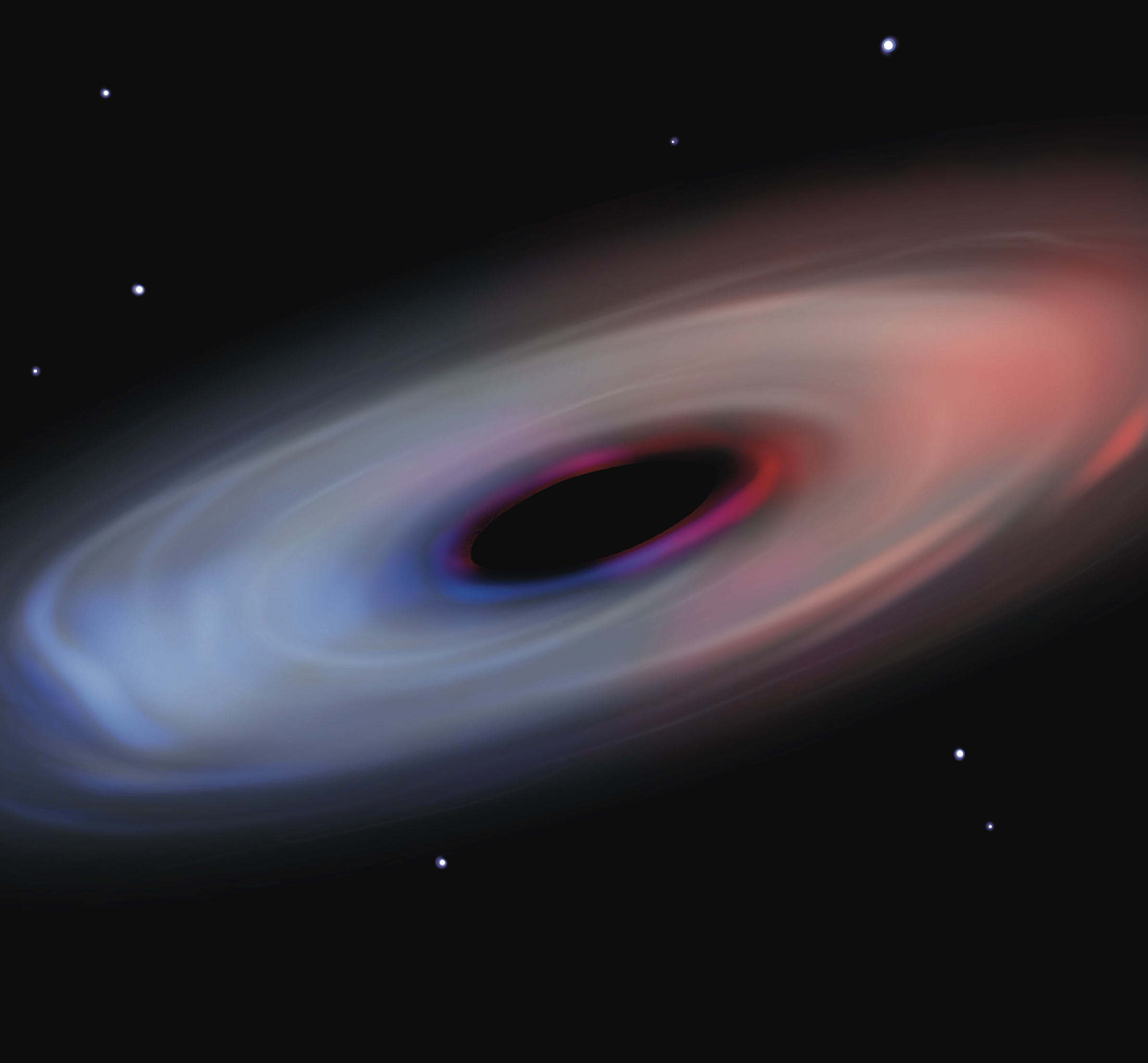
According to NASA’s Webb team, the black hole’s mass was measured directly for the first time using the telescope’s Near Infrared Spectrograph (NIRSpec). Previous estimates, based on indirect methods calibrated for modern galaxies, had placed QSO1’s black hole at around 40 million solar masses—but those relied on assumptions that may not apply to the early universe. The new measurement, tracing the gravitational influence of the black hole on surrounding gas, confirms the higher mass and rules out significant stellar contributions.
“This is a remarkable finding,” said Roberto Maiolino of the University of Cambridge, a co-author of the study. “It’s a paradigm shift, a total revisiting of the classical scenarios of how black holes form and grow.” The team’s work, published alongside a companion paper in The Monthly Notices of the Royal Astronomical Society, argues that QSO1’s black hole could not have formed through traditional stellar collapse or mergers—leaving only two radical possibilities: primordial black holes formed in the universe’s infancy, or direct collapse of massive gas clouds that bypassed star formation entirely.
The “Little Red Dot” Phenomenon: Why QSO1 Stands Out
“Little red dots” (LRDs) are among the most perplexing discoveries from the James Webb Space Telescope. First identified in 2023, these compact, red-shifted objects appear as tiny specks in Webb’s deep-field images, yet their spectra suggest they host actively feeding black holes—despite their minuscule size. QSO1, in particular, is magnified sixfold by gravitational lensing from the galaxy cluster Abell 2744, allowing astronomers to study it in unprecedented detail.
What makes QSO1 extraordinary is its lack of a galaxy. Most supermassive black holes reside at the centers of galaxies, where they grow alongside their host. But QSO1’s black hole accounts for over two-thirds of the system’s total mass, with stars contributing less than 20 million solar masses—far less than the black hole itself. As Ars Technica reports, this “naked” black hole challenges the idea that galaxies are necessary for black hole formation.
The team’s analysis rules out runaway mergers as a formation mechanism, since QSO1 lacks the dense stellar clusters required for repeated black hole collisions. This leaves two speculative pathways: primordial black holes, which could have formed from extreme density fluctuations in the early universe, or direct collapse of gas clouds into black holes without an intermediate stellar phase. Both scenarios require conditions far more extreme than those in the modern universe.
Expert Reactions: A “Stranger World” Ahead?
The findings have sparked debate among astronomers. Jenny Greene, an astrophysicist at Princeton University, called the results “very important” but noted their potential to reshape cosmic history. “If everything in this paper is true at face value, then we are living in a stranger world,” she told Scientific American. “That’s why this is very important.”
Greene’s caution reflects broader skepticism about the initial mass estimates of LRDs. Earlier studies used indirect methods—such as measuring the luminosity of gas around black holes—to estimate their masses. But these techniques assume that early black holes behave like their modern counterparts, an assumption now called into question. The Webb team’s direct measurement of QSO1’s mass, using the rotation of surrounding gas, provides the first robust test of these methods in the early universe.
“Before now, all of the mass measurements of black holes in the early universe have been indirect,” said Francesco D’Eugenio of the University of Cambridge. “We didn’t know if those assumptions really apply to the distant universe.” The new data suggest they don’t—at least not for QSO1.
What This Means for Cosmology: A Black Hole “Before Its Time”
The implications of QSO1’s discovery extend beyond black hole formation. If supermassive black holes can form independently of galaxies, it could rewrite the timeline of cosmic structure. Galaxies are thought to assemble hierarchically, with smaller structures merging over billions of years. But if black holes like QSO1 formed first, they might have acted as gravitational seeds, pulling in gas and stars to form galaxies around them—a reversed version of the standard model.
This scenario aligns with some theoretical models of the early universe, where primordial density fluctuations could have spawned black holes directly. However, as Live Science notes, the most plausible explanation for QSO1’s mass—primordial black holes growing by a factor of 10 in just 700 million years—would require rapid mergers among a population of early black holes. Without more examples, this remains speculative.
The Webb team’s study also highlights the telescope’s unique ability to probe the early universe. Gravitational lensing, which magnified QSO1 by a factor of six, was critical to resolving its structure. Without this effect, QSO1 would have been invisible to even the most powerful telescopes. Future observations of other LRDs could provide more data points—but for now, QSO1 stands as the most extreme case yet.
What Happens Next: The Search for More “Naked” Black Holes
The discovery of QSO1 is unlikely to be the last of its kind. Webb’s deep-field surveys have already turned up dozens of LRDs, and follow-up studies will attempt to measure their masses directly. If other “naked” black holes are found, it could confirm that QSO1 is not an anomaly but a glimpse into a common phase of cosmic evolution.
For now, the question remains: Did QSO1’s black hole form first, or is it an exception? The answer may lie in the details of its formation. If primordial black holes are confirmed, it would support theories that black holes can arise from quantum fluctuations in the early universe. If direct collapse is the culprit, it would require conditions far more extreme than those in modern star-forming regions.
One thing is certain: QSO1 has already forced astronomers to rethink the relationship between black holes and galaxies. As Maiolino put it, “This is a total revisiting of the classical scenarios.” The Webb telescope’s next observations will be critical in determining whether QSO1 is a lone oddity—or the first of many black holes that defy the rules of cosmic evolution.
The stakes are high. If QSO1’s black hole is confirmed to have formed independently, it could mean that the universe’s first light sources were not stars—but black holes.
