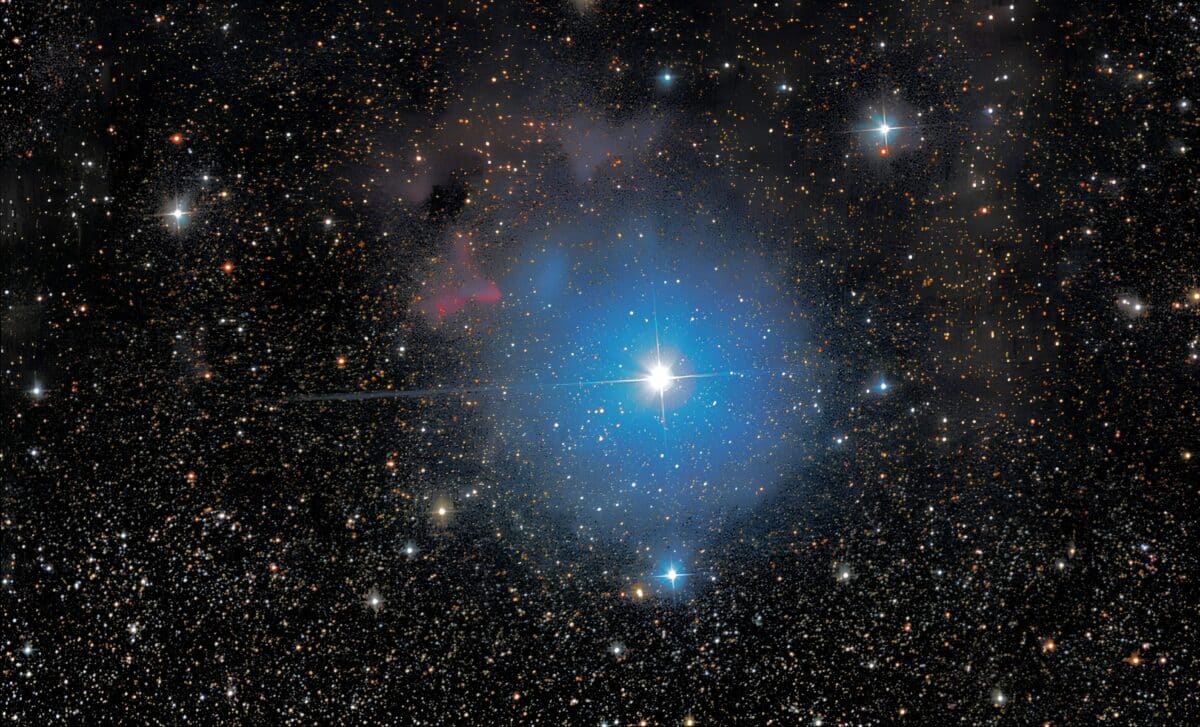
Astronomers have finally identified the source of the mysterious X-ray emissions from Gamma Cassiopeiae, a star in the constellation Cassiopeia that has baffled scientists since 1866. A new review paper confirms the star is part of a binary system, with a hidden white dwarf companion feeding on ejected disc material from the primary star.
A 160-Year-Old Astronomical Puzzle
cluster (priority): aol.com
For over a century and a half, Gamma Cassiopeiae—the 63rd brightest star in the night sky—defied standard classification. The mystery dates back to 1866, when Italian astronomer Angelo Secchi observed the star’s spectra and noticed that its hydrogen emissions were dark rather than bright. Secchi, a pioneer who studied the spectra of approximately 4,000 stars, established an entirely new category to accommodate this anomaly: the Be star, where B represents the star’s temperature and e denotes the presence of hydrogen emission lines.
As reported by India Defence Review, the nature of these stars remained elusive for generations. Astronomers eventually determined that Be stars rotate at extreme velocities, typically between 70 to 80 percent of the speed that would cause the star to disintegrate. This rapid rotation flings gas from the equator, creating a surrounding disc. While roughly 20 percent of B-type stars fall into this category, Gamma Cassiopeiae consistently exhibited behavior that pushed the limits of existing models.
The Soviet-Era Breakthrough and Modern Confirmation
cluster (priority): littleastronomy.com
The path to solving the mystery involved a significant contribution from mid-20th-century Soviet scientists, including A.A. Boyarchuk and V.G. Gorbatskii. During a period of high variability in the star’s brightness and temperature, these researchers modeled the disc surrounding Gamma Cassiopeiae not as a uniform envelope, but as a collection of individual gas blobs.
According to AOL, this foundational research remained largely inaccessible to Western scientists for decades because it was published exclusively in Russian. A new review paper, authored by researchers at Russia’s Pulkovo Observatory and St. Petersburg University and published in the journal Galaxies, has now brought these findings to an English-speaking audience for the first time.
The stakes of the mystery escalated in 1976, when satellite observatories revealed that the star was emitting high-energy X-rays at a rate hundreds of times higher than typical Be stars. The plasma responsible for these emissions reached temperatures as high as 150 million degrees Celsius. This intensity led scientists to hypothesize the existence of a compact companion, such as a neutron star or a white dwarf, capable of stripping material from the primary star’s disc.
The Role of White Dwarfs in Stellar Evolution
The mystery of the star Gamma Cassiopeiae finally solved
The identification of this companion as a white dwarf provides a critical link in understanding stellar life cycles. A white dwarf is the remnant of a low or medium-mass star, typically one with a mass less than eight times that of our Sun. While these objects are roughly the mass of the Sun, they are compressed into a volume only slightly larger than Earth, making them among the densest forms of matter in the universe.
As noted by NASA’s Imagine the Universe, the balance between gravity and internal pressure is the defining factor in a star’s evolution. When a star exhausts its hydrogen, it collapses, heats up, and eventually expands into a red giant before shedding its outer layers to leave behind a white dwarf core. The discovery at Gamma Cassiopeiae confirms that when such a remnant exists in a binary pair, the gravitational interaction can result in the violent consumption of the primary star’s disc material, producing the intense X-ray signatures that haunted astronomers for decades.
Future Implications for Binary Star Research
cluster (priority): news.google.com
The resolution of the Gamma Cassiopeiae mystery is expected to influence how researchers approach similar binary systems. Astronomers are now hopeful that this new understanding will clarify why such binary pairs are not observed more frequently. By bridging the gap between historical Soviet modeling and modern X-ray observations, this research provides a clearer framework for studying the complex, variable nature of Be stars.
As Sky at Night Magazine emphasizes, the history of astronomy is fundamentally an accumulative process where each generation builds upon the successes and mistakes of those who came before. The identification of this white dwarf companion serves as a testament to the persistence of the scientific community in reconciling 19th-century observations with the high-energy data provided by modern space telescopes.
Leo Andersson covers innovation, AI, and cybersecurity. A former engineer turned journalist from Stockholm, Leo has contributed to major tech outlets across Europe. His analytical style and deep understanding of technology trends define Globally Pulse’s forward-looking reporting.