
Tonight, May 19, 2026, the waxing crescent Moon will align between Venus and Jupiter in the western sky after sunset, creating a rare celestial spectacle visible worldwide with the naked eye.
A Celestial Alignment: Moon, Venus, and Jupiter Converge
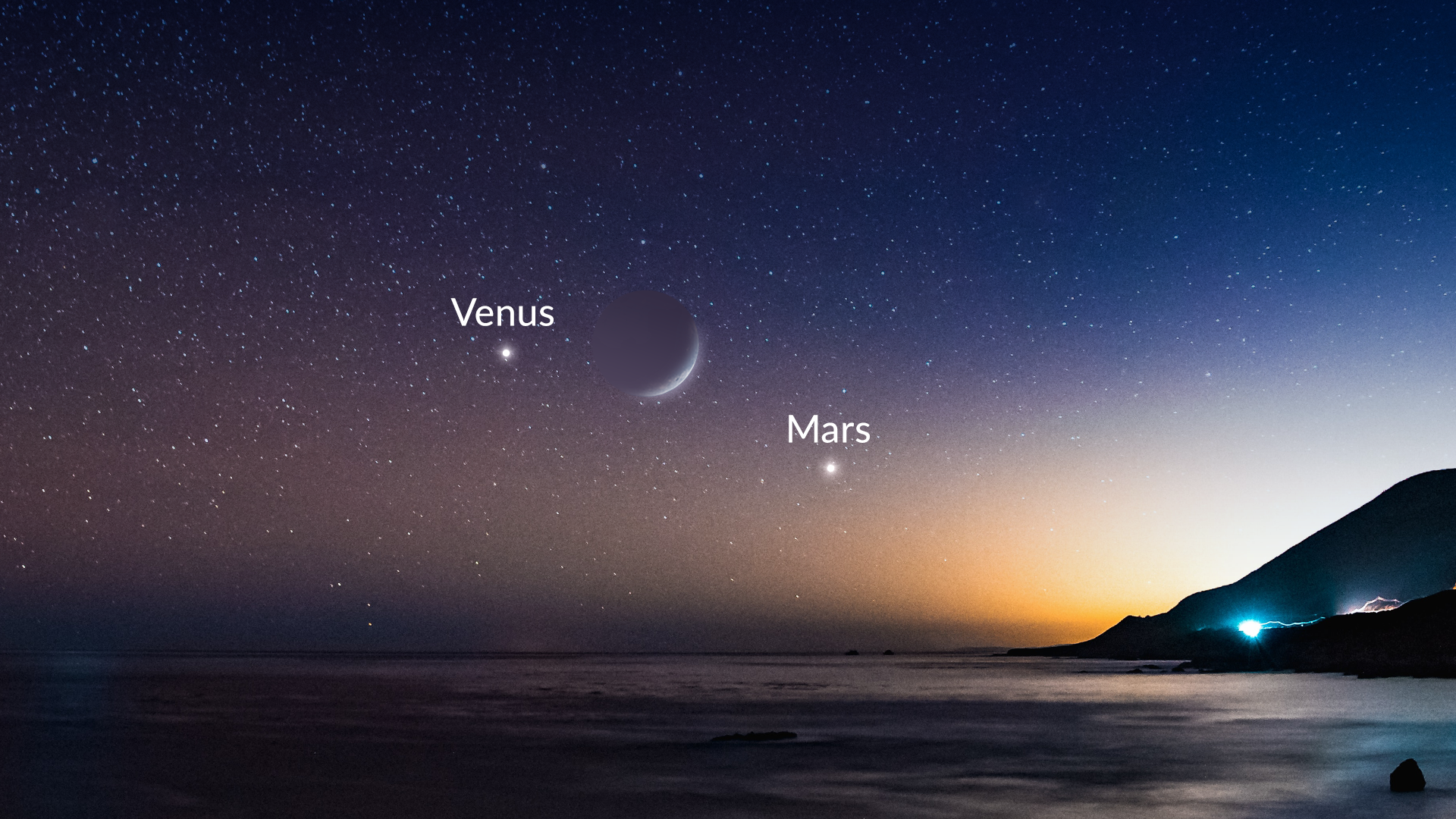
The night sky is offering a rare treat this week as the crescent Moon drifts between Venus and Jupiter, two of the brightest planets visible from Earth. Tonight, the trio will form a striking triangular formation low in the western sky just after sunset, according to verified astronomical observations. This alignment is not merely a coincidence but a predictable celestial dance, with the Moon’s orbit carrying it past the planets in a sequence that repeats with each lunar cycle.
Venus, often called Earth’s “twin” due to its comparable size and composition, will appear low on the horizon, while Jupiter, the solar system’s largest planet, will shine higher above it. The crescent Moon, just a few days past new moon, will act as a luminous guidepost between the two, creating a visually striking tableau. Astronomers emphasize that this alignment is particularly favorable for observers with clear western horizons, as the planets and Moon will set shortly after twilight.
Why This Week’s Alignment Stands Out
While planetary alignments occur regularly, the proximity of the Moon to Venus and Jupiter this week is noteworthy for its accessibility. Unlike some celestial events that require telescopes or specialized equipment, this spectacle is visible to the naked eye under clear skies. The Moon’s crescent phase adds a dramatic contrast, making the planets’ brightness stand out against the fading twilight.
According to Sky at Night Magazine, the Moon will pass Venus on the evening of May 18 and then drift toward Jupiter by May 19, creating a dynamic shift in the sky over just 24 hours. The magazine notes that Venus and Jupiter are the most prominent planets in the May 2026 sky, with Venus appearing as a brilliant white point near the horizon and Jupiter as a slightly dimmer but still vivid yellowish “star” higher in the sky.
This alignment is part of a broader celestial trend: Venus and Jupiter are gradually converging, culminating in their closest approach—a conjunction—on June 9, 2026. Tonight’s display offers a preview of that event, with the Moon serving as a temporary marker in the sky.
How to Observe the Spectacle
To witness the alignment, observers should face west shortly after sunset, when the sky is still bright but the planets and Moon are visible. The key to success is a clear, unobstructed horizon, as Venus and the Moon will be low in the sky. Binoculars or a small telescope can enhance the view, revealing details such as Jupiter’s four largest moons or Venus’s gibbous phase, though these are not necessary for the naked-eye experience.
Photographers will find this event particularly rewarding. The contrast between the thin crescent Moon, Venus’s brilliance, and Jupiter’s steady glow creates a compositional opportunity. Astrophotographers in locations like Philadelphia and Copperopolis, California, have already captured striking images of the alignment, as documented by Sky at Night Magazine and shared on social media platforms.
For those in urban areas where light pollution may obscure fainter stars, the planets and Moon will still be visible due to their intrinsic brightness. However, rural or suburban locations with darker skies will offer the best conditions for observing additional details.
Scientific Context: The Mechanics Behind the Alignment
The alignment is a result of the relative positions of Earth, the Moon, Venus, and Jupiter in their orbits. The Moon, orbiting Earth every 27.3 days, frequently passes near planets in the sky due to its rapid motion. Venus, with its 225-day orbit around the Sun, and Jupiter, with its 12-year orbit, appear to move slowly against the backdrop of stars from Earth’s perspective.
Tonight’s alignment is particularly close because the Moon’s orbit is inclined relative to Earth’s orbit around the Sun, allowing it to pass near planets at varying distances. Venus’s current position low in the western sky after sunset coincides with Jupiter’s higher elevation, creating the triangular formation. This configuration is not unique but is especially photogenic due to the Moon’s crescent phase and the planets’ brightness.
Astronomers note that while such alignments are common, the combination of a thin crescent Moon and two of the brightest planets in the sky makes this event stand out. It serves as a reminder of the dynamic nature of our solar system, where celestial bodies move in predictable yet visually captivating patterns.
What Comes Next: The Venus-Jupiter Conjunction
Tonight’s alignment is just the beginning of a month-long celestial show. Over the coming weeks, Venus and Jupiter will continue to draw closer in the sky, reaching their closest conjunction on June 9, 2026. During this event, the two planets will appear separated by less than the diameter of the Moon, a sight that has captivated stargazers for centuries.
While tonight’s event is accessible to casual observers, the June conjunction will require more precise timing and conditions. The planets will be lower in the sky and may be harder to spot in urban areas. However, tonight’s alignment offers an opportunity to practice locating Venus and Jupiter, ensuring that observers are ready for the grand finale.
For those interested in tracking the planets’ movements, astronomical apps and websites such as Sky at Night Magazine and NASA’s Solar System Ambassadors provide real-time updates and viewing tips. The alignment also serves as a reminder of the broader accessibility of astronomy: no telescope or advanced knowledge is required to appreciate the beauty of our solar system.
A Spectacle for All
Tonight’s celestial alignment is more than just a visual treat—it is a demonstration of the predictability and grandeur of the universe. Whether observed through a telescope, binoculars, or simply the naked eye, the sight of the Moon between Venus and Jupiter offers a moment of connection between Earth and the cosmos.
As the planets and Moon set in the west, they leave behind a reminder that the universe is not static but a dynamic stage where celestial bodies perform their age-old ballet. For now, the show is on tonight, and all that is required is a clear sky and a moment of curiosity.
