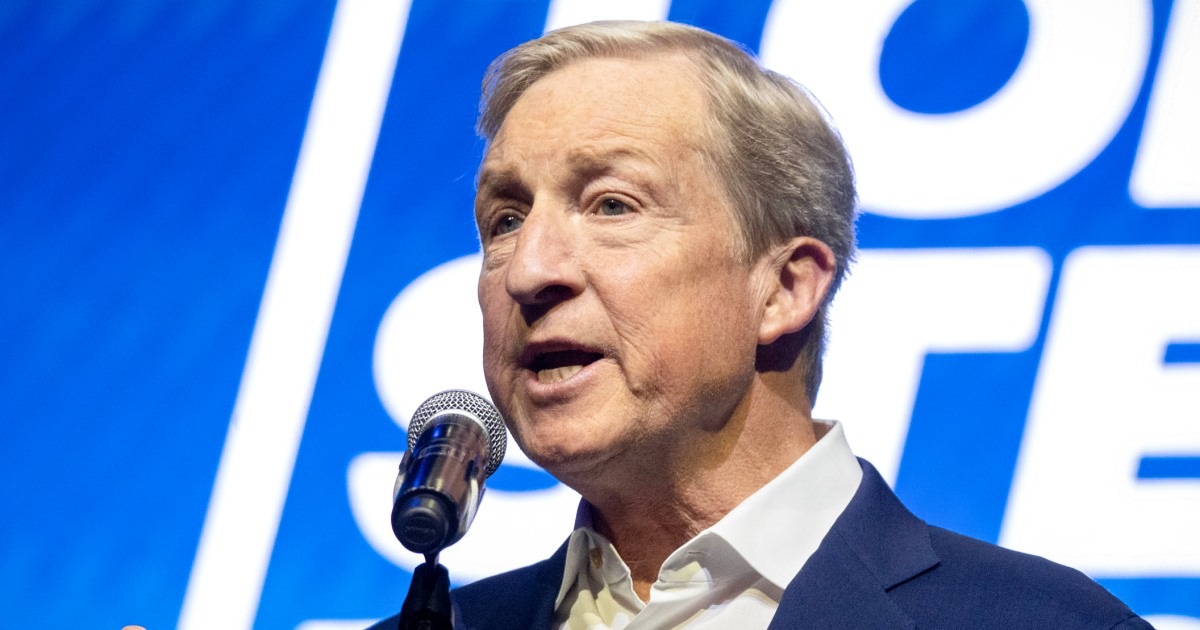
Billionaire climate activist Tom Steyer failed to qualify for California’s gubernatorial runoff after spending more than $200 million of his own fortune on the race. As of Wednesday, June 10, 2026, official results show Steyer trailing both Democrat Xavier Becerra and Republican Steve Hilton, marking the second time he has lost a major campaign despite record-setting personal expenditures.
A Record-Breaking Primary Defeat
Tom Steyer’s bid for the California governorship ended in a third-place finish, according to the latest vote tallies reported by The Desert Sun. With the state’s open primary system sending only the top two candidates to the general election, Steyer’s 22.4% share of the vote proved insufficient to overtake Republican Steve Hilton, who held 25.1%, and Democrat Xavier Becerra, who led with 27.7%.

The financial scale of the campaign was unprecedented. According to NBC News, Steyer contributed more than $215 million of his own capital to the effort. This spending allowed his campaign to dominate the airwaves, accounting for roughly two-thirds of all gubernatorial ad spending in the state. Data from the ad-tracking firm AdImpact indicates that Steyer poured $209 million into television advertisements alone, far outpacing the $11.7 million spent by Becerra, the candidate with the next-highest advertising budget.

The sheer volume of capital injected into the race transformed the campaign landscape, forcing other candidates to adapt their strategies to compete with a constant barrage of media messaging. In California’s top-two primary system—established by voters in 2010—the primary serves as a single, nonpartisan contest where the two candidates with the most votes advance, regardless of party affiliation. Because the system allows two candidates from the same party to advance, Steyer’s failure to surpass both Becerra and Hilton effectively ended his candidacy in a state where Democrats hold a significant registration advantage.
The Political Perils of Self-Funding
Political analysts suggest that Steyer’s immense wealth functioned less as a strategic advantage and more as a liability. In an analysis for the Los Angeles Times, veteran campaign strategist Dan Schnur noted that voters often view massive self-funding as a barrier to empathy. Focus groups frequently questioned how a candidate with tens of millions of dollars at their disposal could identify with the financial pressures facing average families.
For more on this story, see DOJ Announces Probe into Election Fraud Claims in California.
This skepticism is a recurring theme for self-funded candidates in California. Historical data shows a long line of wealthy individuals who attempted to enter public office through personal wealth—including Al Checchi, Meg Whitman, and Carly Fiorina—only to be defeated by traditional political figures. During the 1998 gubernatorial primary, Checchi spent $40 million, yet lost to Gray Davis, who spent only $9 million on his own campaign. The pattern suggests that while financial resources provide the means to build name recognition and infrastructure, they cannot necessarily manufacture the grassroots enthusiasm or personal narrative required to mobilize a wide electorate.
Controversies and Campaign Scrutiny
Beyond the optics of his wealth, Steyer faced significant criticism regarding the origins of his fortune. As reported by Forbes, opponents targeted his past investments through Farallon Capital, specifically regarding coal mining and private prisons.
“I deeply regret that Farallon made that investment, and I personally ordered the investment in CCA to be sold because it did not accord with my values then or now.” — Tom Steyer, hedge fund founder
Despite these attempts to address past holdings, the narrative of his wealth remained a central point of attack. Former Democratic rival Katie Porter accused Steyer of attempting to “buy the governor’s office,” while other critics highlighted his lack of prior public service as a disqualifying factor for voters looking for a candidate with a proven track record. The criticism was compounded by the fact that Steyer’s climate activism, while a cornerstone of his public identity, was frequently contrasted by opponents with the historical carbon-intensive investments of his former hedge fund.
What Comes Next in the Vote Count
While the race has been called, the final margin remains subject to the remaining uncounted ballots. As of June 9, approximately 1.7 million ballots were still being processed across the state. Christian Grose, a professor of political science at the University of Southern California, observed that while Steyer’s path to the general election is “not impossible,” it remains “narrow.”

The slow pace of the count is standard for California, which utilizes a widespread mail-in ballot system. Under California election law, ballots postmarked by Election Day are eligible to be counted if they arrive within a specific window, leading to a “late-count” trend that often shifts results in the days following the primary. County election officials are currently tasked with verifying signatures and processing thousands of provisional ballots.
The Steyer campaign has signaled it will wait for the full count to conclude. Campaign manager Heather Hargreaves noted in a letter to supporters that official results are still fluctuating, as county election offices continue to validate ballots. However, experts like Schnur remain skeptical of a late-stage reversal, noting that Steyer’s chances appear to be “shrinking fairly rapidly” as the remaining votes are tabulated. The outcome of this race now leaves the Democratic party to focus its resources on Xavier Becerra as he prepares for the general election showdown against Steve Hilton, signaling a shift in the state’s political strategy regarding high-spending, self-funded candidates.
