The outbreak of Bundibugyo virus disease (BVD) has spread rapidly across the Democratic Republic of the Congo and into neighboring Uganda, with 534 confirmed cases and 93 deaths reported as of 6 June 2026. Health authorities have officially declared the situation a public health emergency, as international partners scramble to mobilize US$ 518 million for a continental response.
Rapid Escalation in the Democratic Republic of the Congo
The situation in the Democratic Republic of the Congo (DRC) has evolved significantly since the first suspected case was reported on 24 April 2026. According to the World Health Organization (WHO), confirmed cases reached 515 in the DRC by 6 June, with 91 deaths. This sharp increase in recorded figures is partially attributed to expanded testing capacity, which allowed officials to process a backlog of samples that had previously gone untested.

The virus has proved geographically dispersive, affecting 25 health zones across Ituri, North Kivu, and South Kivu provinces. Ituri remains the epicenter, accounting for 94% of the DRC’s confirmed cases. Operational challenges are mounting, however, as security incidents near health facilities frequently disrupt access for response teams and medical supplies. In areas like Bunia, Rwampara, and Mongbwalu, the scale of the outbreak has required the deployment of thousands of community mobilizers and specialized personnel to manage contact tracing and isolation efforts.
Dr. Jean Kaseya, Director-General of the Africa Centres for Disease Control and Prevention (Africa CDC), stated in a 7 June press briefing that the logistical footprint of the response is constrained by the “porous nature of transit hubs” in the eastern DRC. The agency’s field teams report that current surveillance is hampered by a lack of real-time digital reporting tools in rural health zones, leading to a lag between patient presentation and laboratory confirmation. The Ministry of Health in the DRC has requested that international partners prioritize the shipment of mobile diagnostic laboratories to reduce the turnaround time for RT-PCR testing, which currently averages 48 to 72 hours for remote sites.
Cross-Border Transmission and Regional Preparedness
Uganda is now managing its own confirmed cases, with ReliefWeb reporting that the disease was introduced by a 59-year-old traveler treated in Kampala. The high level of population mobility—driven by trade networks and mining activities—has made the border region a primary area of concern for epidemiologists.

Uganda’s Ministry of Health, led by Dr. Jane Ruth Aceng, has activated the National Task Force to oversee screening at 14 designated points of entry along the DRC border. Clinical guidance issued by the Ugandan health authorities on 3 June mandates that all travelers presenting with temperatures exceeding 38.0°C be placed in temporary isolation and tested via rapid diagnostic assay. Surveillance data indicates that over 12,000 individuals have been screened at the Mpondwe border post since the declaration of the emergency, though health officials acknowledge that informal crossings—often used by traders to bypass regulated checkpoints—remain a significant “blind spot” in the containment strategy.
For more on this story, see Bundibugyo Ebola Outbreak Surpasses 1,100 Cases in Africa-Global Fears Grow.
- Continental Action: On 5 June, the Africa Centres for Disease Control and Prevention (Africa CDC) and the WHO launched a joint preparedness plan, requesting US$ 518 million.
- Financial Gap: UNICEF is specifically appealing for US$ 70.7 million to support its six-month response plan; while US$ 53.3 million has been mobilized to date, a funding gap of US$ 17.4 million remains.
- Local Readiness: Countries like Rwanda have initiated volunteer training and surveillance enhancements in border districts, citing their proximity to the outbreak as a significant risk factor, according to data from recent DREF operations.
Molecular Insights into Viral Spread
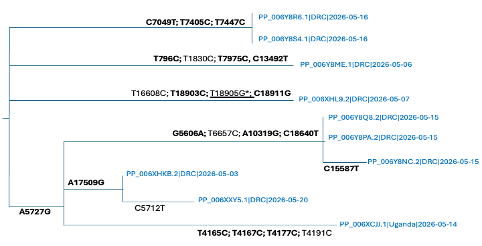
Preliminary molecular evolutionary analysis suggests the outbreak has been circulating longer than initial reports indicated. Researchers analyzing 10 sequences collected as of 28 May 2026 found that the sampled viruses share a most recent common ancestor from early-to-mid March 2026, according to analysis published on Virological. The presence of 23 unique mutations within that small sample size indicates that the virus was likely spreading undetected for several weeks before the first official declaration.
The estimated reproduction number (R0) is currently calculated between 1.31 and 1.55, suggesting ongoing transmission. However, experts emphasize that these figures should be interpreted with caution due to the limited number of sequences available and the high degree of uncertainty in current field sampling. Dr. Oliver Brady of the London School of Hygiene & Tropical Medicine noted in a peer-reviewed advisory that while the current R0 suggests a controlled spread, the estimate is sensitive to the “ascertainment bias” inherent in outbreaks where mild cases may not be captured in the denominator. Consequently, the data cannot be used to predict the eventual peak of the outbreak, as the current model does not account for potential changes in human behavior or the impact of ongoing social distancing interventions.
Operational Challenges and Treatment Limitations
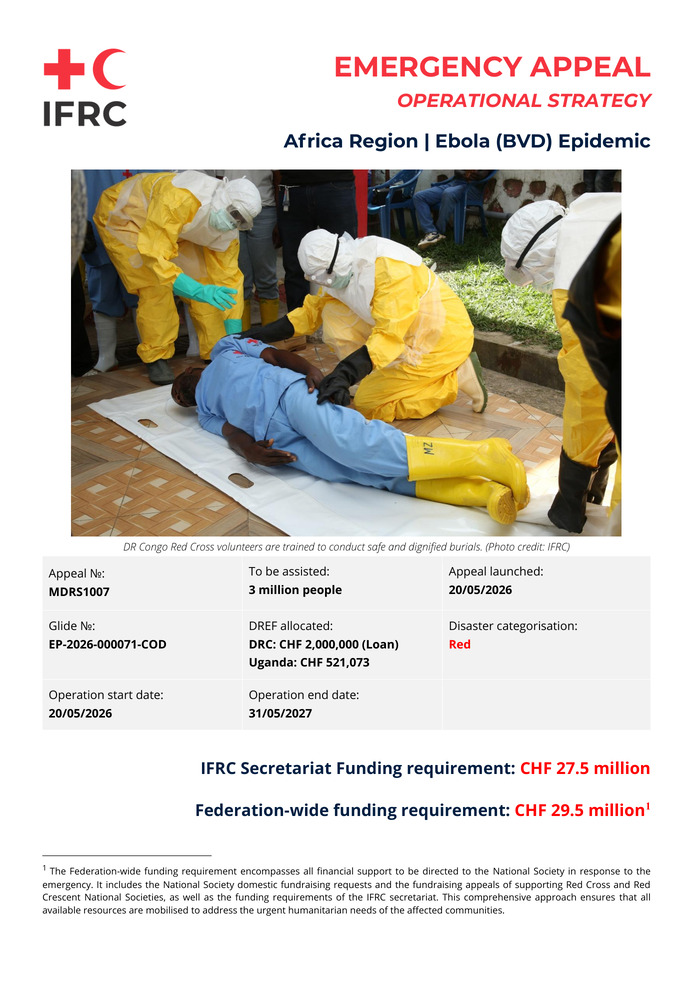
A critical hurdle in the current response is the lack of a widely available, licensed vaccine or specific targeted treatment for the Bundibugyo strain. This distinguishes the current emergency from previous outbreaks of other Ebola variants. Consequently, the response relies heavily on foundational public health measures, including safe burials and aggressive contact tracing.
Clinical management is currently limited to supportive care, which focuses on fluid resuscitation, electrolyte balancing, and the management of secondary infections. The WHO’s Clinical Management Team has advised that treatment centers should prioritize early initiation of intravenous hydration, as dehydration is a primary driver of mortality in BVD cases. While experimental therapeutics used in previous Zaire ebolavirus outbreaks are being evaluated for compassionate use, the regulatory body for the DRC, the Institut National de Recherche Biomédicale (INRB), has confirmed that no clinical trials for BVD-specific monoclonal antibodies have been authorized at this time.
UNICEF has reported that 24 teams have been deployed to manage the containment of the virus. These specific units, known as “Decontamination Teams,” are tasked with disinfecting high-risk areas to prevent further environmental transmission. UNICEF, via Flash Update No. 2, emphasizes that these teams are operating under strict safety protocols to mitigate exposure risks to staff.
Despite the grim statistics, there are signs that early intervention is effective. As of 5 June, several patients have been successfully discharged from treatment centers in both the DRC and Uganda. As UNICEF noted in its latest flash update, when patients seek care, lives can be saved. Public health officials continue to urge community members to report symptoms immediately, as trust in health providers remains a fragile but essential component of the ongoing containment effort. Readers who have concerns regarding potential exposure or who are experiencing symptoms should contact their local Ministry of Health hotline or consult with a qualified medical professional for guidance on screening and isolation protocols.
