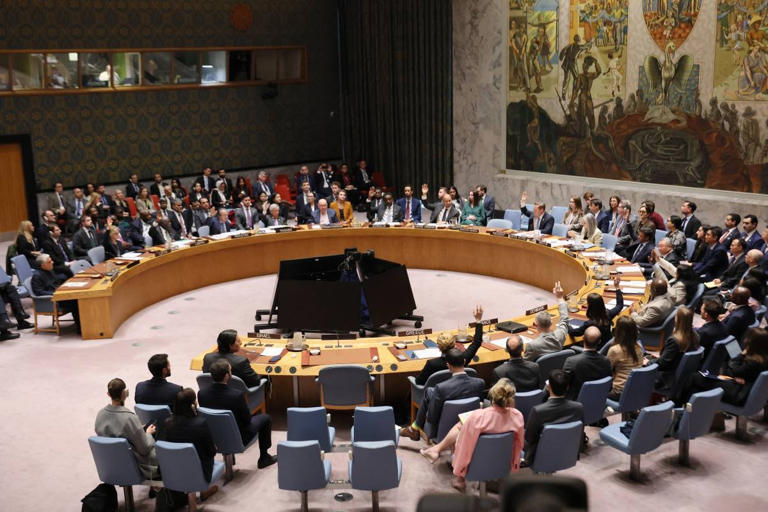
United States Secretary of State Marco Rubio announced Friday, May 29, 2026, that international efforts are underway to secure a United Nations Security Council resolution aimed at addressing threats to commercial shipping in the Strait of Hormuz. The diplomatic push seeks to establish a consensus regarding the vital waterway.
Diplomatic Standoff at the United Nations
As of late May 2026, the United Nations Security Council is considering a draft resolution introduced by Bahrain. The measure demands that Iran cease threats and attacks against vessels navigating the Strait of Hormuz and end hostilities directed at Persian Gulf states. The proposal specifically addresses the deployment of sea mines and Iran’s attempts to implement a tolling system for commercial vessels utilizing the international passage.
According to documents circulated among Security Council members, the draft resolution explicitly calls for the “immediate cessation of all non-consensual vessel inspections” and demands the removal of any infrastructure installed by the Islamic Revolutionary Guard Corps (IRGC) to levy transit fees. A senior advisor to the Bahraini mission at the UN confirmed that the text was finalized following a series of closed-door consultations held at the UN headquarters in New York throughout the final week of May.
Secretary of State Marco Rubio, speaking to journalists prior to a NATO foreign ministers’ meeting in Sweden, stated that the draft has secured the highest number of co-sponsors for any resolution ever presented to the council. Despite this support, the resolution faces potential obstruction.
Unfortunately, a couple of countries on the Security Council are thinking about vetoing it. That would be lamentable. Let’s see if the United Nations still works.
Marco Rubio, United States Secretary of State
Diplomatic sources close to the negotiations indicated that the “couple of countries” referenced by Rubio are China and Russia. Both permanent members have signaled their intent to use their veto power if the resolution text is not amended to include language regarding regional de-escalation that goes beyond the maritime focus. Russian Deputy Ambassador to the UN, Dmitry Polyanskiy, stated during a press briefing on Thursday that the current draft “ignores the reality of the regional security architecture” and risks turning the Security Council into an instrument of unilateral pressure.
Regional Tensions and Iranian Response
The diplomatic friction follows a period of heightened instability in the waterway. On May 22, 2026, shipping gridlock was reported in the Strait of Hormuz. While international negotiators work toward a resolution, Iranian officials have signaled strong opposition to the current draft.
Lloyd’s List Intelligence reported that at least 14 oil tankers were forced to anchor outside the strait on May 22 after Iranian naval forces conducted a live-fire drill in the vicinity of the Omani coast. The U.S. Central Command (CENTCOM) released satellite imagery on May 23 showing two Iranian frigates positioning themselves near the narrowest point of the channel, which prompted a formal protest from the United Arab Emirates and Saudi Arabia to the UN Security Council.
Amir Saeid Iravani, Iran’s Ambassador to the United Nations, characterized the proposal as being “deeply flawed, and one-sided.” According to Ambassador Iravani, the resolution fails to address the underlying causes of the crisis. He argued that a sustainable solution requires a permanent end to the U.S.-Israeli war with Iran, alongside the lifting of the U.S. blockade currently affecting Iranian ports and vessels.
In a formal letter submitted to the UN Secretary-General on May 27, Iravani asserted that Iran exercises “sovereign oversight” over the waterway to protect its national security interests from what he termed “hostile foreign surveillance.” The Iranian mission further disputed the legality of the U.S. naval presence in the region, citing the 1982 United Nations Convention on the Law of the Sea (UNCLOS) as the only governing framework that should be applied, while simultaneously rejecting the Security Council’s jurisdiction over the matter.
The Path to Global Consensus
The United States has actively campaigned for a unified international stance to prevent further escalation in the region. Secretary Rubio emphasized the necessity of global cooperation, noting that he is unaware of any nation that should support the implementation of tolls in an international waterway.

During a briefing at the State Department on Friday, spokesperson Matthew Miller confirmed that Rubio has held bilateral calls with counterparts from the United Kingdom, France, and Japan to solidify support for the Bahraini resolution. Miller noted that the U.S. remains “deeply concerned” by reports from shipping firms, such as Maersk and Hapag-Lloyd, which have communicated to the U.S. Maritime Administration that the current volatility in the Strait of Hormuz has increased insurance premiums for transit by nearly 400% since early May.
A similar resolution, also sponsored by Bahrain, was previously blocked by vetoes from China and Russia. These two nations, along with the United States, France, and the United Kingdom, hold permanent seats on the Security Council, granting them the power to unilaterally reject proposed measures. The U.S. remains focused on achieving the necessary consensus to ensure the security of the strait, though the threat of further vetoes remains a significant hurdle in the council’s ability to maintain peace and security through binding resolutions.
In response to the deadlock, the European Union’s High Representative for Foreign Affairs, Josep Borrell, issued a statement on May 29 urging the Security Council to find a “middle ground” that recognizes the right to freedom of navigation while addressing Iranian grievances. However, analysts at the International Crisis Group have noted that the divergence between the U.S. insistence on a security-focused resolution and the Russian-Chinese demand for a broader political framework makes a breakthrough unlikely before the next scheduled council vote, currently set for June 2, 2026.
