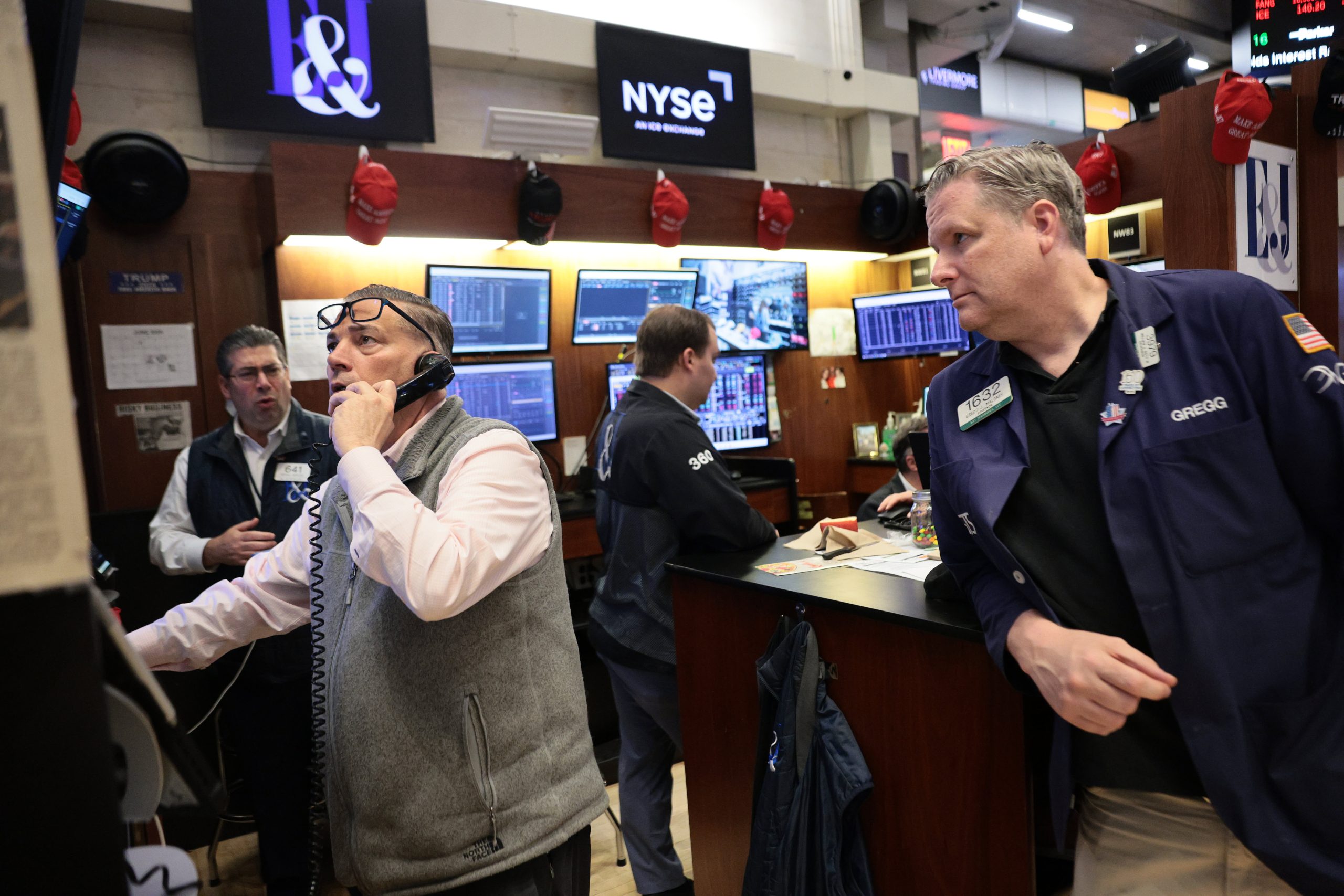
Stocks rose Thursday as chipmakers rebounded, but tensions with Iran and Oracle’s AI spending plans kept markets on edge.
U.S. equities gained ground Thursday, June 11, 2026, with the S&P 500 up 0.4%, the Nasdaq Composite climbing 0.5%, and the Dow Jones Industrial Average rising 306 points (0.6%)—even as President Donald Trump’s threat of “very hard” strikes on Iran and escalating oil market risks weighed on investor sentiment. The market’s advance came despite Oracle’s 11% stock drop after announcing plans to raise $20 billion for AI investments, while chip stocks like Intel and AMD surged, signaling a volatile week ahead for tech and energy sectors.
Why Stocks Rose Despite Iran Tensions
The S&P 500’s 0.4% gain and Nasdaq’s 0.5% rise reflected a rebound in AI-related stocks after a brutal week, but the rally was capped by two major overhangs: Trump’s latest threats against Iran and Oracle’s aggressive AI funding plans. According to CNBC, the Nasdaq Composite hit USD 50,267.31 (+348.53), while the Dow Jones Industrial Average climbed 326 points (0.7%) as of midday trading. The market’s resilience came despite Trump’s late-night post on Truth Social, where he warned of “very hard” strikes on Iran and vowed to seize control of Iran’s oil infrastructure, including Kharg Island. “At some point in the not too distant future, we will be taking Kharg Island, and other oil infrastructure points, and assume total control of their Oil and Gas Markets,” Trump wrote, sending oil prices briefly spiking before stabilizing near $90 a barrel for West Texas Intermediate.
Yet the market’s muted reaction to the escalation suggests investors are pricing in a status quo—at least for now. “Markets don’t seem to be fazed,” said Thomas Martin, senior portfolio manager at Globalt Investments. “[The] inflation reports that we’ve gotten don’t show that the higher price of oil is really pushing through to other areas, so the underpinnings of the economy are still fairly strong.” The Bureau of Labor Statistics reported Thursday that the producer price index rose 1.1% in May—above expectations—while core inflation remained subdued at 0.4%, reinforcing the view that inflationary pressures are contained despite oil’s volatility.
The Iran Escalation: What Happened and Why It Matters
Trump’s threats followed a fresh round of U.S. “self-defense strikes” against Iran late Wednesday, as confirmed by U.S. Central Command on X. The attacks, directed by Trump, marked the latest escalation in a conflict that has seen limited but persistent strikes over the past month. While oil prices initially surged—Brent crude briefly spiked before settling at $92.64 per barrel—the market’s indifference to the rhetoric suggests traders are betting on a contained conflict, at least for now. “The strikes have been more limited compared to the early weeks of the war, and talks aimed at extending the ceasefire are ongoing,” AP News reported, noting that the latest clashes have not disrupted global oil flows as severely as earlier phases.
For more on this story, see Nasdaq Hits New High on AI Stocks, Dollar Tree Surges as Markets Defy Iran Tensions.
The geopolitical risk premium, however, remains a wildcard. Trump’s explicit threats to seize Iranian oil infrastructure—including Kharg Island, a critical export hub—could disrupt supply chains if carried out. While the immediate market reaction was muted, the long-term implications hinge on whether the U.S. follows through on its threats. Historically, such rhetoric has led to short-term volatility, but the absence of a broader regional escalation so far has kept traders focused on domestic economic data rather than geopolitical flashpoints.
Oracle’s $20 Billion AI Bet: A Stock Market Warning Sign
Oracle’s 11% stock plunge Thursday underscored the market’s growing skepticism about AI spending. The company reported stronger-than-expected earnings but announced plans to raise $20 billion—$40 billion this fiscal year, following a $48 billion raise last year—to fund its AI push. The move sent a clear message: Big Tech is doubling down on AI, even as profit margins come under pressure. “Other companies’ stocks have also been punished recently for announcing heavy spending on AI,” AP News noted, highlighting a broader trend where investors are questioning whether AI investments will deliver the promised returns.

This follows our earlier report, U.S. strikes Iran: Markets swing as oil plummets 11% after Trump’s policy shift.
The contrast between Oracle’s struggles and the chip sector’s rebound is striking. While Oracle’s stock fell 11.1%, Intel surged 7.8% and Applied Materials climbed 7.5%—part of a broader AI-driven rally in semiconductor stocks. The iShares Semiconductor ETF gained 3%, reflecting investor confidence in the long-term AI buildout. Yet the volatility in Oracle’s stock suggests that not all AI bets are paying off in the short term. The company’s decision to raise $20 billion—on top of last year’s $48 billion—raises questions about whether the market is overestimating AI’s near-term profitability.
SpaceX’s $1.8 Trillion IPO: The Week’s Biggest Story
Friday’s market will be dominated by SpaceX’s highly anticipated IPO, which could become the largest in history with a valuation near $1.8 trillion. The debut comes as investors debate whether AI stocks have peaked or are still in a parabolic phase. Some traders believe the recent chip weakness stems from investors selling semiconductor stocks to make room for SpaceX’s IPO, CNBC reported. The move could reshape the tech sector’s leadership, with SpaceX’s valuation dwarfing even the most optimistic projections for AI-driven companies.
The IPO’s timing is particularly interesting given the market’s recent turbulence. While chip stocks have seen wild swings—Marvell Technology, for instance, plunged 16.7% before rebounding—SpaceX’s entry could signal a shift toward space and defense-related investments. The company’s focus on AI-driven satellite networks and defense contracts aligns with broader government and corporate bets on next-generation infrastructure. If successful, the IPO could validate SpaceX’s position as “the next trillion-dollar company,” as Nvidia CEO Jensen Huang suggested earlier this year.
Read also: U.S.-Iran peace talks spark oil surge, but key hurdles stall markets.
What Comes Next: Three Scenarios for the Market
- Iran tensions: If Trump’s threats escalate into direct attacks on Iranian oil infrastructure, oil prices could spike, triggering a broader market sell-off. The Federal Reserve’s upcoming rate decision—led by new Chair Kevin Warsh—will also shape investor sentiment, particularly if inflation data worsens.
- AI spending: Oracle’s $20 billion raise and other tech giants’ AI investments will face scrutiny as earnings reports roll in. If profit margins continue to shrink, the market may turn against high-spending AI plays.
- SpaceX’s IPO: The debut could either stabilize the market by redirecting capital toward space and defense stocks or deepen volatility if the valuation proves unsustainable.
The market’s ability to shrug off Trump’s Iran threats suggests a degree of complacency—but that could change quickly. As Yahoo Finance noted, the latest strikes were “swift,” leading investors to hope for a resolution. Yet the absence of a clear de-escalation path leaves room for further surprises. For now, the market’s focus remains on AI, oil, and the Fed—but the Iran wild card could re-enter the picture at any moment.
Find more reporting in our Business section.
