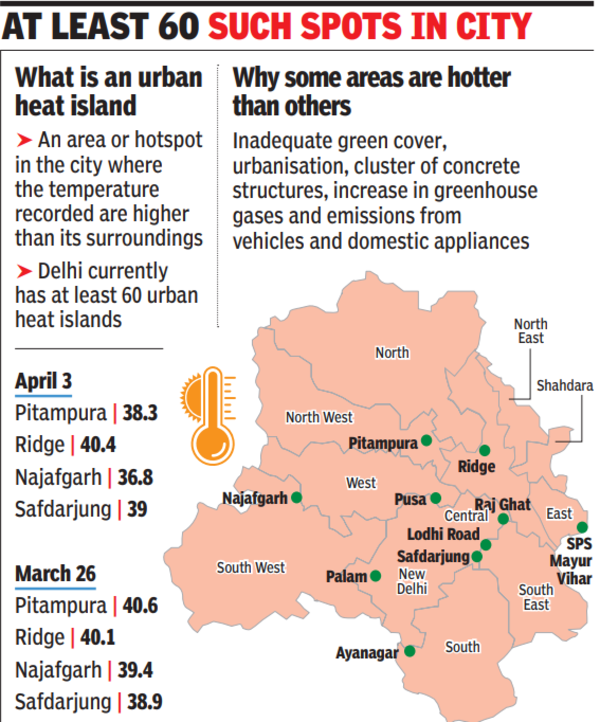
The National Capital Territory of Delhi, a megacity of over 16.8 million people, faces extreme climatic conditions that often exceed standard temperature readings. While official meteorological data records ambient heat, the city’s high density of 11,312 people per square kilometer and vast urban infrastructure create a distinct microclimate that intensifies perceived heat for residents.
Urban Density and the Built Environment
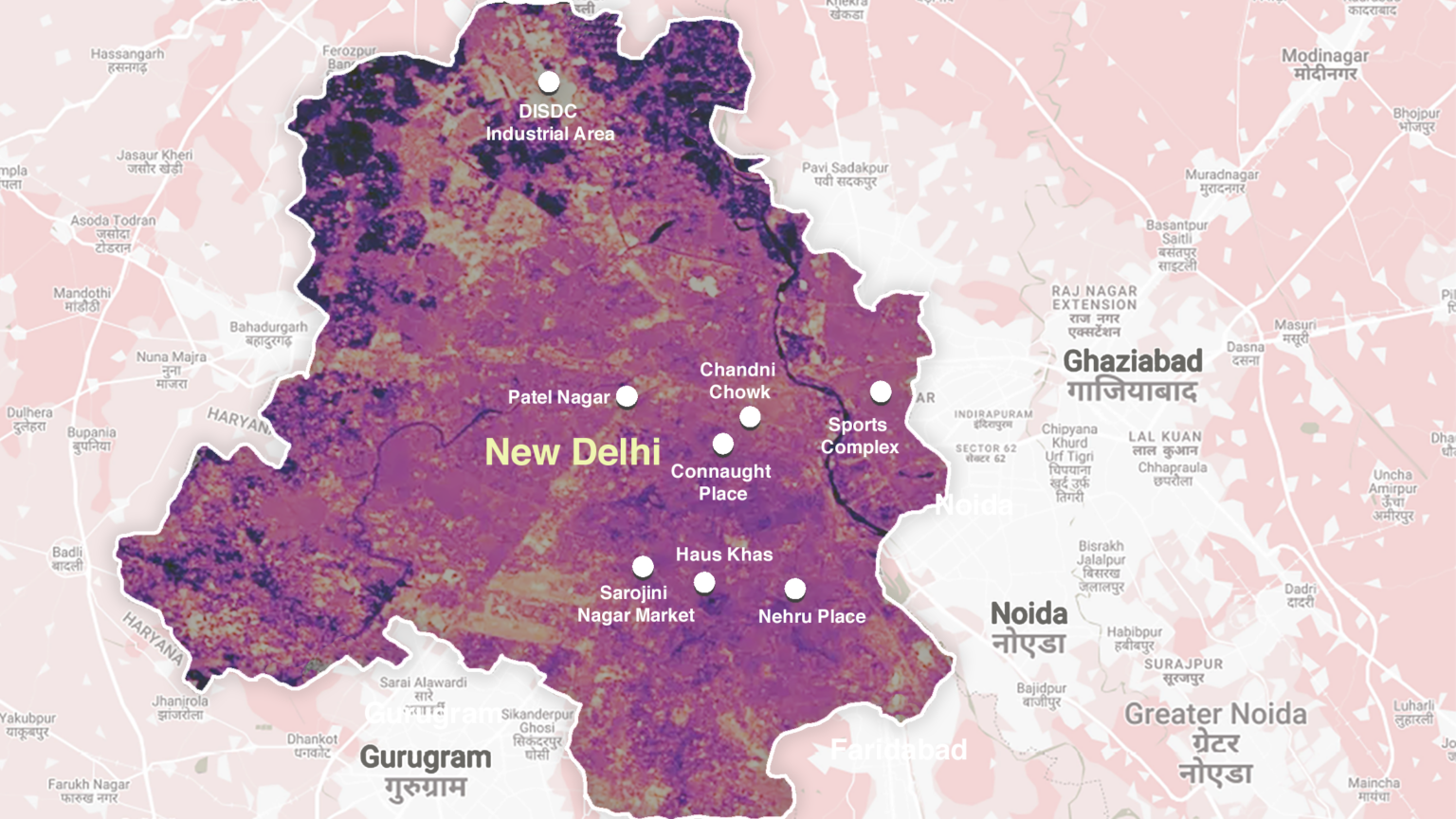
Delhi’s physical transformation from a historic center to a modern megacity has significantly altered its thermal profile. According to Wikipedia, the National Capital Territory covers 1,484 square kilometers, with a population density reaching 29,298 people per square mile. This concentration of human activity and infrastructure, including the dense urban layout of New Delhi and surrounding districts, contributes to the urban heat island effect.
The urban heat island effect is a well-documented meteorological phenomenon where an urbanized area experiences significantly warmer temperatures than its surrounding rural areas. This occurs primarily because urban materials—specifically concrete, brick, and asphalt—possess a high thermal mass. During daylight hours, these surfaces absorb solar radiation, and throughout the night, they slowly re-emit this stored heat into the lower atmosphere. In a city as densely packed as Delhi, the lack of permeable surfaces and green cover exacerbates this, preventing the natural cooling processes that occur in vegetated environments.
The city’s geography also plays a role in how heat is retained. Straddling the Yamuna River, Delhi’s topography includes historic structures like the Purana Qila. The shift from medieval centers to the modern administrative capital, designed by architects Edwin Lutyens and Herbert Baker, replaced natural landscapes with extensive masonry and asphalt. These materials absorb and re-emit solar radiation, keeping the city warmer than surrounding rural areas, particularly during the summer months.
Disparity Between Official Limits and Urban Reality
There is a functional distinction between the administrative definitions of the city and the lived experience of its residents. While New Delhi serves as the seat of the Government of India and houses key institutions like the Sansad Bhavan and the Supreme Court, it is a municipality within the larger NCT.
Standard meteorological stations, often located in open areas like airports or specialized observatories, provide the “official” temperature. However, these readings frequently fail to represent the conditions found in the city’s dense residential corridors, where narrow streets, high-rise buildings, and vehicular exhaust create localized heat pockets. This discrepancy creates a gap between the data used for administrative policy and the actual physiological stress experienced by the population at the street level.

Delhi Tourism describes the city as a place that “touches your pulse” and causes it to fasten to a “frenetic speed.” This description reflects the reality of a megacity where ancient heritage sites, such as the Qutub Minar and Humayun’s Tomb, exist alongside modern, high-intensity transit systems like the Delhi Metro. The sheer volume of human movement, combined with the energy output from a population of over 16 million, ensures that ambient temperature sensors often fail to capture the localized intensity of heat generated within the city’s dense residential and commercial corridors.
Historical Context of the Capital
The climate in Delhi has been a factor in governance since the British colonial period. In 1911, the decision to shift the capital of the British Indian Empire from Calcutta to Delhi was driven by the need for a more central administrative location in northern India.
The choice of Delhi was partly strategic, leveraging its history as a seat of power, though it also placed the colonial administration squarely in a region known for extreme continental weather. Northern India is characterized by hot, dry summers and cool winters, a climate vastly different from the coastal humidity of Calcutta. The colonial architects had to navigate these extremes while imposing a grand, European-style aesthetic on the landscape.
The transition, which saw the inauguration of New Delhi on 13 February 1931, established a permanent administrative footprint in a region known for high seasonal temperatures. As noted in historical records, the development of the city required the acquisition of land under the Land Acquisition Act of 1894. The resulting urban structure—a mix of grand government avenues and dense historic districts—continues to influence how the city experiences heat today.
Why Perceived Heat Matters
For the millions of residents living within the National Capital Region, the difference between official temperature readings and the heat felt at the street level is a matter of daily infrastructure usage. The city’s rapid growth, which includes the development of satellite areas like Gurgaon, Noida, and Faridabad, has created a continuously built-up area. This expansion amplifies the retention of heat across the region.
The implications of this heat are broad, affecting energy demand for cooling, public health outcomes, and labor productivity. When urban centers remain significantly warmer than rural surroundings, the “peak load” for electricity—driven by air conditioning use—increases dramatically. This puts pressure on the power grid and contributes to a cycle of energy consumption that releases further waste heat into the environment. Furthermore, the persistence of high nighttime temperatures in urban areas prevents the body from recovering from daytime heat stress, a critical factor in public health vulnerability.
As the government manages the responsibilities of a megacity, the integration of heritage conservation and modern urban planning remains a primary challenge. Delhi’s identity as a city where “ancient and modern blend seamlessly together” also means that its thermal challenges are as much a product of its deep history as they are of its current, rapid modernization.
Find more reporting in our Technology section.
