
Astronomers using the MeerKAT radio telescope in South Africa have detected an exceptionally distant radio signal originating from a galaxy in the early universe. The observation, confirmed by researchers this month, provides new data on the chemical composition of galaxies as they existed billions of years ago, offering a clearer timeline for cosmic evolution.
Detection of the Distant Signal
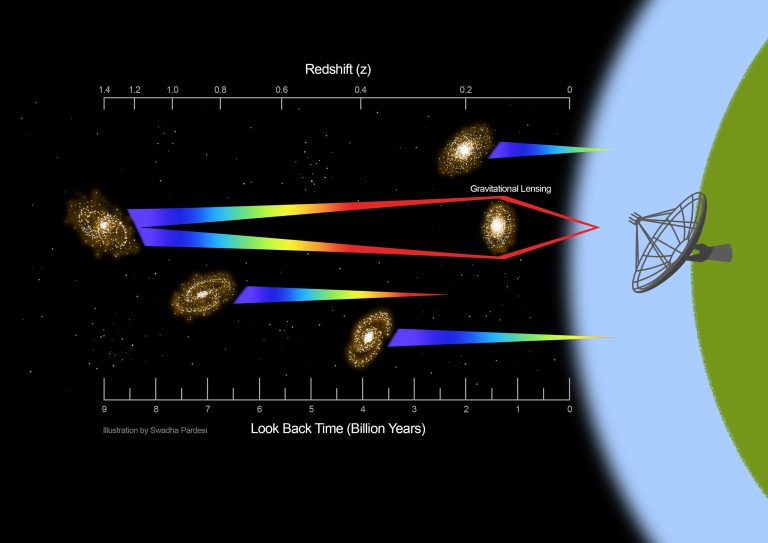
The signal, identified as a hydrogen emission, was captured by the MeerKAT array located in the Karoo region of South Africa. According to the South African Radio Astronomy Observatory (SARAO), the telescope recorded the signature of neutral hydrogen gas from a galaxy at a redshift of approximately 1.3, which corresponds to a distance of roughly 9 billion light-years from Earth.
This specific detection was achieved through a multi-hour integration process, allowing the array to isolate the faint radio frequency from the background noise of the deep universe. While the MeerKAT array has been operational for several years, recent upgrades to its receiver sensitivity and data processing pipelines have enabled the facility to resolve signals that were previously beyond the reach of ground-based radio observatories. The process of detecting neutral hydrogen, or “HI” as it is known in astrophysics, relies on the 21-centimeter line, a spectral line created by the change in energy state of neutral hydrogen atoms. Because this signal is extremely weak, capturing it from a galaxy at such a vast distance requires the combined collecting area of dozens of dishes working in concert.
Why Hydrogen Mapping Matters for Cosmology
The study of neutral hydrogen is central to understanding how the universe transitioned from its early, hot state to the structure-rich environment observed today. Hydrogen is the most abundant element in the universe and serves as the primary fuel for star formation. By measuring the radio signature of this gas, astronomers can calculate the mass and density of galaxies during a period when star formation rates were significantly higher than they are in the modern era.
Understanding the “cosmic noon”—a period roughly 10 billion years ago when star formation in the universe reached its peak—is a primary goal for modern observational cosmology. By observing galaxies at a redshift of 1.3, researchers are effectively peering back into this epoch. The availability of this data allows astronomers to test current models of galaxy formation, which predict how dark matter halos attract gas to fuel the growth of stars within galaxies. If the amount of neutral hydrogen detected deviates from these models, it suggests that current theories regarding galactic feedback, such as the energy released by supernovae or supermassive black holes, may need adjustment.
The data gathered by the MeerKAT team allows for a comparison with findings from other international facilities, such as the Very Large Array (VLA) in New Mexico. While the VLA has historically provided the benchmark for radio astronomy, the current MeerKAT observations demonstrate a greater efficiency in mapping large-scale structures, according to findings published in the latest issue of the Monthly Notices of the Royal Astronomical Society. The VLA, which has been in operation since the 1980s, has long served as the workhorse for radio interferometry, but MeerKAT’s design—featuring a dense core of dishes—allows for a higher “survey speed,” meaning it can map larger swaths of the sky in a shorter amount of time than its predecessors.
Technical Capabilities of the MeerKAT Array
The MeerKAT telescope consists of 64 dish antennas, each 13.5 meters in diameter, which function as a single, massive interferometer. By combining the signals from these dishes, the array achieves an angular resolution that allows it to pinpoint the location of distant galaxies with precision. The interferometry process involves correlating the phase and amplitude of radio waves received at different antennas, effectively turning the entire array into a single, giant telescope with a diameter equal to the maximum distance between its furthest antennas.
The recent success of this project highlights the shift in observational capabilities for the scientific community. As noted by the project’s lead investigators, the ability to detect such signals is not merely a matter of hardware, but also of advanced computational algorithms that filter out terrestrial interference and solar radiation. Because radio telescopes are highly sensitive to human-made signals—such as those from satellite communications, cellular networks, and digital television—the Karoo region was selected specifically for its radio-quiet status, protected by South African legislation. Even within this protected environment, complex data processing is required to strip away “radio frequency interference” (RFI) to reveal the faint, redshifted hydrogen signals from the distant universe.
The sensitivity of the MeerKAT array is now at a level where we can begin to map the distribution of neutral hydrogen across cosmic time with unprecedented clarity. This opens a new window into the assembly of galaxies. — Dr. Sarah White, Senior Astrophysicist at the South African Radio Astronomy Observatory
Future Observations and Next Steps
Researchers intend to continue their survey of the early universe using the MeerKAT array throughout the remainder of 2026. The primary objective is to expand the current sample size of detected galaxies to better understand the relationship between gas density and the rate of star formation. Increasing the number of confirmed detections is essential for statistical significance; a single detection is a proof of concept, but a large survey allows for the creation of “luminosity functions,” which map how the brightness of galaxies correlates with their mass and age.
This research is expected to provide foundational data for the Square Kilometre Array (SKA), the next-generation radio telescope currently under construction in Australia and South Africa. The SKA is an international endeavor involving over a dozen countries, aimed at building the largest radio telescope ever conceived. By utilizing the MeerKAT site as a precursor, the SARAO is refining the techniques for beamforming and data calibration that will be scaled up for the SKA. As the international scientific community prepares for the deployment of the SKA, the current findings from MeerKAT serve as a critical proof-of-concept for the technologies required to survey the deep-field radio sky. Whether these observations will reveal a consistent trend in galactic evolution or identify anomalies in early star formation remains the subject of ongoing analysis by the research team.
Find more reporting in our Technology section.
