The James Webb Space Telescope has revealed a black hole that predates its host galaxy, challenging long-held theories about cosmic evolution. Observations of Abell2744-QSO1, a “Little Red Dot” 13 billion light-years away, suggest the 50-million-solar-mass black hole formed within the first seconds of the Big Bang, according to a study published in Nature and the Monthly Notices of the Royal Astronomical Society.
The Cosmic Paradox: Black Holes Before Galaxies
For decades, scientists believed galaxies formed first, with black holes growing later through stellar collapse and mergers. But the James Webb Space Telescope (JWST) has upended this framework. Researchers studying Abell2744-QSO1, a galaxy 13 billion light-years away, found a supermassive black hole that appears to have existed 700 million years after the Big Bang—long before the galaxy itself could have formed. “This is a remarkable finding,” said Roberto Maiolino of the University of Cambridge, co-author of the study. “It’s a paradigm shift, a total revisiting of the classical scenarios of how black holes form and grow.”
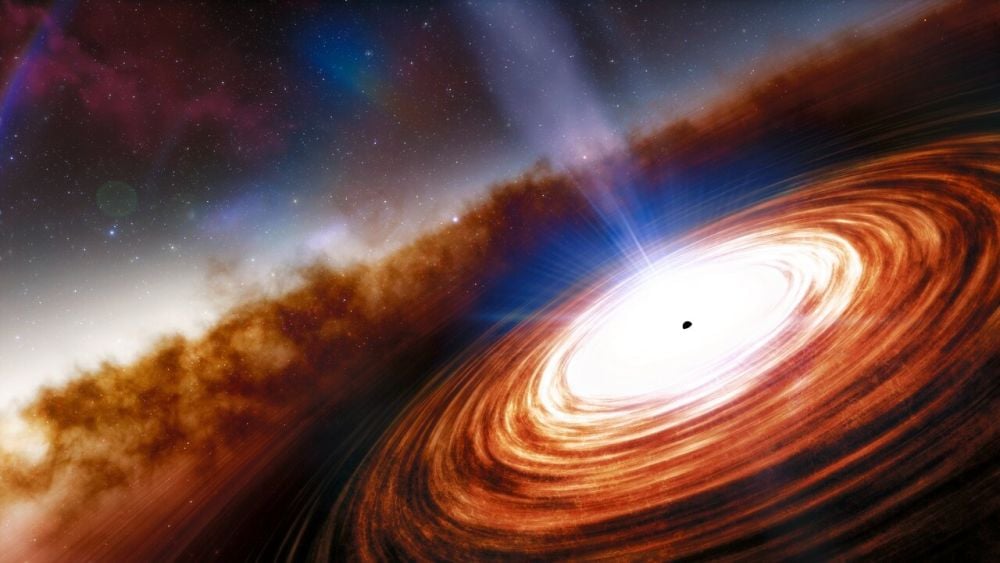
The black hole, estimated at 50 million times the Sun’s mass, defies conventional models. Its existence suggests it may have formed directly from primordial gas clouds, bypassing the need for stellar precursors. “Before now, all of the mass measurements of black holes in the early Universe have been indirect,” said Francesco D’Eugenio, also of Cambridge. “We didn’t know if those assumptions really apply to the distant Universe.”
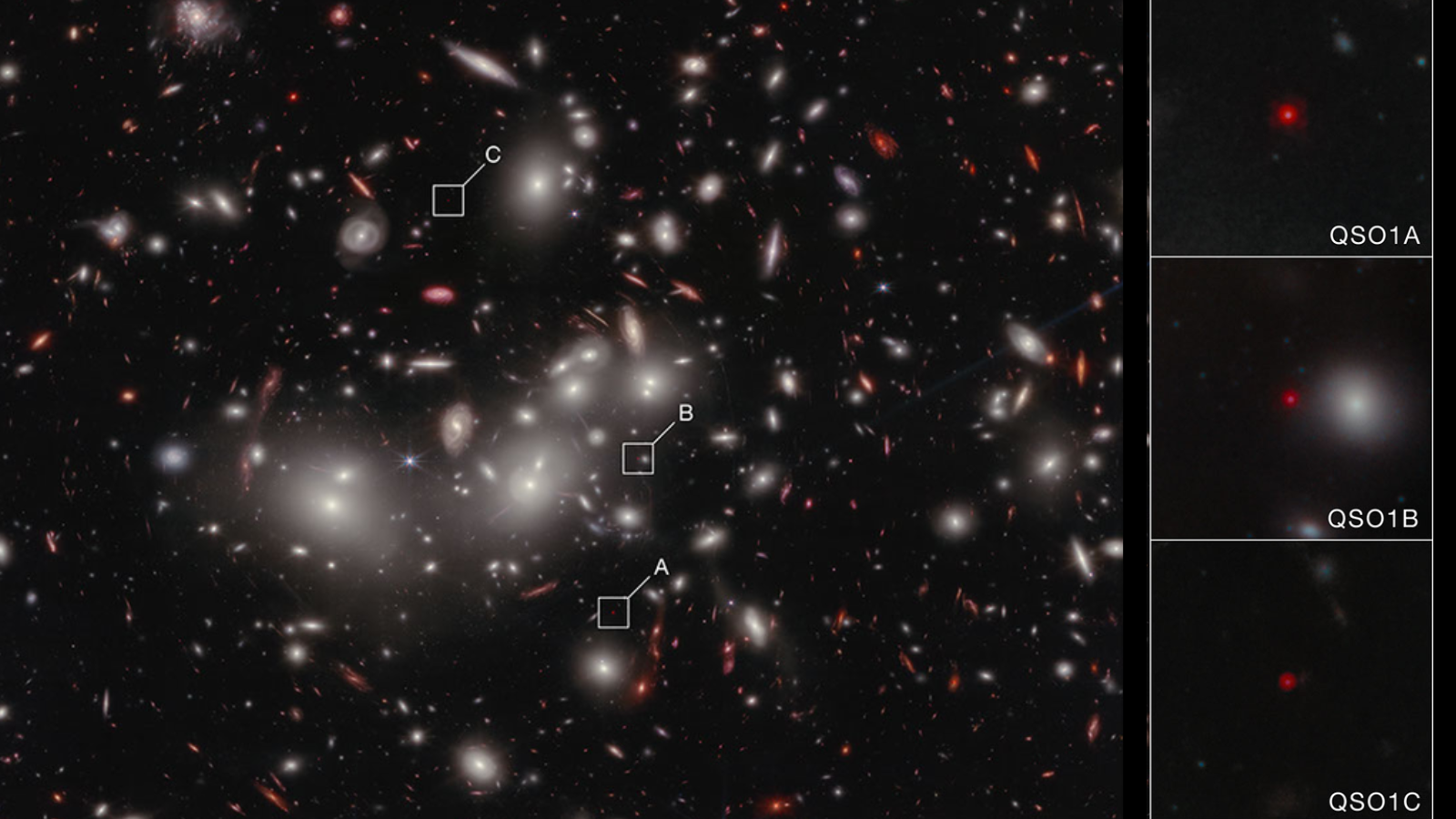
Abell2744-QSO1, dubbed a “Little Red Dot” for its faint, red glow, is a gravitational lensing miracle. Its light, magnified by the galaxy cluster Abell 2744, allowed researchers to study its structure in unprecedented detail. The team’s analysis, published in Space, revealed that the black hole’s mass dwarfs the galaxy’s stellar content, contradicting the standard mass–stellar mass relationship seen in nearby galaxies. In local galaxies, the central supermassive black hole typically accounts for roughly 0.1% of the total stellar mass; at Abell2744-QSO1, that ratio is inverted, with the black hole mass appearing to be significantly higher than the integrated stellar mass of the host.
How JWST Unlocked the Secret
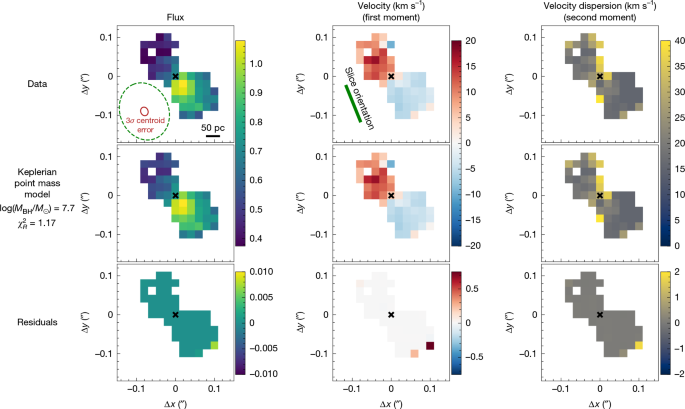
The JWST’s infrared capabilities were critical to the discovery. The telescope’s Near-Infrared Camera (NIRCam) and Integral Field Spectrograph (NIRSpec) captured the faint glow of Abell2744-QSO1, revealing its gas dynamics. Researchers used a technique called spectroastrometry to map the motion of ionized gas around the black hole, confirming its immense gravitational pull. “The key kinematics results are insensitive to flux calibrations,” noted the Nature study, which detailed the data reduction process. By analyzing the broad emission lines of the H-beta and H-alpha hydrogen lines, the team derived the virial black hole mass, a method that relies on the velocity dispersion of gas in the Broad Line Region (BLR).
Gravitational lensing, predicted by Einstein’s theory of general relativity, amplified the galaxy’s light, allowing the team to resolve its structure. “QSO1 is easier to study than other Little Red Dots because it is gravitationally lensed,” explained Space. The lensing effect also revealed that the black hole’s mass exceeds expectations by a factor of 10 to 100, challenging the idea that galaxies “feed” their central black holes. The magnification factor provided by the Abell 2744 cluster, often referred to as Pandora’s Cluster, allowed for a signal-to-noise ratio previously unattainable for objects at a redshift of z ≈ 7.
The Debate Over Cosmic Outliers
While the findings are groundbreaking, some scientists caution against overgeneralizing. A study in The Astrophysical Journal argues that JWST’s observations may suffer from selection bias. Critics point out that “Little Red Dots” represent a specific subset of high-redshift objects that appear unusually bright in the infrared due to extreme dust obscuration. Jorryt Matthee, an astrophysicist at the Institute of Science and Technology Austria, has highlighted that while the NIRSpec data is robust, the interpretation of the “stellar mass” of the host galaxy is subject to significant systematic uncertainties, particularly regarding the assumed initial mass function (IMF) of stars in the early universe.

The discrepancy between the black hole mass and the stellar mass of the host has led to competing hypotheses. One theory, proposed by researchers at the Cosmic Dawn Center, suggests that these objects might be “overmassive” due to high-accretion rates in a dense, gas-rich environment, rather than a failure of standard galaxy formation models. Others, including theoretical astrophysicist Priyamvada Natarajan of Yale University, have suggested that these supermassive black holes could be the direct collapse of massive gas clouds (DCBHs) in the early universe, effectively skipping the “seed” phase typically associated with Pop III stellar remnants. This mechanism would allow for the rapid formation of a 10^5 to 10^6 solar mass black hole within a few hundred million years, providing a potential solution for how such massive objects existed so soon after the Big Bang.
The NIRSpec data reduction process faced intense scrutiny regarding the removal of foreground contamination from the lensing cluster. The Nature paper utilized a sophisticated subtraction algorithm to isolate the light of Abell2744-QSO1 from the cluster’s intra-cluster light. Despite this, some independent reviewers have raised concerns about the potential for “broad-line contamination,” where light from the accretion disk is misinterpreted as gas motion. The research team addressed these concerns by performing extensive Monte Carlo simulations, which demonstrated that the kinematic signatures of the gas are consistent with a rotating disk around a compact, high-mass gravitational source rather than an artifact of detector noise or spectral overlap.
Future observations with the Mid-Infrared Instrument (MIRI) are planned to further constrain the dust extinction parameters of the host galaxy. These observations, scheduled for the upcoming JWST cycle, aim to determine if the “Little Red Dot” classification is a universal trait of early-universe, high-mass black hole hosts or merely a reflection of the specific environmental conditions found in the line of sight toward Abell 2744. Until then, the community remains divided on whether Abell2744-QSO1 represents a common evolutionary pathway or a rare, extreme outlier in the cosmic population.
