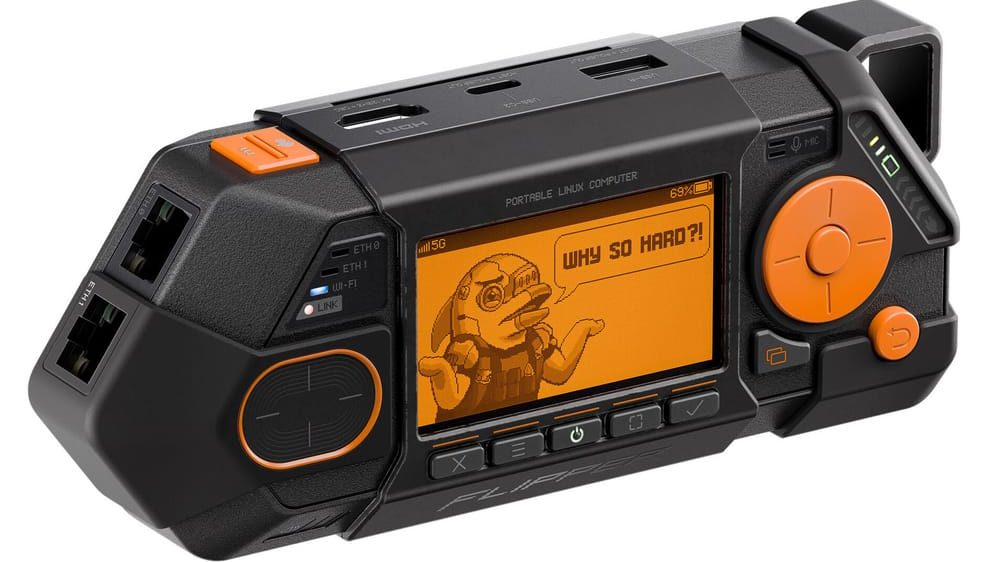
Flipper Devices, the company behind the widely used Flipper Zero, has announced the Flipper One, a new networking multi-tool designed for Linux-based computing. While the project remains in the early development stages, the company is soliciting community input to refine the hardware and software before a potential launch later this year.
A Pivot to Network-Centric Computing
The Flipper One represents a deliberate shift in direction from the company’s previous hardware. While the Flipper Zero gained popularity for its ability to interact with low-level radio protocols like NFC, RFID, and infrared, the Flipper One is engineered for a different layer of the digital stack. It is intended to function as a “network multitool,” handling high-speed connectivity including Wi-Fi 6E, 5G, and dual Gigabit Ethernet ports.

According to TechCrunch, the device is not a direct successor to the Zero. Instead, it aims to provide a platform for more intensive tasks such as running local AI models, acting as a VPN gateway, or serving as a portable media box. The hardware architecture reflects this ambition, featuring an eight-core RK3576 system-on-chip paired with 8GB of RAM and a Mali-G52 GPU. The company has stated that the base model of this new gadget is expected to cost under $350.
Hardware Architecture and Open Design
To manage its complex feature set, the Flipper One utilizes a co-processor design. A dedicated Raspberry Pi RP2350 microcontroller handles the low-level subsystems, including the display, touchpad, LED indicators, and power management. This allows the device to maintain basic interface functionality even when the primary Linux-based CPU is powered down.

The device is designed to be “the most open and best-documented ARM computer in the world,” as noted by Hackaday. Flipper Devices is actively pushing its support for the RK3576 chip into the mainline Linux kernel, ensuring that the hardware remains accessible to the open-source community. Beyond the internal processing, the unit includes an M.2 slot for expansion, supporting SSDs, cellular modems, or software-defined radio (SDR) modules.
The project is the result of years of development, during which the team has rebuilt the architecture from scratch several times. By utilizing the RK3576 chip, the designers are attempting to create a Linux cyberdeck that bridges the gap between specialized pentesting hardware and general-purpose ARM computing.
Community-Driven Development and Financial Risks
In an effort to avoid the closed-development cycles typical of consumer electronics, Flipper is publishing its internal task trackers, debates, and design discussions on a public portal. As PCMag reports, this approach allows users to suggest improvements to the hardware layout and the emerging Flipper OS. This operating system is being built to support multiple user profiles, allowing the device to switch between configurations like a travel router or a desktop environment without requiring a fresh installation of the OS.
Despite the ambition behind the project, the team acknowledges significant hurdles. The company has generated over $150 million in sales from its previous products, but the Flipper One faces both supply chain and engineering challenges.
“There’s a lot of uncertainty in this project, along with technical challenges and financial risks (like the current RAM chip crisis). I don’t know if we’ll be able to do everything we’ve planned, but we’ll give it everything we’ve got.” — Pavel Zhovner, CEO of Flipper Devices, via PCMag
The public portal for community engagement is intended to serve as a hub for collaborative troubleshooting, allowing the engineering team to gather feedback on the device’s thermal management and physical form factor as they iterate toward a final production design.
Usability and Future Availability
A core design goal for the Flipper One is to solve the usability issues that plague many DIY cyberdecks, specifically the reliance on mouse-and-keyboard inputs for small-screen interfaces. The team is developing a proprietary interface, FlipCTL, which relies on a D-pad and customizable buttons to navigate the Linux environment. According to The Verge, while the company has not finalized the device’s retail price, it is targeting a point around $350 for a potential Kickstarter campaign later this year.

As Gizmodo notes, the company’s commitment to transparency extends to showing “all the messy stuff companies usually keep behind closed doors.” Whether this level of openness can navigate the technical complexities of a high-performance Linux handheld remains to be seen. For now, the project serves as a test of whether a community-vetted device can bridge the gap between a simple hacking tool and a versatile, portable computer.
The transition from the Flipper Zero—which focused on sub-gigahertz radio and various protocol emulation—to the Flipper One marks a significant increase in computational overhead. The reliance on the RK3576 SoC necessitates robust power management and cooling solutions, which the community has begun to scrutinize through the open-source documentation provided by the development team. The final assembly will be subject to the availability of key components, which the company continues to monitor in light of broader market volatility.
