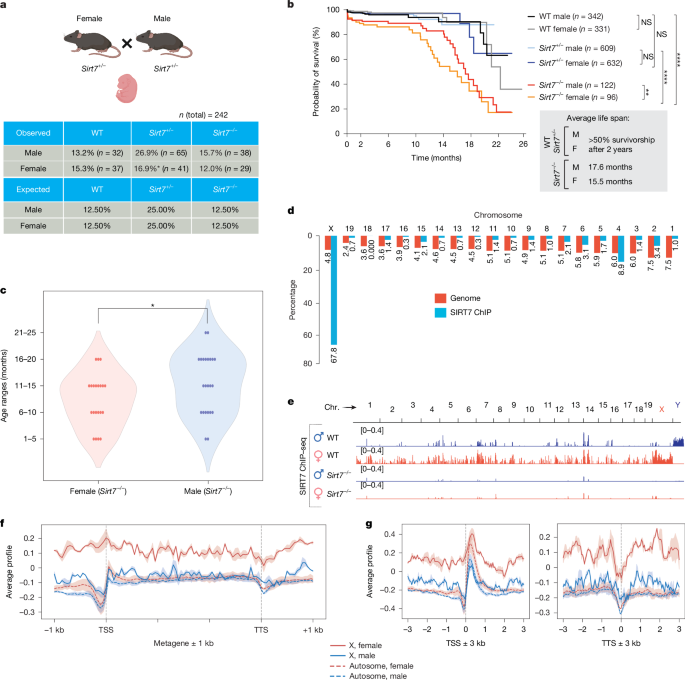
SIRT7, a member of the sirtuin family, has been identified as a critical regulator of dosage compensation and a protector of the female X chromosome, according to recent studies published in Nature and PMC. The research highlights its role in balancing gene expression between sexes and maintaining genomic stability, with implications for understanding genetic disorders and aging.
SIRT7’s Role in Chromatin Regulation
The study published in Nature details SIRT7’s multifaceted functions in chromatin modification and DNA repair. Researchers found that SIRT7 interacts with histones and non-histone proteins to regulate gene expression, particularly in mitochondrial function and stress response. For instance, SIRT7’s deacetylation activity was shown to enhance DNA repair mechanisms, safeguarding against genomic instability. This aligns with earlier work from 2009 and 2014, which established sirtuins as key players in cellular homeostasis.

One notable finding is SIRT7’s role in X chromosome inactivation. The study notes that SIRT7 helps maintain the silenced state of the female X chromosome, preventing overexpression of X-linked genes. This mechanism is critical for dosage compensation, ensuring that females, who have two X chromosomes, do not produce double the gene products of males, who have one X and one Y. The research underscores SIRT7’s evolutionary conservation, with parallels observed in both mammals and insects.
Dosage Compensation Mechanisms in Insects
The PMC review provides a broader context, focusing on dosage compensation in insects. It categorizes the process into two primary modes: upregulation of the heterogametic sex’s chromosomes (e.g., males in XY systems) and downregulation of the homogametic sex’s chromosomes (e.g., females in WZ systems). The paper highlights that while mechanisms vary across species, the underlying goal—equalizing gene expression between sexes—remains consistent.
For example, in Drosophila melanogaster, dosage compensation is achieved by doubling X chromosome gene expression in males through the male-specific lethal (MSL) complex. In contrast, lepidopteran insects like Bombyx mori employ a different strategy, involving the downregulation of Z chromosomes in females. The review emphasizes that SIRT7’s role in mammals may have evolutionary parallels in these insect systems, though the exact pathways differ.
Implications for Genetic Research
The dual studies highlight SIRT7’s potential as a therapeutic target. Researchers suggest that modulating SIRT7 activity could address conditions linked to dosage imbalance, such as certain cancers and neurodegenerative diseases. For instance, SIRT7’s involvement in DNA repair and mitochondrial function positions it as a candidate for interventions targeting aging-related pathologies.

However, challenges remain. The PMC review notes that insect studies often lack the molecular detail available in mammalian models, creating gaps in understanding. Conversely, mammalian research, while advanced, struggles to translate findings into clinical applications. Bridging these divides requires interdisciplinary collaboration, as emphasized by the authors of both studies.
What’s Next for SIRT7 Research?
Future research is likely to focus on SIRT7’s interactions with other sirtuins and its role in disease. The Nature study calls for longitudinal studies to track SIRT7’s activity across different developmental stages. Meanwhile, the PMC review advocates for comparative analyses of dosage compensation mechanisms in non-model insects, which could reveal novel evolutionary insights.
As the field progresses, the interplay between SIRT7 and other regulatory proteins will be a key area of exploration. Scientists caution that while the findings are promising, translating them into therapies will take years of rigorous testing. For now, the studies reaffirm SIRT7’s central role in maintaining genomic balance, offering a foundation for future breakthroughs.
Find more reporting in our Health section.
