The 2026 AHA/ACC/ADA/ASN Guideline for the Prevention, Detection, Evaluation, and Management of Cardiovascular-Kidney-Metabolic (CKM) Syndrome marks a pivotal shift in addressing the interconnected health crises of obesity, diabetes, chronic kidney disease, and cardiovascular disease, according to news.google.com.
CKM Syndrome: A Unified Framework for Interconnected Conditions
The guideline, the first of its kind, emphasizes the need for a unified approach to managing conditions that often co-occur. “Heart, kidney, and metabolic conditions don’t occur in isolation—they are deeply connected,” said Chiadi E. Ndumele, MD, PhD, MHS, chair of the guideline writing committee, as reported by American College of Cardiology. The document replaces the 2013 guideline for managing overweight and obesity, reflecting a broader understanding of how these conditions interact. Nearly 90% of U.S. adults have at least one condition within CKM syndrome, including high blood pressure, abnormal cholesterol, high blood glucose, reduced kidney function, and excess weight, according to News-Medical.

Excess Weight as a Key Driver
Excess weight, particularly abdominal fat, is identified as a central factor in CKM syndrome. “In terms of CKM health, weight is not just about a number on a scale—people with the same body weight can have very different health profiles,” said Ndumele, as quoted in News-Medical. The guideline highlights how fat tissue affects metabolic health, including blood sugar management and fat storage. Ambar Kulshreshtha, MD, PhD, a volunteer member of the American Heart Association, added, “We are saying that prevention is as important, if not more important, than treatment,” according to News-Medical.
Interdisciplinary Care and Common Language
The guideline addresses the challenge of fragmented care, where clinicians specializing in different conditions often lack a shared framework. “The challenge is how to connect the recommendations from different clinicians who may specialize in only one of these conditions,” Ndumele noted in news.google.com. To tackle this, the document advocates for coordinated interdisciplinary care, including a “CKM coordination point person” to ensure patient-centered approaches. Kulshreshtha emphasized the need for healthcare professionals to shift focus from appearance to health risks, stating, “Maintaining a healthy weight has long been seen as essential to heart health and preventing other chronic illness. However, doctors don’t always raise the topic of weight unless a patient brings it up,” as reported by News-Medical.

Recommendations and Future Implications
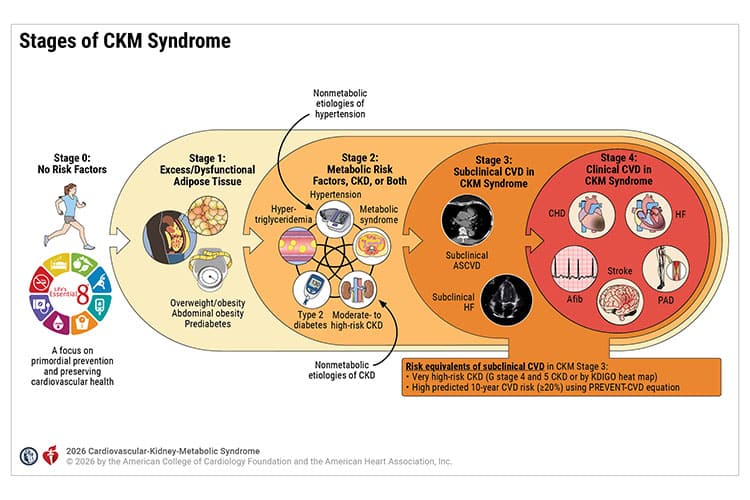
The guideline outlines four stages of CKM syndrome and recommends screening for social determinants of health, such as food insecurity and housing instability. It also introduces the PREVENT equations for improved risk assessment, which consider kidney and metabolic health factors. “These equations take into account kidney and metabolic health factors for a more comprehensive and precise estimation of risk compared with previous tools,” according to American College of Cardiology. The document also highlights the use of GLP-1-based therapies for select patients with obesity and type 2 diabetes, alongside lifestyle modifications and medications.
Despite its comprehensive approach, the guideline acknowledges gaps in data, particularly for patients with heart failure and chronic kidney disease. “Some unanswered questions still remain, particularly for CKM syndrome patients with heart failure,” the authors noted in American College of Cardiology. The focus on prevention and early intervention underscores a broader shift in healthcare, aiming to reduce the burden of chronic diseases before they escalate. As Kulshreshtha emphasized, “The multiple consequences of obesity include diabetes, chronic kidney disease, and cardiovascular disease. The guideline provides healthcare professionals with approaches for identifying and managing these conditions,” according to News-Medical.
