The World Cup kicks off Thursday in the U.S., Canada, and Mexico with public health officials already tracking three infectious threats: measles outbreaks near stadiums, a parasitic fly that vanished from the U.S. in 1966, and heat risks affecting 48 million people. While measles cases are concentrated near practice sites and base camps, health departments in Atlanta and Dallas are expanding surveillance for sexually transmitted infections and mosquito-borne diseases like dengue.
Measles: The Unseen Outbreak Near Stadiums
Measles, a highly contagious virus that can spread through the air, is already circulating in all three host countries, with a significant outbreak in Mexico. Seven World Cup base camps and practice sites are located near active measles clusters, raising concerns as fans and players travel between cities. According to Your Local Epidemiologist, the risk is particularly high for unvaccinated individuals, and health officials are urging travelers to check their vaccination status before attending matches. The Centers for Disease Control and Prevention (CDC) has not yet issued a formal travel advisory, but local health departments in host cities are monitoring vaccination rates closely.
Dr. Marcus Plescia, district health director for Fulton County, Georgia—which includes Atlanta, host to eight World Cup matches—warned that measles could spread rapidly in crowded venues. “We’re worried about things maybe we wouldn’t have been worried about as much before, particularly measles,” he said in an interview with NPR. Atlanta’s Centennial Olympic Park, where a month-long fan festival is expected to draw 15,000 people daily, is a particular concern. While measles cases in the U.S. have declined in recent years, outbreaks remain a risk in densely populated areas, especially among children and immunocompromised individuals.
The CDC reports that 30 measles outbreaks have been confirmed in the U.S. so far in 2026, with most cases linked to international travel or unvaccinated communities. Health officials are advising fans to carry proof of vaccination or a recent negative test result, though enforcement at stadiums remains unclear. Unlike COVID-19, measles has no widely available rapid test, meaning outbreaks are often detected only after cases emerge.
The Return of the Screwworm Fly: A Parasite Eradicated—Then Back
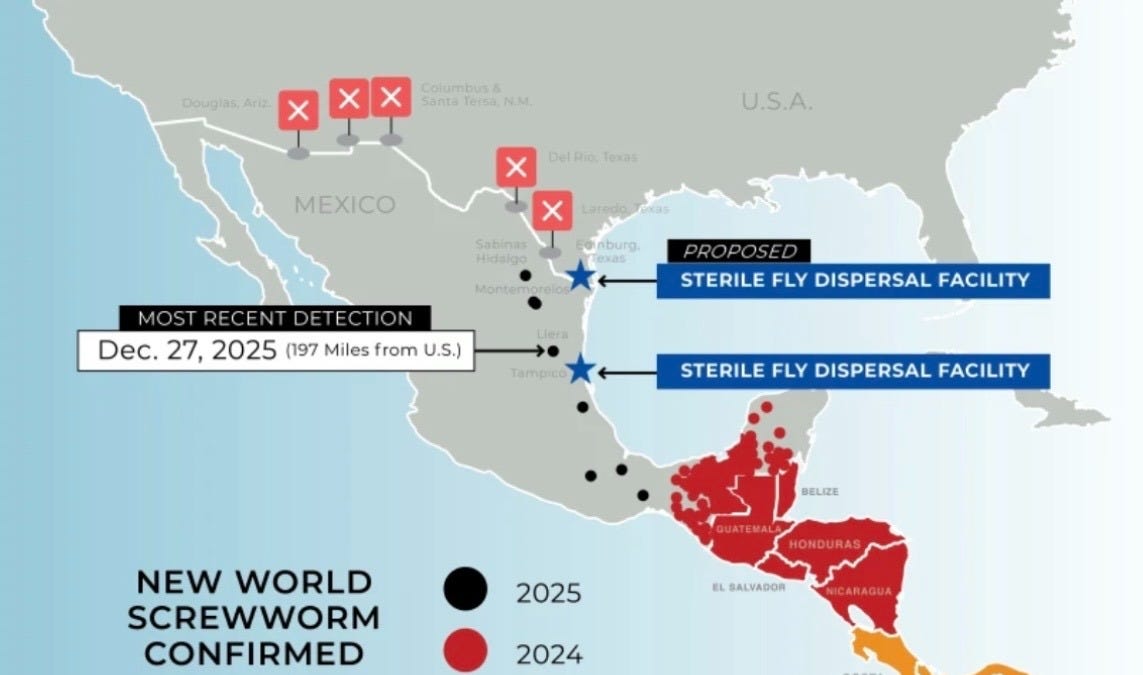
In a development that has stunned entomologists, the screwworm fly—a parasitic insect that lays eggs in open wounds, leading to fatal infections in livestock and even humans—has re-emerged in the U.S. after being declared eradicated in 1966. The fly, native to the Americas, was wiped out through a decades-long sterile insect technique program, but its sudden reappearance near World Cup host cities has health officials on alert. According to Your Local Epidemiologist, the fly’s return is tied to climate shifts and potential illegal smuggling of infected animals.
Photo: NPR
While the risk to humans is considered low—screwworm flies primarily target livestock—their presence could disrupt agricultural trade and force a costly reinstatement of eradication measures. Dr. Philip Huang, director of Dallas County Health and Human Services, noted that the fly’s return underscores how global travel and climate change can reintroduce long-vanquished threats. “We always test for West Nile virus, but we’re also increasing our testing for dengue, chikungunya, and now we have to watch for screwworms,” Huang told NPR. The U.S. Department of Agriculture is coordinating with local agencies to monitor livestock herds, but no human cases have been reported to date.
Heat Risks: 48 Million People Under “Major” Threat
With temperatures soaring, heat-related illnesses are the most immediate public health concern for the World Cup. The CDC’s HeatRisk tool projects that 48 million people across the U.S., Canada, and Mexico will face “major” heat risk during the tournament, while 100,000 will encounter “extreme” conditions. Unlike traditional heat indices, which focus on temperature alone, HeatRisk accounts for humidity—a critical factor in cities like Atlanta, where Dr. Plescia jokingly calls the region “Hotlanta.”
Fear of measles outbreak at the World Cup
“Heat-related injuries are going to be an issue,” Plescia said. Cooling stations are being set up at stadiums and fan zones, but officials warn that prolonged exposure—especially for outdoor workers, athletes, and homeless populations—could lead to heat stroke. The CDC advises avoiding strenuous activity between 10 a.m. and 4 p.m., staying hydrated, and recognizing symptoms like dizziness, nausea, and confusion. Fans are also urged to check their urine color: dark yellow indicates dehydration.
Heat risks vary by location. In Dallas, where nine matches will be played, officials are distributing free water and shade tents, while in Toronto, where temperatures are expected to hover near 90°F (32°C), public transit has extended operating hours to accommodate heat-sensitive commuters. Unlike past tournaments, where heat advisories were reactive, this year’s preparations are proactive—thanks to a year of planning by local health departments.
Sexually Transmitted Infections and Mosquito Surveillance: The Hidden Dangers
Beyond measles and heat, public health officials are bracing for spikes in sexually transmitted infections (STIs) and mosquito-borne illnesses. Dr. Huang’s Dallas County Health department is expanding wastewater surveillance to detect early outbreaks of diseases like influenza, COVID-19, and—critically—STIs. “We’re worried about sexually transmitted infections because there’s going to be a lot of people here and it’s going to be a festive atmosphere,” Plescia said. Clinics near stadiums are stocking up on emergency contraception and testing kits, though no specific numbers for expected cases have been released.
Photo: Your Local Epidemiologist
Mosquito surveillance is another priority. While West Nile virus remains the primary concern, Dallas health officials are now testing for dengue and chikungunya—viruses that thrive in warm, humid climates and can be spread by travelers. “We’re always testing for West Nile, but we’re increasing our testing for dengue, chikungunya, and now we have to watch for screwworms,” Huang said. The risk is elevated in cities like Houston and Dallas, where stagnant water from recent rains could create breeding grounds.
What Comes Next: Monitoring and Mitigation
As the tournament begins, health departments will rely on real-time data from wastewater testing, mosquito traps, and vaccination records to respond quickly to outbreaks. The CDC’s Health Security Operations Center is coordinating with local agencies, but funding cuts at the federal level have forced cities to take the lead. Atlanta’s health department, for example, has hired additional environmental inspectors to monitor food vendors—a critical task given the 15,000 daily visitors expected at Centennial Olympic Park.
The biggest unknown remains how effectively these measures will work. Unlike past World Cups, where health risks were largely contained to food safety and minor illnesses, this year’s threats—measles, screwworm flies, and extreme heat—are interconnected. Climate change, global travel, and urban density have created a perfect storm for infectious diseases. While officials insist they are prepared, the sheer scale of the event means even small lapses could have large consequences.
For now, the focus is on prevention: vaccination drives, heat safety campaigns, and expanded testing. But as fans flood stadiums, the real test will be whether health systems can adapt in real time. One thing is certain—this World Cup will be remembered not just for its soccer, but for the public health challenges it exposes.
Consult your healthcare provider for personalized advice on travel vaccinations and heat safety.
Dr. Nadia Rowe oversees medical, science, and wellness reporting. Holding a public-health doctorate and having contributed to Health Spectrum Review, she bridges scientific rigor with accessible communication. Her mission: make accurate health information available to everyone.