
The U.S. Commission of Fine Arts on May 23, 2026, approved President Donald Trump’s 250-foot triumphal arch for Washington, D.C., despite overwhelming public opposition and unanswered questions about funding and construction—while the administration announced it would bypass Congress entirely. The arch, proposed for a traffic circle near Arlington National Cemetery and the Lincoln Memorial, would honor the nation’s 250th anniversary by framing Arlington House, the former plantation of Confederate General Robert E. Lee, rather than the war dead buried there.
Why This Arch Is a Civil War Erasure
The arch’s location is deliberate: it would obscure the Lincoln Memorial while framing Arlington House, the mansion built by enslaved labor and once owned by Lee, who led the Confederate armies that killed over 16,000 soldiers buried at Arlington National Cemetery. The site’s history is inseparable from the war’s human cost. As journalist Noah Brooks wrote in 1864, describing wounded soldiers arriving in Washington: “Maimed and wounded… arrived by hundreds as long as the waves of sorrow came streaming back from the fields of slaughter. They came groping, hobbling, and faltering, so faint and so longing for rest that one’s heart bled at the piteous sight.” By August 1864, the government had buried 26 soldiers around Lee’s rose garden; by war’s end, over 16,000 lay there. The first Memorial Day ceremony was held at Arlington on May 30, 1868.
Yet the arch’s design—approved by a commission whose members were all appointed by Trump—ignores this history. The National Republican newspaper in 1864 called Arlington Cemetery a “righteous use of the estate of the rebel General Lee.” Today, the arch would invert that judgment, turning a burial ground for Union soldiers into a backdrop for a monument to national pride that excludes the very dead it was built to honor.
The Commission’s Rush and the Public’s Outrage
The Fine Arts Commission’s approval on May 23 came just two weeks after its April meeting, where it granted preliminary approval to a nearly identical design. Commissioners—including Vice Chair James McCrery II, an architect who previously led Trump’s White House ballroom project—dismissed public opposition despite 600 written submissions, 99.5% of them in opposition, according to Commission Secretary Thomas Luebke. At the hearing, McCrery II criticized the design for lacking “one of its key visual components”: sculptures or artwork on its walls. Yet the commission moved forward without addressing funding, soil stability, or how the arch would integrate with the surrounding landscape.

Rebecca Miller, executive director of the D.C. Preservation League, called the process “the MO of this administration and this review board”: “This continued desire to move things at a pace where the public doesn’t have an opportunity to participate seems to be the MO of this administration and also the MO of this particular review board.” The commission’s vote was swift—just two hours of discussion—but the public’s exclusion was anything but. Outside the National Building Museum, protesters held signs reading “Not in Our Name” and “Erasing Our History.”
“We’re doing it. The land is owned by the secretary—the Interior Department. We don’t need anything from Congress.”
—President Donald Trump, May 23, 2026
Bypassing Congress: A Constitutional Gambit
Trump’s claim that the arch doesn’t require congressional approval is legally dubious. While the Commission of Fine Arts oversees designs, the National Capital Planning Commission—another federal agency—must still approve construction on federal land. That body has the arch on its June 15 agenda, but Trump’s administration is already signaling it will ignore that hurdle. As NPR reported, the White House has suggested the arch could be funded by private donations left over from Trump’s White House ballroom project, though no cost estimate has been released.
The administration’s end run around Congress is part of a broader pattern. The arch is one of several Trump-era projects—including the White House ballroom and a proposed statue of himself—designed to leave a physical mark on Washington without legislative approval. The strategy risks setting a precedent: if the executive branch can unilaterally approve monuments on federal land, what’s next? A Trump tower in the National Mall? A golden statue of himself atop the Capitol?
The Arch’s Design: A Monument to What?
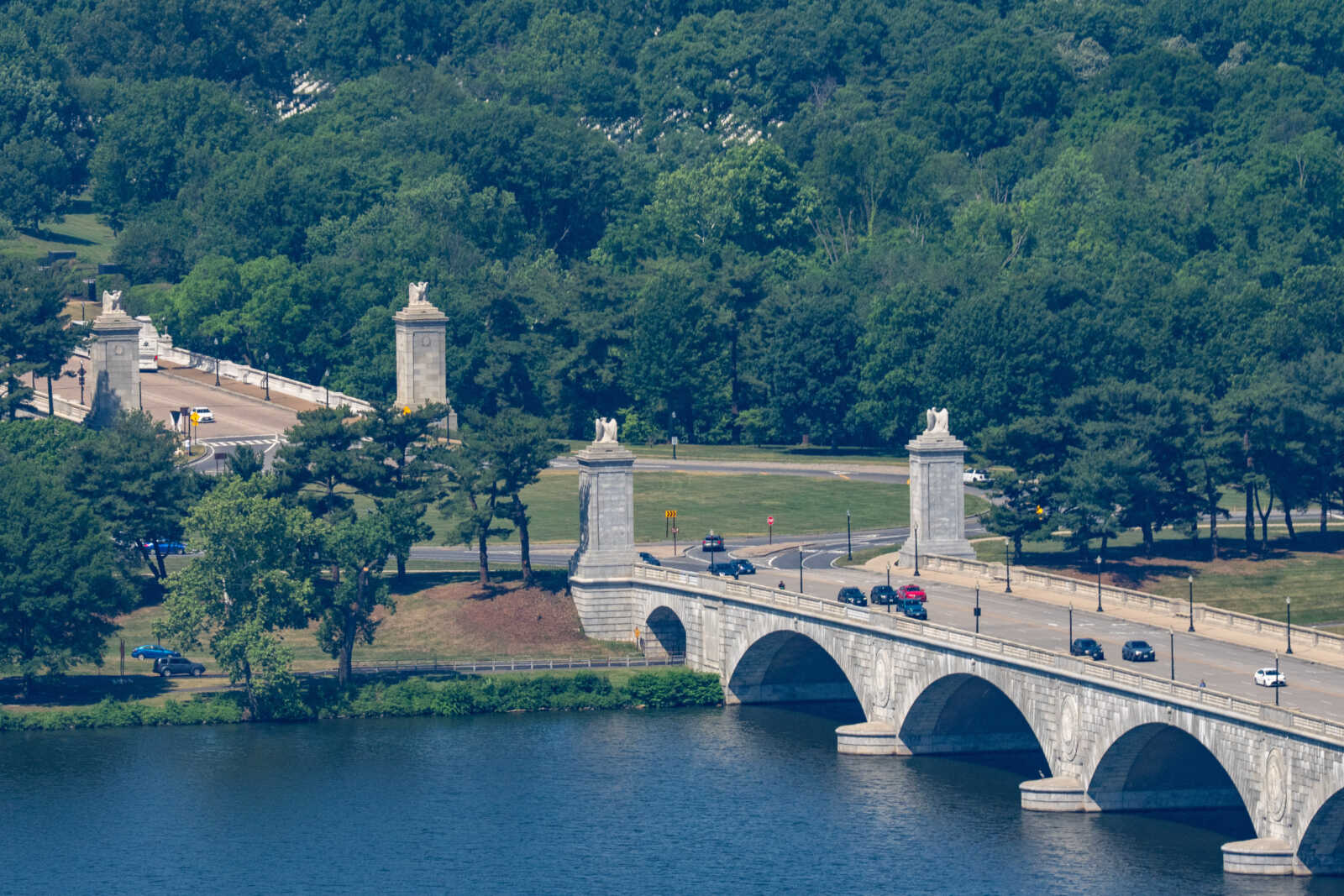
The approved design is a 250-foot structure topped by a Lady Liberty-like figure holding a torch, flanked by two gilded eagles. Originally, four lions were to guard its base, but those were removed—likely to avoid comparisons to Confederate monuments. Yet the arch’s symbolism is no less problematic. As the Arlingtonian reported, the structure would stand where the Memorial Bridge meets the Virginia side of the Potomac, directly framing Arlington House while blocking views of the Lincoln Memorial. The effect is less “triumphal” than “revisionist.”
Commission Chair Rodney Mims Cook Jr. called the building “beautiful,” but beauty is in the eye of the beholder. The arch’s lack of artistic detail—no murals, no bas-reliefs—leaves its purpose vague. Is it a celebration of American resilience? A vanity project for Trump? Or an attempt to rewrite history by centering Lee’s legacy over the soldiers who died to end his rebellion? The answer may depend on who gets to decide.
What Happens Next: The Legal and Political Battles Ahead
The Fine Arts Commission’s approval is just the first step. The National Capital Planning Commission will vote on June 15, and legal challenges are already brewing. Historic preservation groups, including the D.C. Preservation League, have vowed to sue if construction begins without congressional approval. The Interior Department’s claim that it doesn’t need Congress is shaky: federal law requires approval for any structure on federal land, and past administrations—including Trump’s own—have sought congressional backing for similar projects.

Even if the arch proceeds, funding remains uncertain. While the White House has suggested private donations, the cost—estimated in the tens of millions—could strain public-private partnerships. And with inflation and competing priorities, will donors really step up for a monument that divides the nation?
The bigger question is whether this arch will stand as a symbol of unity or division. In a city where monuments to the Civil War are already contentious—from the Robert E. Lee statue in Richmond to the Emancipation Memorial in D.C.—this project risks deepening those fractures. As historian Heather Cox Richardson noted in her May 23 newsletter, the arch’s location is a deliberate erasure: “The arch does not frame the nation’s honored dead, but frames instead the home of the man who led the armies of the Confederacy that killed them.”
The Stakes: History, Memory, and Who Controls the Narrative
This isn’t just about an arch. It’s about who gets to shape America’s story. The Lincoln Memorial stands as a tribute to the president who preserved the Union. Arlington National Cemetery is the final resting place for those who died to end slavery. But the proposed arch would turn the site into a backdrop for Trump’s legacy—a 250-foot billboard for his presidency, built on land purchased from Lee after his defeat.
The public’s role in this decision has been marginalized. The Fine Arts Commission’s process was rushed, the National Capital Planning Commission’s vote is months away, and Congress—where this should be debated—has been sidelined. If the arch is built, it will be because of executive overreach, not democratic consent. And that’s a dangerous precedent for any nation that claims to be a republic.
The next 30 days will be critical. The Planning Commission’s vote, legal challenges, and public pressure will determine whether this arch becomes a reality—or another footnote in the story of how one administration tried to rewrite history in stone.
